
Insights and Analytics

Job Titles Explain Under 10% of the Skills a Tech Job Requires
Jared Rand

Give me a job posting's title and ask me to predict which skills it requires. Cross-validated against 44,417 US tech postings, the title accounts for 5–9% of the variance — under 10% however the vocabulary is sliced.

That is one dataset, so I ran the same test on a second one with an opposite generating process. A job ad is written by a recruiter to attract applicants. A career-profile description is written by the worker afterwards to describe having done the job. If titles were doing real work, they should predict skills in both.

job postings career profiles
records 44,417 138,123
variance in skills explained by the title 6.9% 3.9%
shuffled-label baseline −0.15% −0.04%

Titles explain less on the profile side, not more.

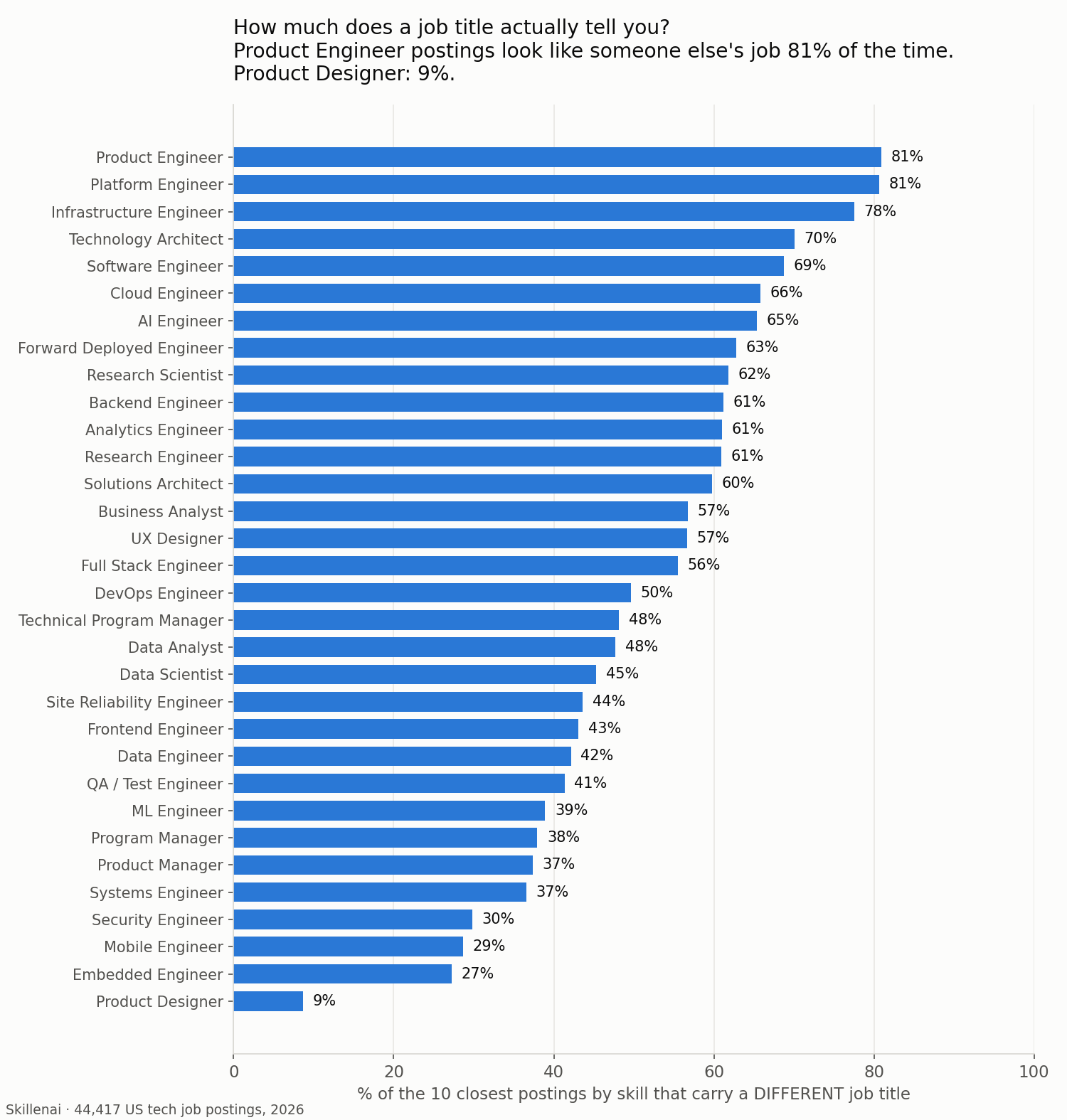
Here is the same fact in a form you can feel. For each posting, take the ten postings whose skills sit closest to it, and count how many carry a different title.

Bar chart ranking tech job titles by how often their ten nearest postings in skill space carry a different title, from Product Engineer at 81% to Product Designer at 9%

For 52.5% of postings, most of the closest skill matches are filed under someone else's title. On career profiles the same measure comes out at 62.2%.

The spread is nine-fold. A Product Engineer posting looks like another job 81% of the time. A Product Designer posting: 9%.

Get an email when we publish a new post. No account needed, unsubscribe anytime.

Which titles blur into which

role keeps its own blurs into
Platform Engineer 19% DevOps 20%, SRE 12%, Software Engineer 9%
Product Engineer 19% Full Stack 21%, Software Engineer 15%, Frontend 13%
Infrastructure Engineer 24% DevOps 16%, SRE 15%, Platform 8%
Software Engineer 31% Full Stack 11%, Backend 9%
Cloud Engineer 34% DevOps 23%
AI Engineer 35% ML Engineer 16%
UX Designer 43% Product Designer 51%
Security Engineer 72% nothing above threshold
Product Designer 92% nothing above threshold

The asymmetries are the story

UX Designer sends 51% of its neighbourhood to Product Designer. Product Designer sends essentially nothing back. That is not two titles converging — it is one title being absorbed by the other.

The same one-way pull appears three more times. Research Engineer, Research Scientist and AI Engineer all drift toward ML Engineer, which stays put. Cloud, Platform and Infrastructure Engineer all drift toward DevOps. Four titles orbiting one job.

And some titles blur into nothing in particular. Technology Architect, Solutions Architect and plain Software Engineer spread most of their overlap thinly across many roles with no dominant partner. Those are not hybrids of two jobs — they are titles that do not map onto a coherent skill set at all.

Security, Embedded, Mobile and Product Designer are the opposite: bounded, self-contained, recognisable from their skills alone.

What follows

Searching for work: the title is a weak filter. Postings that look unrelated by title are frequently near-identical by skill. If you filter on titles you are discarding most of the market.

Hiring: if Platform, Cloud, Infrastructure, DevOps and SRE all pull toward one job, five separate requisitions are five funnels competing for one candidate pool.

Building tools: this is why title-based search underperforms. Most of the signal is in the skills, and the title throws it away.

Two things this does not show

That the per-role ordering holds outside job ads. The aggregate finding replicates on profiles; the ranking does not. Across the 13 roles measurable in both, the correlation is weak and not significant (Spearman ρ=0.23, p=0.45). Product Designer is the most self-contained title in job postings and only middling in how designers describe their own work; Software Engineer runs the other way. That may be a real difference between how employers advertise a job and how workers describe having done it, or it may reflect that the two sides identify roles differently. I cannot separate those here, so the table above is a statement about job postings specifically.

That roles are blurring more than they used to. Our postings index has no history before 2026, and every supply-side proxy built from career histories came back flat. Roles are blurred. That they are blurring more is unproven, and I would not claim it.

Where this sits

Full methodology, data and figures

Related posts

Get more posts like this

Subscribe to get new posts by email. No account needed, unsubscribe anytime.