
The Middle-Manager Purge Isn't AI or Remote Work. It's a Title Bubble.
Get an email when we publish a new post. No account needed, unsubscribe anytime.
The two obvious suspects
AI fails on timing. The departures trend starts in 2020. AI had no measurable impact on the labor market until years later, and the much-cited Gartner projection — that 20% of organizations will use AI to flatten their structure — is a statement about future intent, not the cause of a five-year-old trend. When Jack Dorsey blames AI for cuts that began before AI could move the labor market, the timeline simply doesn't line up.
Remote work fails on the data. This one deserves a real test, because the mechanism is plausible: if remote collaboration tools absorb the coordination work managers do, then remote-heavy environments should need fewer managers. We checked it three ways.
Test 1: Remote postings are not flatter
If remote work substitutes for management, remote job postings should carry fewer managers per individual contributor (IC). They don't.
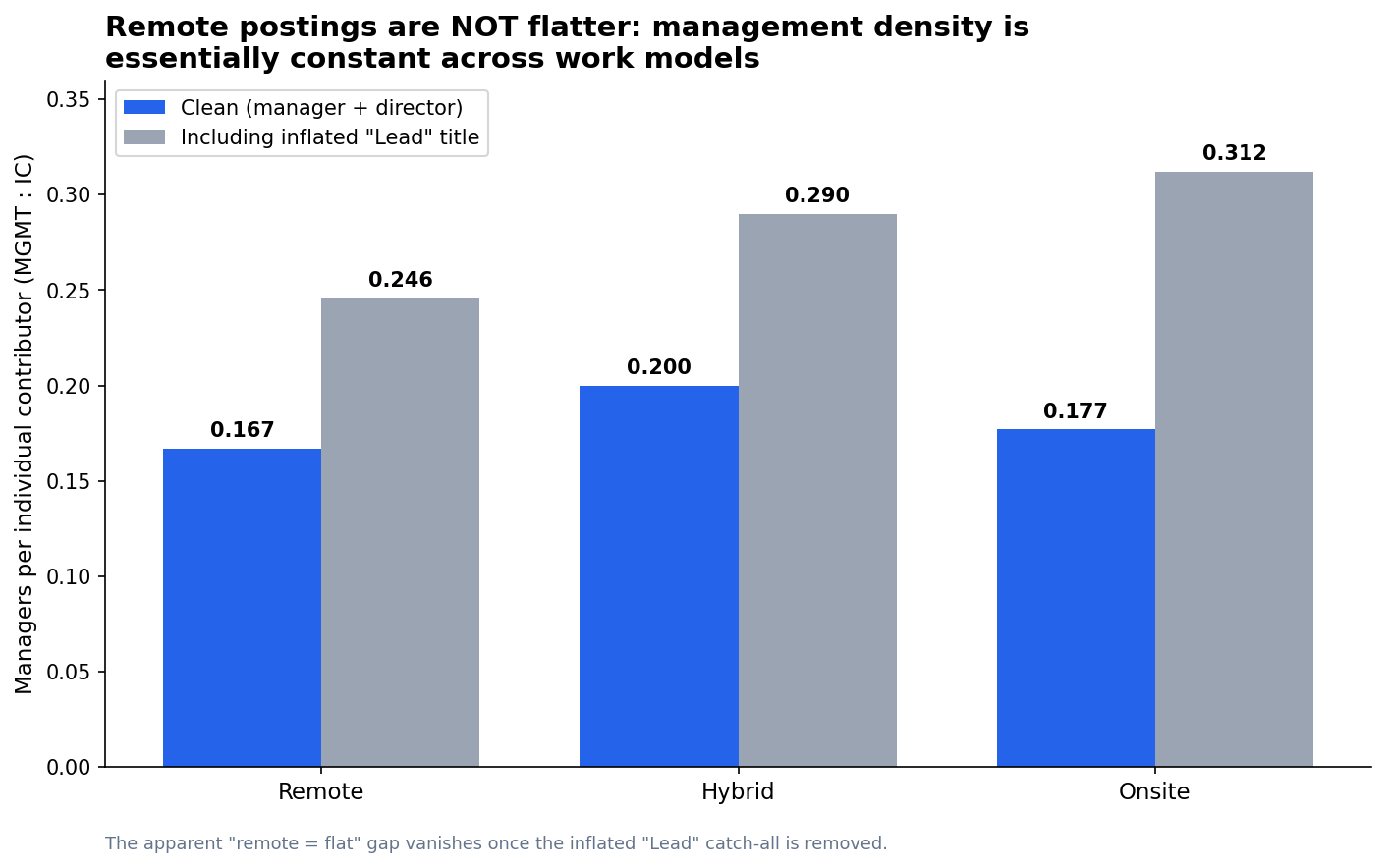
Manager-and-director density per IC comes out at 0.167 for remote versus 0.177 for onsite — essentially identical. Hybrid is actually the highest at 0.200. There is no remote flattening effect.
(The wider grey bars show what happens if you naively include the "Lead" title in the management count. Hold that thought — that gap turns out to be the whole story.)
Test 2: Becoming a manager costs almost no remote work
Maybe the effect is hidden inside careers: senior remote ICs get promoted into management, then get pulled back to the office. To check, we held the job family constant and looked only at engineering, where the IC-to-manager step is clean.
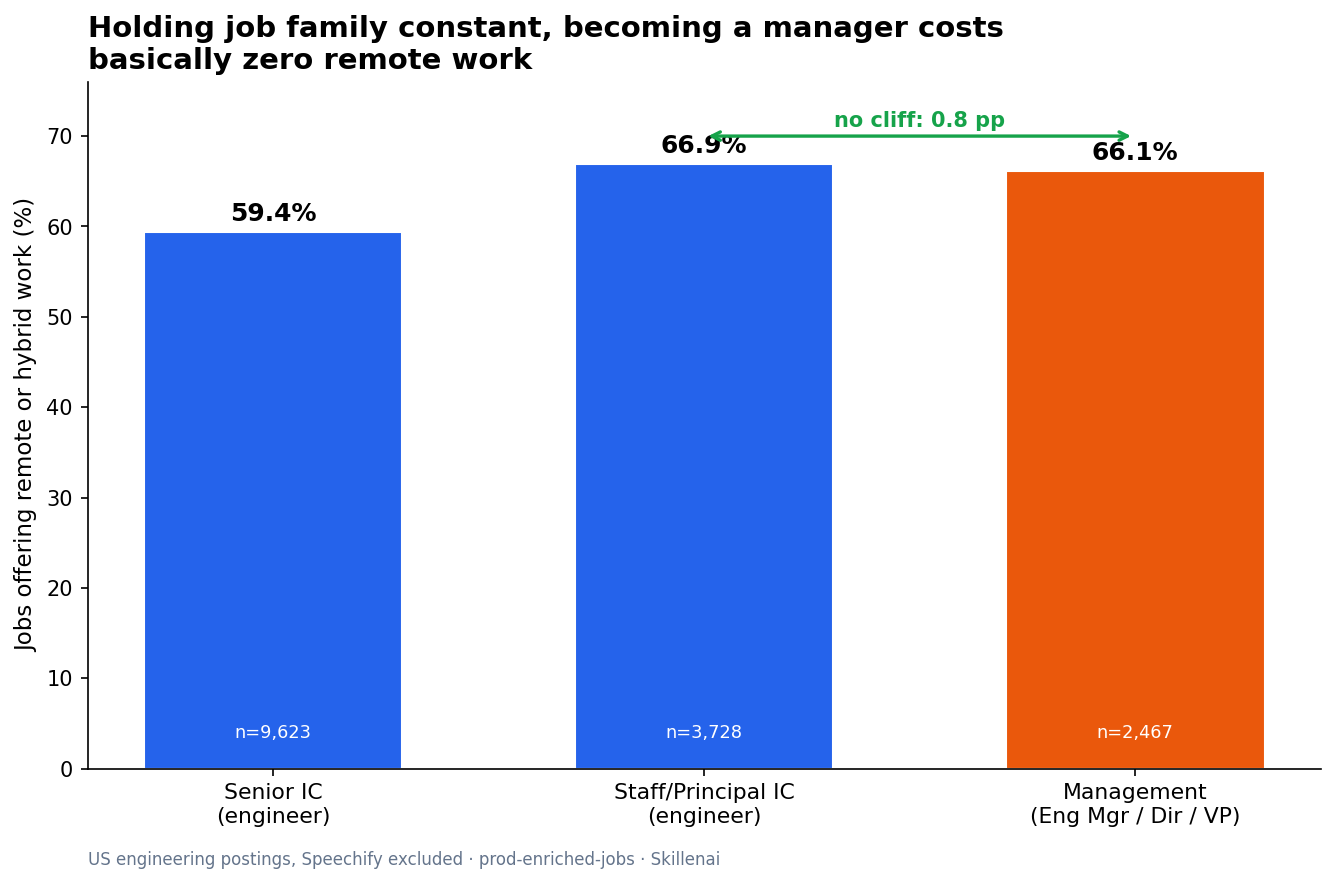
Staff/principal engineers: 66.9% remote-or-hybrid. Engineering managers and directors: 66.1%. The gap is 0.8 points. Stepping into engineering management costs essentially zero remote flexibility. There is no cliff.
Test 3: Remote-first companies are not flatter
Pooled postings mix flat startups with hierarchical enterprises, so we ran the sharpest version: across 251 companies with enough volume, do the remote-first firms run leaner on management than the onsite-first ones?
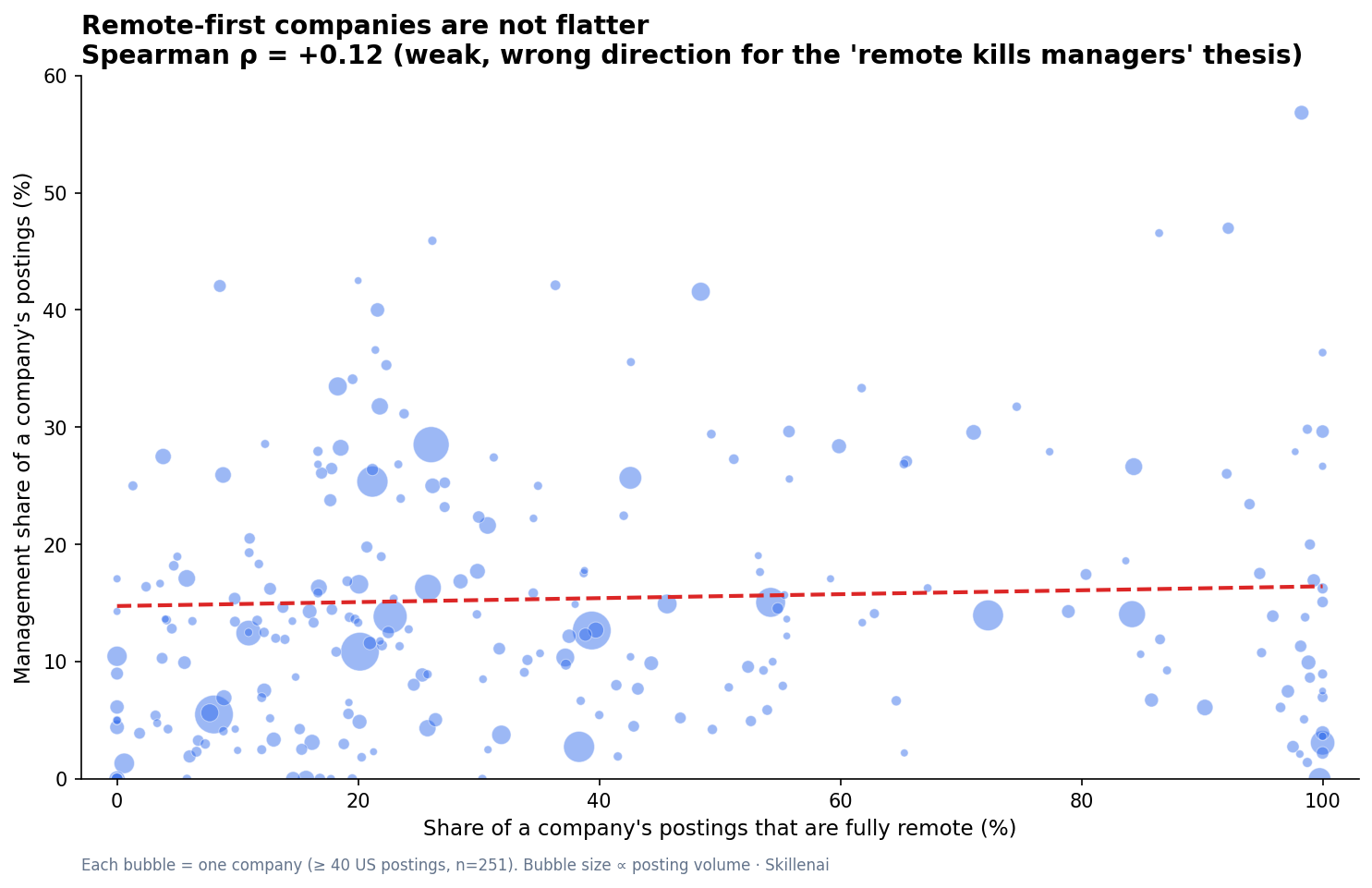
The correlation is +0.12 — weak, and pointing the wrong way. Remote-first companies carry a slightly higher management share (16.1%) than onsite-first ones (13.4%). Whatever is thinning the management ranks, it isn't remote work.
What actually fits: a title bubble
If you go looking for what did start in 2020, you find it quickly. From roughly 2008 onward, a decade of cheap capital, then the pandemic hiring frenzy, then the historically tight 2021–22 labor market drove companies to mint managers at an extraordinary rate. In Canada, where the public data is cleanest, management jobs grew 33% from early 2021 while non-management grew just 8%; managers went from 8.5% to 10.2% of the workforce. Much of it was pure title inflation — economists describe firms handing out "manager" titles to justify raises and retain people, for jobs with influence rather than authority. In tech, the number of job titles containing "Lead" or "Principal" reportedly doubled between 2019 and 2021.
Then rates rose, margins came back, and the over-hiring began to unwind — the "Great Flattening." Average spans of control widened from about 10.9 direct reports in 2024 to 12.1 in 2025, and roughly 41% of companies reported cutting management layers.
Here's the key thing about title inflation: it doesn't reverse itself. Titles are asymmetric — trivial to inflate, nearly impossible to deflate. You can't re-title an incumbent "junior" without losing them. So the inflation got baked in permanently, and the correction arrives through layoffs, not demotions. That's why middle managers are over-represented in the cuts: there were simply too many of them to begin with.
And we caught the fingerprint in our own data. Remember the "Lead" title from Test 1 — the one that created a fake flattening signal? In our index, "Lead" is no longer a coherent management tier at all. It's a grab-bag: Technology Lead, Technical Test Lead, Lead Software Engineer, even Product Designer. The title got inflated into meaninglessness, exactly as the reporting on 2019–2021 title inflation predicts. We can't prove the timeline from a single snapshot — our index has no pre-2026 history — but the dissolved "Lead" category is precisely what a stuck title bubble looks like from the hiring side.
One career, in miniature. Skillenai's founder lived this arc. In 2019 his data-science team re-leveled and he went from "associate" to "senior" within months. By 2023 he was a principal; by 2025, a senior manager; by 2026, back to a senior IC. A full round trip through the title ladder — while his salary rose monotonically the entire way. The titles were noise. The pay was the signal.
The remote-work valley (and the kicker)
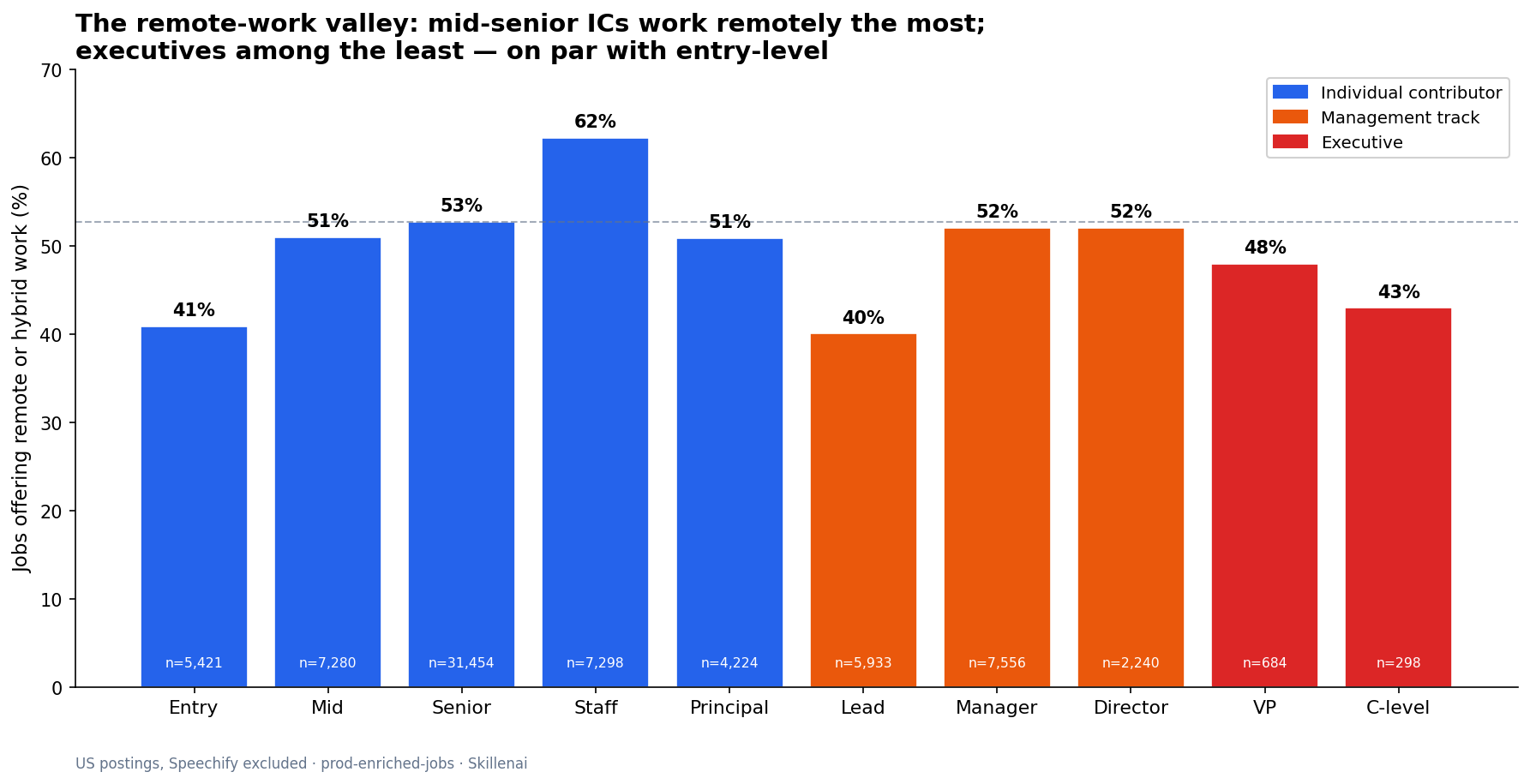
One more pattern worth seeing, because it sets up the irony. Remote availability isn't flat across seniority — it rises along the IC ladder to a peak at Staff (62%), then the management and executive ranks fall back down.
Where do the executives land? At the bottom of the experienced ranks. C-level postings are remote-or-hybrid just 43% of the time — on par with entry-level workers, and below every senior IC and management tier.
Which lands the kicker. The executives mandating a return to the office have barely more remote flexibility than the most junior people in the building. They aren't coming back to anything. They never left.
What this means for your career
- If you're an IC: your title is a weaker signal than it's ever been. Anchor your self-assessment and your negotiation on scope and compensation, not the word on the badge.
- If you're a manager: the layer is being thinned because it was over-built, not because you're being automated. The durable defense is being demonstrably load-bearing — owning coordination and outcomes a flatter org can't drop.
- If you're hiring: "Lead" and "Manager" have decayed as filters. Read the responsibilities, not the title.
The Great Flattening is real. But it isn't the robots, and it isn't your home office. It's the slow correction of a bubble we spent fifteen years inflating — and the bill is landing on the layer that grew the fastest.
Full methodology, all four analyses, and the data filters are on GitHub. US postings, spam employers excluded; work-model and seniority fields at ~95% and ~76% coverage. External title-inflation and flattening figures are cited from published reporting (Bloomberg/Live Data Technologies, Korn Ferry, Gartner, Gallup, and Statistics Canada via the Globe and Mail), not produced from the Skillenai index.