
44% of Tech Job Postings Mention AI. Only 10% Require It.
Get an email when we publish a new post. No account needed, unsubscribe anytime.
Workers Are Adopting AI Faster Than Anything Else
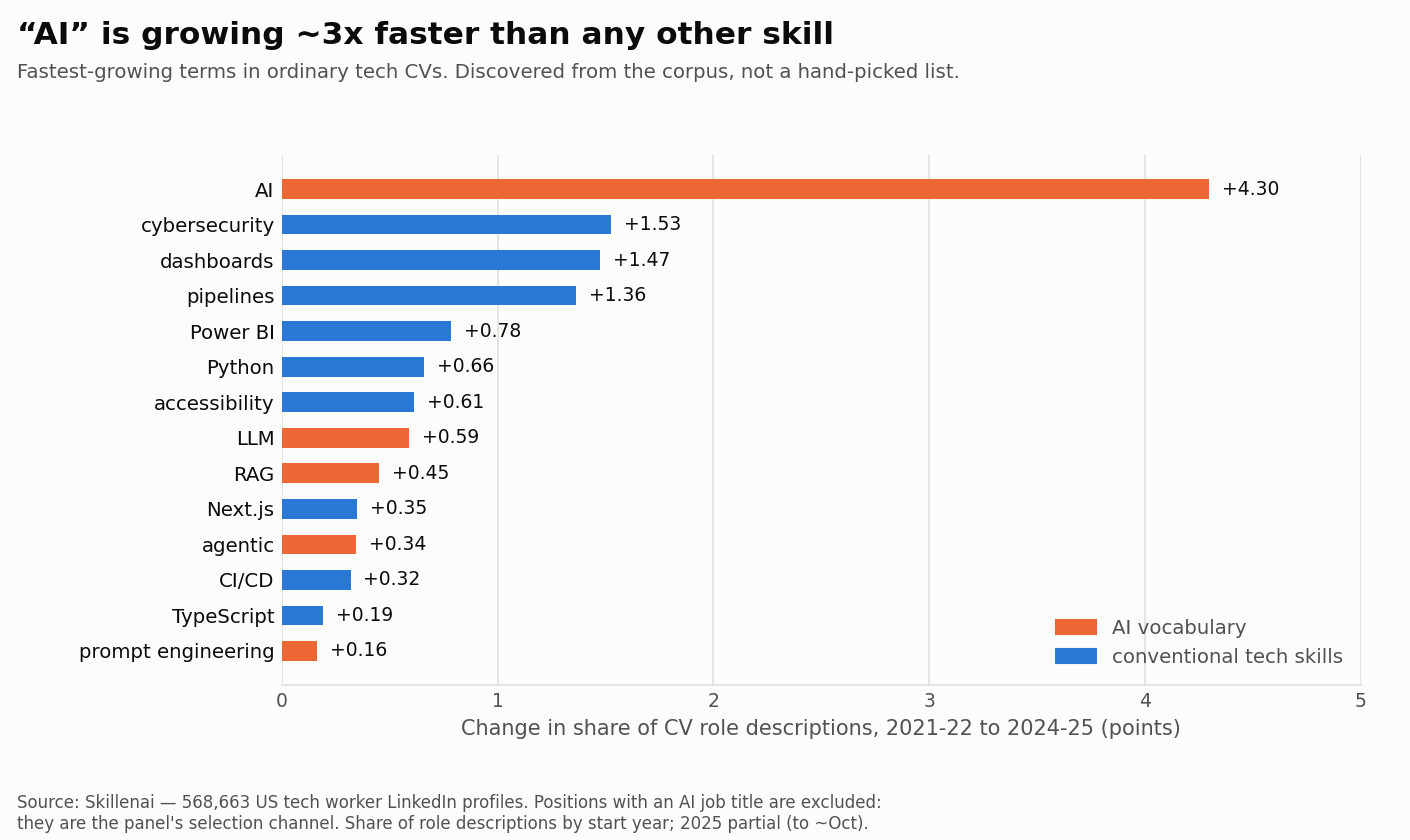
We didn't start from a list of AI skills. Starting from a list only tells you what you already believed. Instead we counted every one, two, and three word phrase in those CVs, compared 2021-22 against 2024-25, and ranked by what grew.
13,165 phrases cleared the bar. Here's where AI landed.
| Term | 2021-22 | 2024-25 | Change | Rank of 13,165 |
|---|---|---|---|---|
| ai | 1.87% | 6.17% | +4.30 | 2 |
| cybersecurity | 1.52% | 3.04% | +1.53 | 27 |
| dashboards | 4.12% | 5.59% | +1.47 | 30 |
| pipelines | 4.09% | 5.45% | +1.36 | 38 |
| Power BI | 2.12% | 2.91% | +0.78 | 98 |
| Python | 6.14% | 6.80% | +0.66 | 132 |
| llm | 0.15% | 0.74% | +0.59 | 157 |
| rag | 0.07% | 0.52% | +0.45 | 229 |
| agentic | 0.04% | 0.39% | +0.34 | 327 |
| TypeScript | 1.25% | 1.44% | +0.19 | 681 |
Second place. Out of 13,165. The only phrase growing faster is the word "ensuring," which tells you something about how people write CVs but nothing about the labor market.
Cybersecurity is the fastest growing real skill and AI beat it by almost 3x. If you want to argue the AI skills story is hype, you have to explain that first row.
Now look at which AI word is actually moving. Plain "ai" is at +4.30. RAG is 229th. Agentic is 327th.
This is subtle so I'll reframe it for emphasis: the people writing these CVs are not claiming they can build AI systems. They're claiming they use AI. For a product manager or a frontend engineer, AI fluency means working with the thing, not constructing it. RAG, LangChain, and MCP are specialist vocabulary. If you're hiring for a non-AI role and screening on them, you're asking the wrong question.
Employers Are Mostly Just Talking
Here's the other half, and it's the half that should make you skeptical.
We measured the same postings two different ways, using two systems that don't know about each other.
- Talk: does the word "AI" appear anywhere in the posting? This catches all the marketing. "Distyl is an applied AI technology company." "AI-driven workflow automation." You've read a hundred of these.
- Ask: did our enrichment pipeline's language model pull out an AI skill as an actual requirement of the job? This catches requirements no matter how they're phrased, including bullet points and skill tags that a keyword search would sail right past.
| Requires an AI skill | Does not | Total | |
|---|---|---|---|
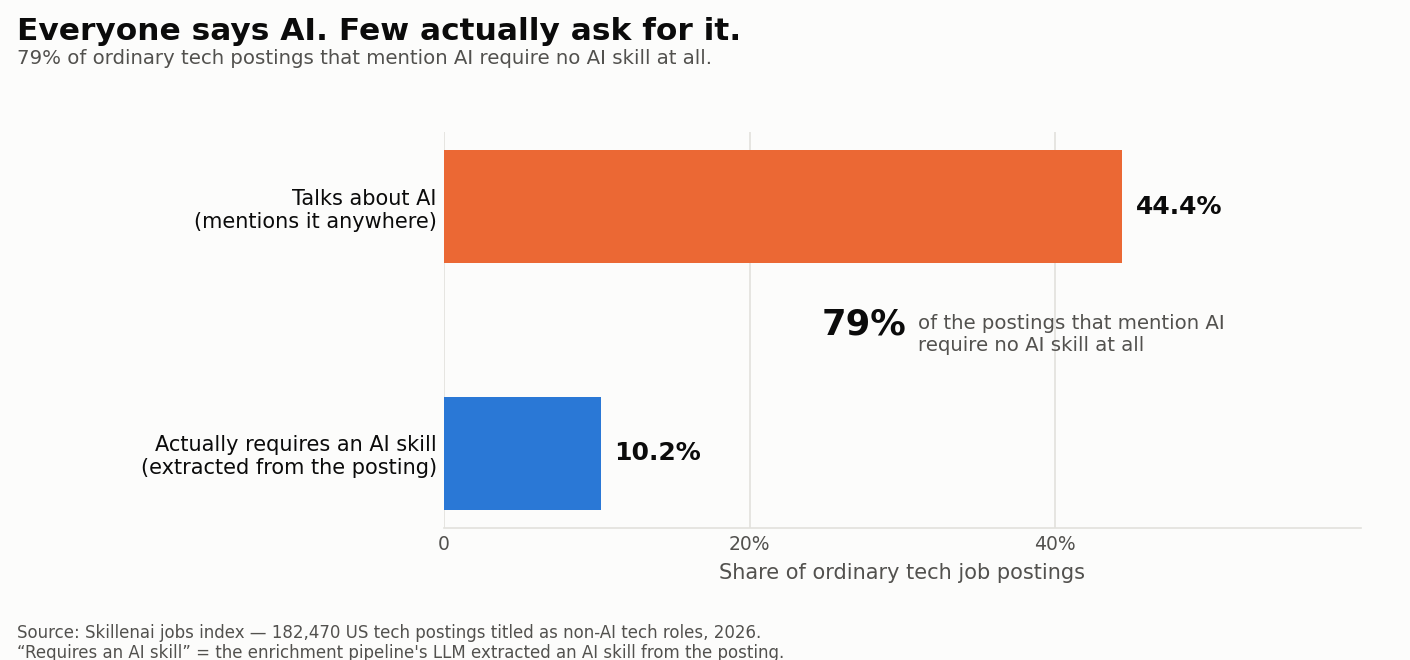
| Mentions "AI" | 17,348 | 63,621 | 80,969 (44.4%) |
| Doesn't mention it | 1,346 | 99,155 | 100,501 |
| Total | 18,694 (10.2%) | 163,776 | 182,470 |
Read the cells, not the margins. The number that matters is 63,621: postings that talk about AI and ask for none of it. That's 79% of everything that mentions AI, and more than a third of the entire ordinary tech job market.
Why would a company do that? Because saying you're an AI company is free. Requiring AI skills of your engineers is not. It shrinks your candidate pool and raises what you have to pay. The gap between 44% and 10% is the price companies are willing to pay to make the claim, and that price is approximately zero.
There's one more number in that table worth pulling out. 1,346 postings require an AI skill without ever writing the word "AI." They ask for "experience with machine learning" or "LLMs" instead. If you're searching job boards for "AI," you're missing one in fourteen of the jobs that actually want it.
When employers do ask for AI, they want generic fluency about five times more often than they name ChatGPT or Copilot specifically. Which lines up exactly with what workers are writing on their CVs. Both sides of this market are describing a way of working. Neither one is asking about a tool.
What To Do About It
If you're job hunting:
- Put AI on your CV and say what you actually did with it. The demand is real and it's the fastest moving thing in the data.
- You are not behind for lacking RAG or LangChain. In ordinary tech roles those show up in well under 1% of CVs. They matter if you're going after AI roles specifically, and mostly don't if you aren't.
- Search job boards for "machine learning" and "LLM" too, not just "AI." One in fourteen otherwise.
- When a posting talks about AI throughout and never asks for an AI skill, that's the marketing department, not the hiring manager. Four times out of five, that's what's happening.
Method, and What This Can't Tell You
Both of our corpora select on AI, and if you don't correct for that you'll fool yourself. Our jobs index admits postings by keyword and those keywords include AI terms. Our profile panel is pulled with a job title list that also includes AI titles. So a person lands in the panel because they hold an AI-titled role, those roles are recent, and the recent end of every trend gets inflated. We exclude AI-titled roles on both sides throughout. Skip that step and the 2024-25 CV numbers read about 1.8x higher than they should.
We also audited the ambiguous terms instead of assuming they were fine. Roles started before 2020 are 56% of the CV corpus, so a term that's just ordinary English should land about 56% of its hits back there. Bare "RAG" came in at 5%. It's genuinely AI-era, not red/amber/green status reports.
The limits are real. US tech only, not the whole labor market. CV text is self-reported, so it's what people claim and not what they can do. Only about 35% of roles carry a description at all. 2025 is partial. And people go back and add AI to old jobs, which flattens the early years, so the real growth is probably steeper than what we're showing.
One correction we made mid-analysis, which I'd rather flag than bury. An earlier version of this compared two phrase lists we'd built ourselves at wildly different breadths, and got an "8:1" gap between how employers describe themselves and what they ask candidates for. When we expanded the requirement list, the requirement rate more than tripled and most of the gap went with it. We threw the claim out. The 4.3:1 figure above is measured differently: the requirement side isn't our vocabulary at all, it's a separate extraction system. That's the whole reason we trust it.
Scripts and data are in our notebooks repo if you want to check our work.