
The Breakout Blog Author of May 2026 Doesn't Exist
Get an email when we publish a new post. No account needed, unsubscribe anytime.
TL;DR
- A coordinated network of 221 fake author bylines materialized in May 2026 across 333+ low-authority cloud-themed domains (
deployed.cloud,midways.cloud,toggle.top,typescript.website, and friends). - This is the AI-native version of a Private Blog Network (PBN) — the same PageRank-gaming attack SEO operators have been running against Google since the early 2000s. The Skillenai
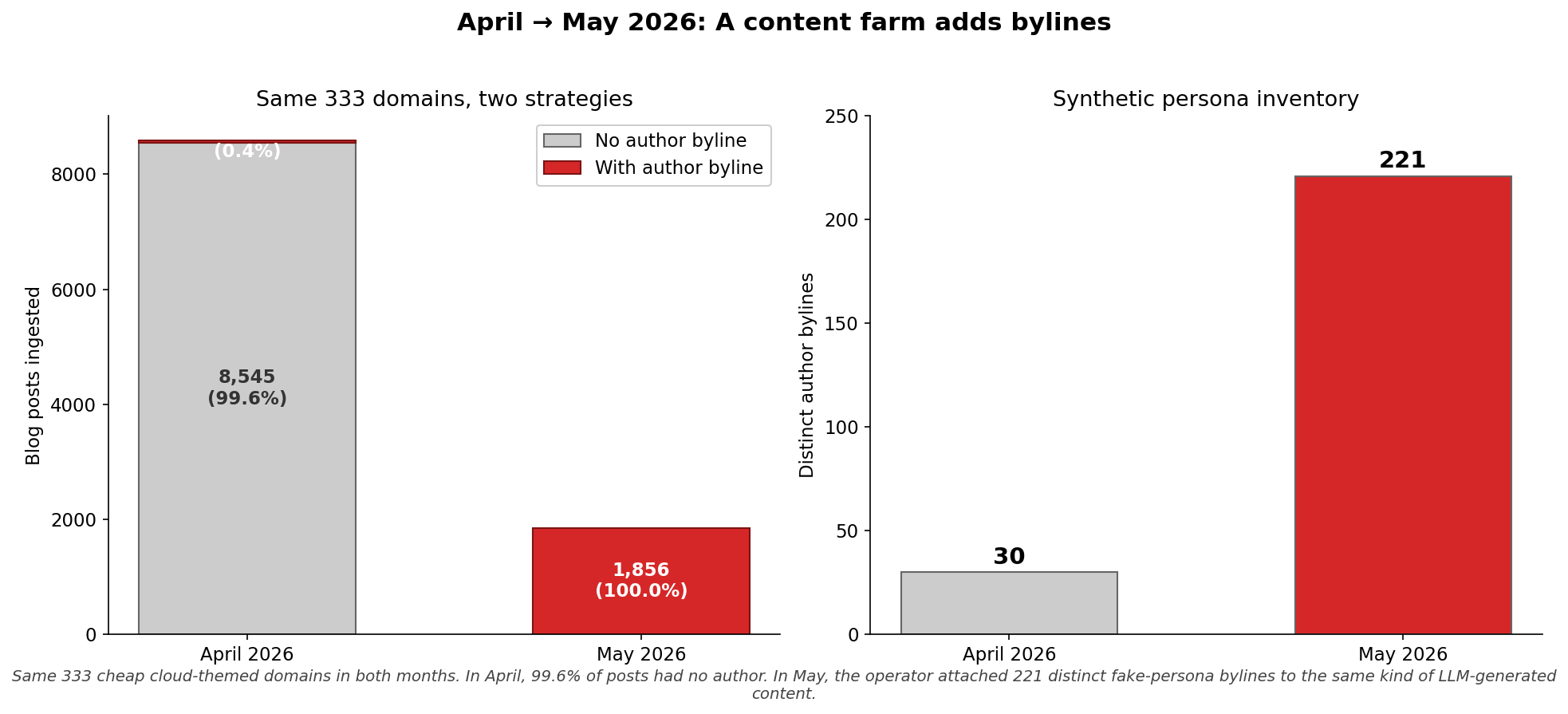
authorAuthoritysignal is PageRank-derived. The whole point of the operation is to inflate it. - The same infrastructure was already publishing in April — 8,583 posts on those 333 domains — but 99.6% of April posts had no author byline. The May "breakout" is an attribution-layer grafted onto an existing PBN, not new content output. Author-level authority became a ranking surface, so the operator filled it.
- Top synthetic byline Daniel Mercer posted 381 times in 20 days across 208 distinct domains with an average
authorAuthorityof 3.72 — sitting at the 95th–99th percentile of all May blog posts in our index. - 141 domains host two or more of these personae.
deployed.cloudalone is shared by 8 different "authors." - Strip the network out and the real human breakouts are a small but legitimate handful: Rod Trent (Microsoft security, +65% volume + authority doubled), Ruben Hassid (AI commentator, authority 2.03 → 3.37 on lower volume), Alex Merced (Dremio / Apache Iceberg evangelist), Marin Ivezic (post-quantum cryptography, 6× volume), and the Futurism.com AI desk.
How the search started
The brief was simple: find an author in the Skillenai blog dataset (prod-enriched-blog) who had a breakout May compared to April — either in publication volume or in per-post authority.
We pulled the top author bylines from prod-enriched-blog for April and May separately, applied the standard junk-author filter (empty strings, generic placeholders like admin / Unknown, team accounts, email-as-author, HTML fragments, multi-author blobs), removed known junk source domains, and joined the two months. Surviving universe: 1,767 clean April authors, 1,761 clean May authors, 393 in both months.
Of the breakouts that survived the filter, the very top spots all clustered around a single set of "Mercer" and "Ellis" surnames publishing on cheap .cloud / .website / .uk domains. That's where the story turned.
The byline-attribution shift
The same 333 domains the network used in May were already running in April — they just published with the author field empty. In May, the operator started attaching personae.
| Metric | April 2026 | May 2026 |
|---|---|---|
| Posts on the 333 network domains | 8,583 | 1,856 |
| Posts with an author byline | 38 (0.4%) | 1,856 (100%) |
| Distinct named author bylines | ~30 (long tail of one-offs) | 221 |
| Top byline | "Atlas Whoff" (4 posts) | "Daniel Mercer" (378 posts on these domains) |
Volume on these domains actually fell by ~78% between April and May. The "breakout" we found isn't more content — it's the same content getting attribution-coated. Bylines are a downstream trust signal. Anonymous content is suspect; bylined content is treated as authored. The operator added the layer.
The persona inventory
Ten of the bylines dominate the network. Each spreads its posts across many domains — on average only 1.0–1.8 posts per domain — which is the inverse of how real bloggers behave (real bloggers concentrate on their own site).
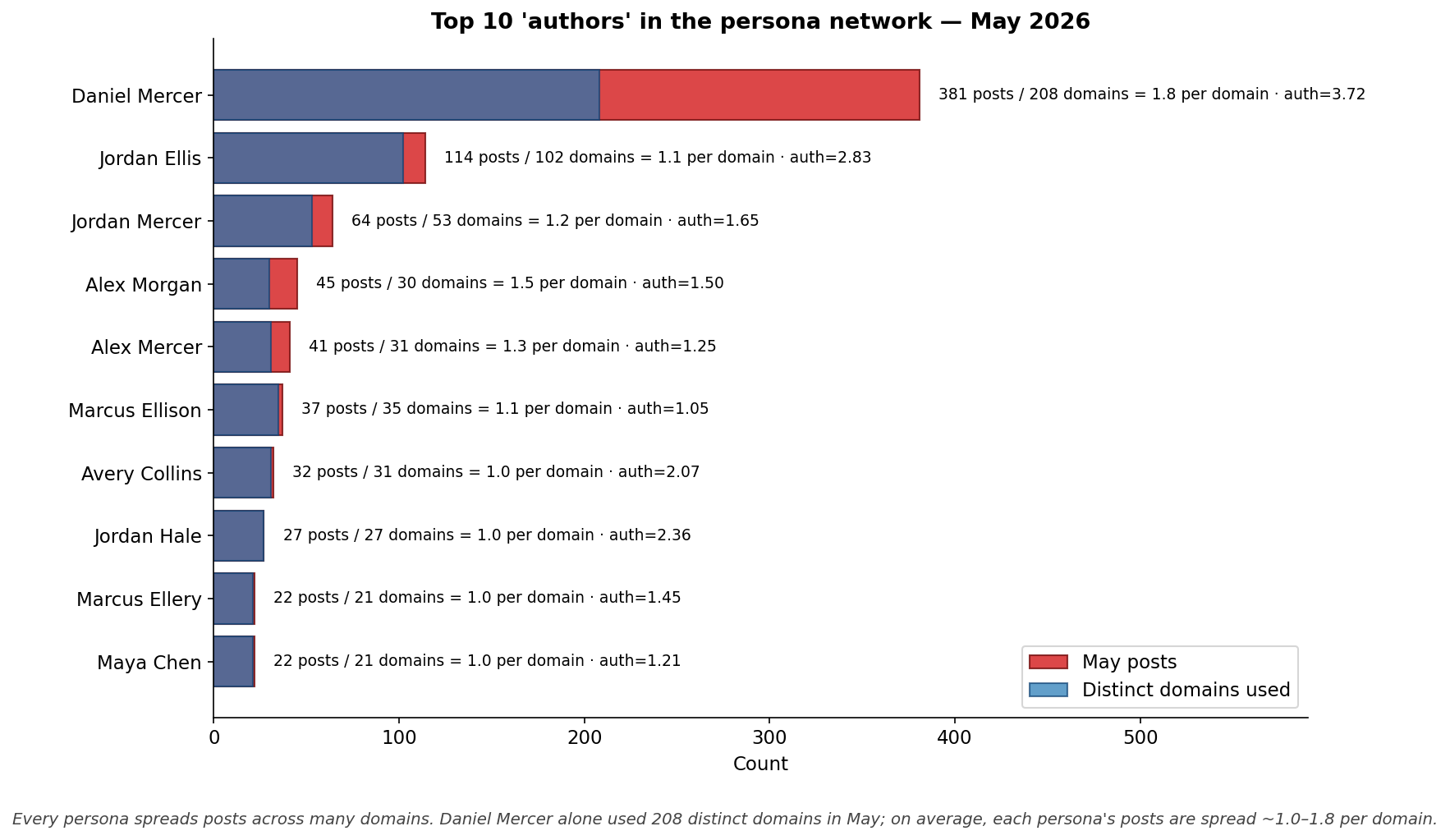
| Persona | May posts | Distinct domains | Posts / domain | Avg authority |
|---|---|---|---|---|
| Daniel Mercer | 381 | 208 | 1.8 | 3.72 |
| Jordan Ellis | 114 | 102 | 1.1 | 2.83 |
| Jordan Mercer | 64 | 53 | 1.2 | 1.65 |
| Alex Morgan | 45 | 30 | 1.5 | 1.50 |
| Alex Mercer | 41 | 31 | 1.3 | 1.25 |
| Marcus Ellison | 37 | 35 | 1.1 | 1.05 |
| Avery Collins | 32 | 31 | 1.0 | 2.07 |
| Jordan Hale | 27 | 27 | 1.0 | 2.36 |
| Marcus Ellery | 22 | 21 | 1.0 | 1.45 |
| Maya Chen | 22 | 21 | 1.0 | 1.21 |
The surname clustering — Mercer, Ellison, Ellery, Morgan, Mercer, Mercer, Mercer — is consistent with one operator drawing first/last names from a small seed list with combinatorial swaps. Twenty additional thinner bylines (Ethan Mercer, Jordan Vale, Maya Thornton, Avery Morgan, Maya Thompson, Avery Cole, Marcus Hale, Avery Mitchell, Jordan Blake, …) fill out the second tier with 5–20 posts each.
The shared-infrastructure smoking gun
A persona network is only a network if the same domains host multiple personae. They do, and aggressively: 141 of the 333 domains host two or more of the personae we identified.
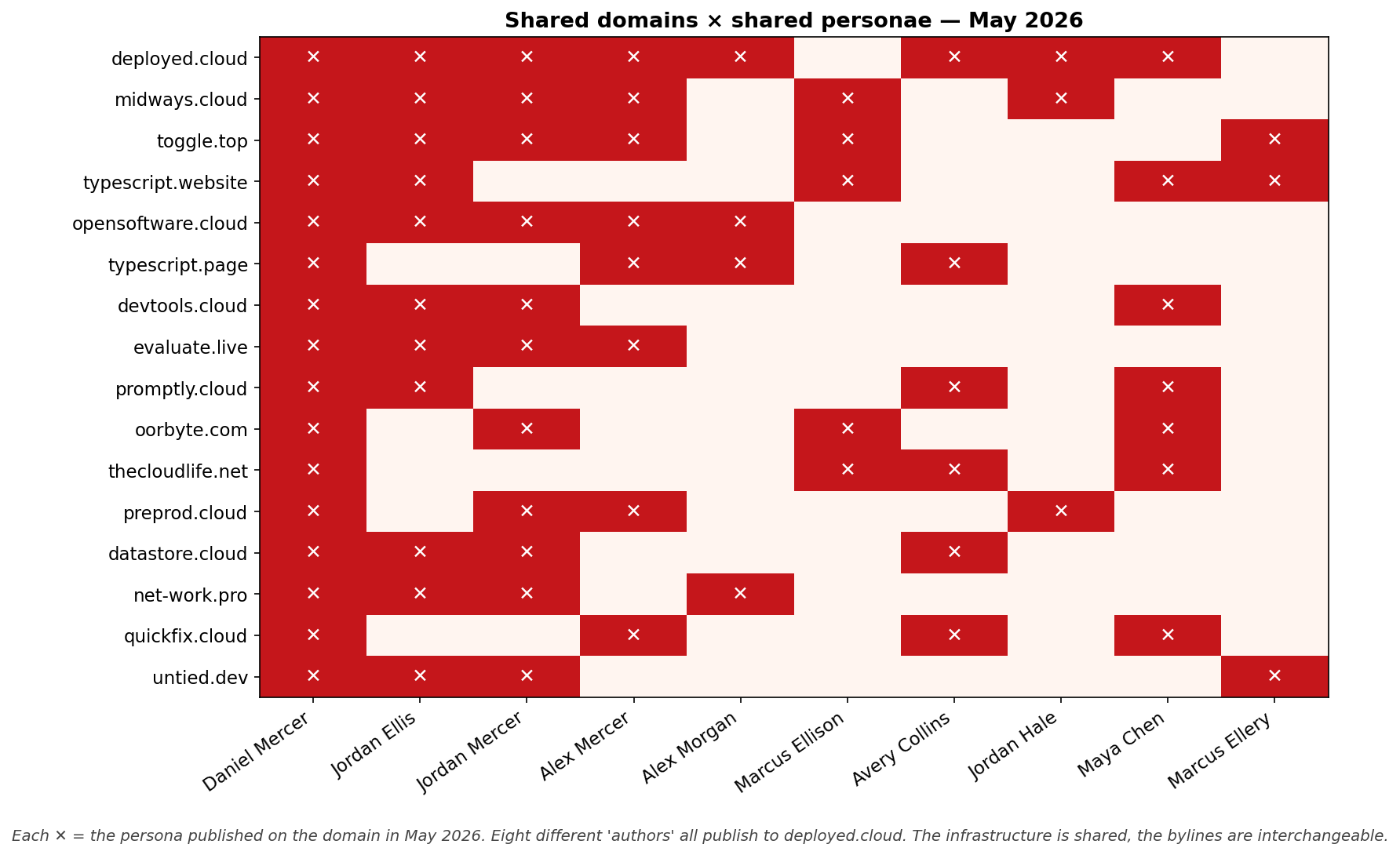
The single domain deployed.cloud is shared by 8 different "authors." midways.cloud and toggle.top are each shared by 6. Real bloggers don't publish under three byline aliases on a friend's domain in the same month.
Why anyone would do this — and why it works
authorAuthority in the Skillenai blog index is a PageRank-style score on the graph of authors, domains, and cross-references between them. Every system that ranks "who is influential" on the web — Skillenai's, Google's, Ahrefs', Moz's, Semrush's — leans on some PageRank variant for the same reason Google did in 1998: links and citations between independent sources are the cheapest available proxy for "this is worth reading." The signal is durable, the math is well understood, and the alternatives are all worse.
Which means the attack against it is also durable, also well understood, and at least 20 years old. SEO operators call it a Private Blog Network (PBN): a cluster of cheaply registered domains, each with low-quality but topically-relevant content, all interlinking with each other and (eventually) with whatever the operator wants to rank. To PageRank, a clique of 200 mutually-citing domains looks indistinguishable from 200 independent voices endorsing each other — that's both the algorithm's whole premise and its whole exploit. Google's entire anti-spam history — Panda, Penguin, the helpful-content updates, the link-spam updates of 2022 and 2024 — is a continuous arms race against PBN-shaped attacks. SEO services still sell PBN packages openly. The cost is well understood. The math is well understood.
The only thing that changed in May 2026 is that the operator no longer has to pay humans to write the filler content.
What we caught here is the AI-native generation of the classical PBN:
- Classical farm: dozens of low-paid ghostwriters producing barely-readable, topically-relevant posts. 2026 farm: one operator and an LLM API key. Content cost has collapsed by roughly three orders of magnitude.
- Classical PBN: easy to spot by content quality — posts read like spun garbage, so search engines could fingerprint them. 2026 PBN: reads like a slightly underbaked AI playbook. It clears any "is this written by a human" content filter and almost any topical-coherence filter.
- Classical PBN: published anonymously, because the backlink juice came from domain-to-domain links and the bylines didn't matter. 2026 PBN: added bylines once the operator realized that author-level authority is now its own ranking surface — which is exactly what we caught happening on May 12.
The result: the median real author scores 0.40 on authorAuthority. Daniel Mercer averages 3.72. That number puts him in the same band as Futurism.com staff writers — except his posts live on myscript.cloud and pyramides.cloud, and he is sitting at the centre of a 333-domain clique that mutually cites itself into a top-5% PageRank.
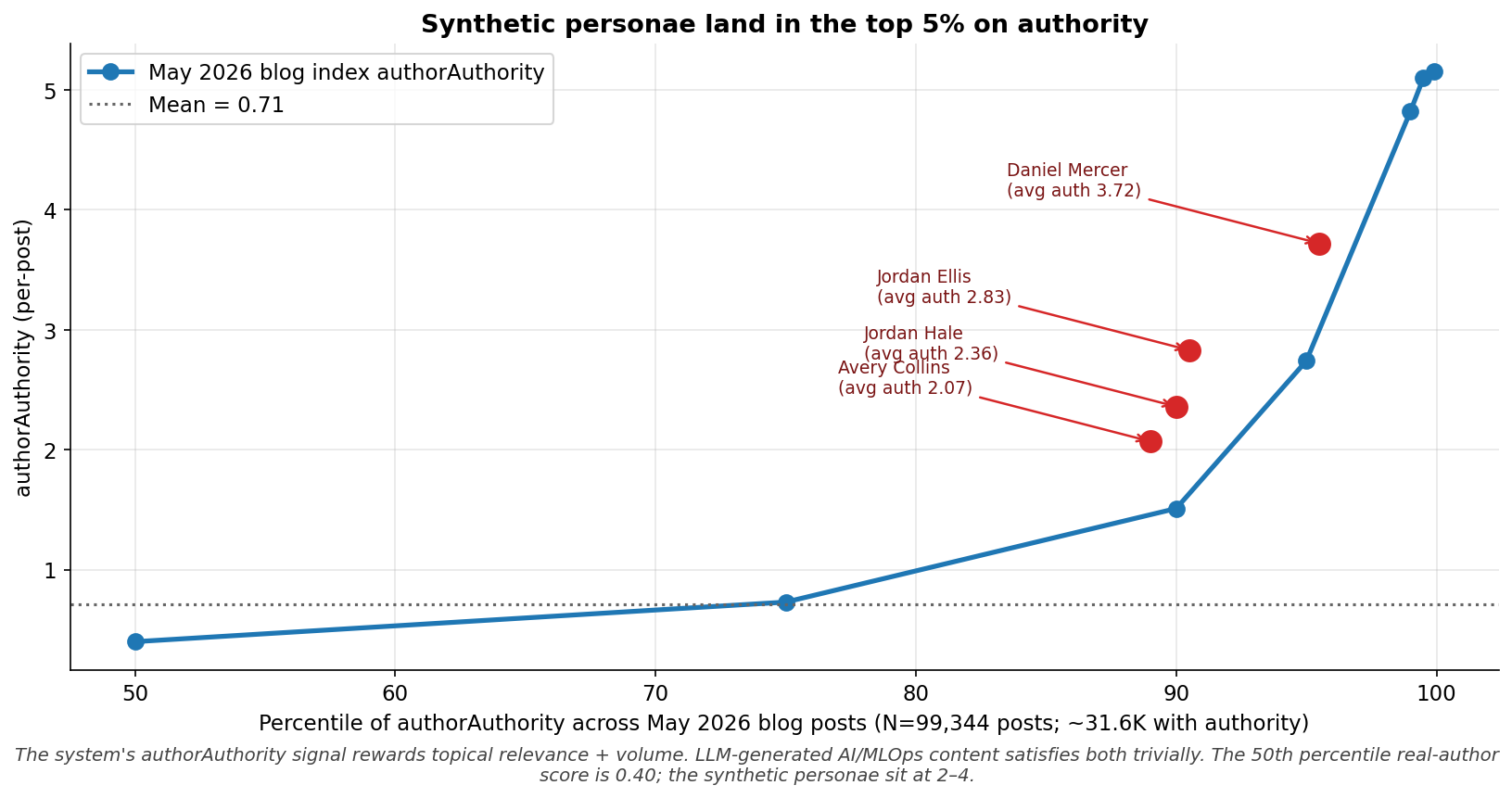
This is not a defect peculiar to the Skillenai signal. Any PageRank-derived authority score on any open corpus is in the same arms race Google has been fighting for two decades. The April → May transition is the first round being fought on our corpus.
When the persona was born
Daniel Mercer made his first post on May 12, ramped to a 94-posts-per-day peak on May 22, and tapered after. The pattern is consistent across the other personae in the network — they all activated mid-month and decayed by month-end.
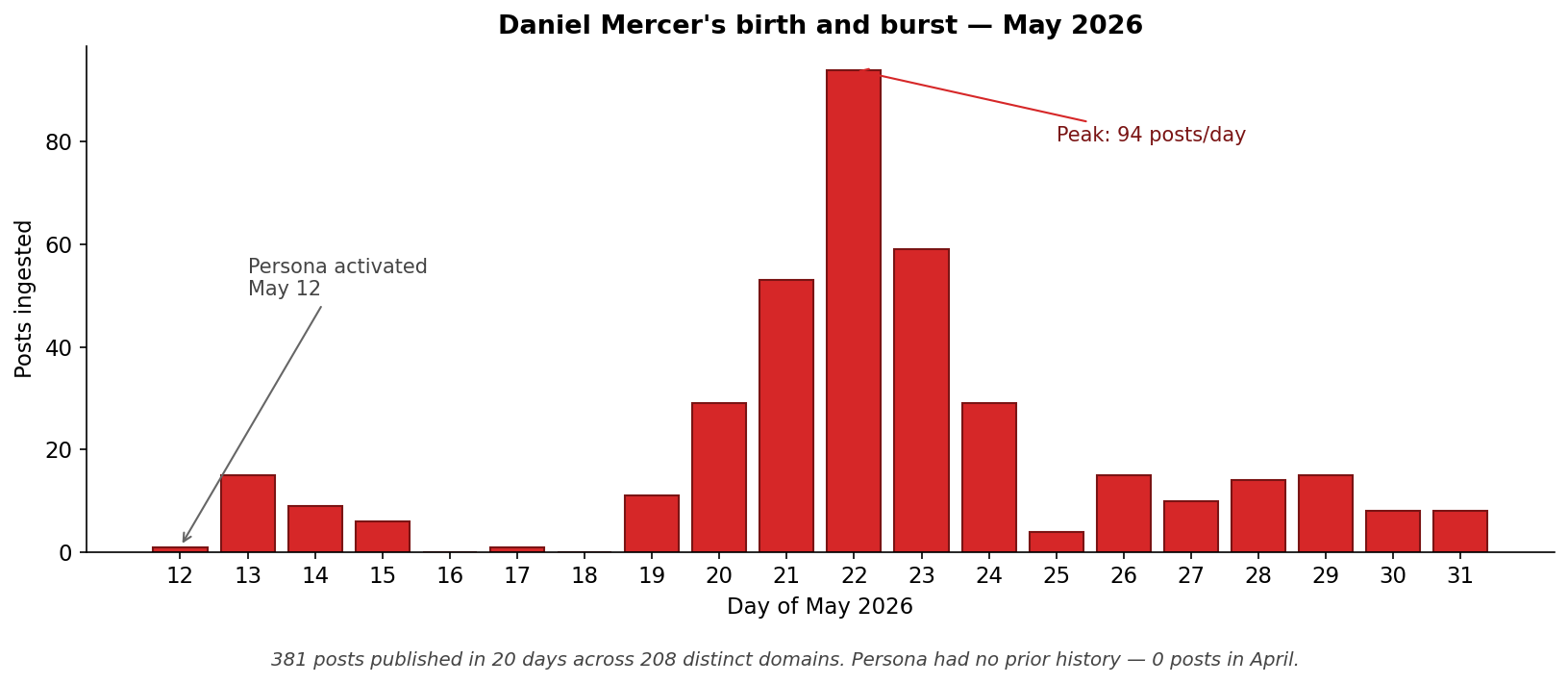
It looks for all the world like a campaign — a deliberate switch in strategy, executed across the whole network at once. Whoever runs this farm decided in early May that anonymous content wasn't paying off as well as bylined content, and threw the switch.
The real breakouts
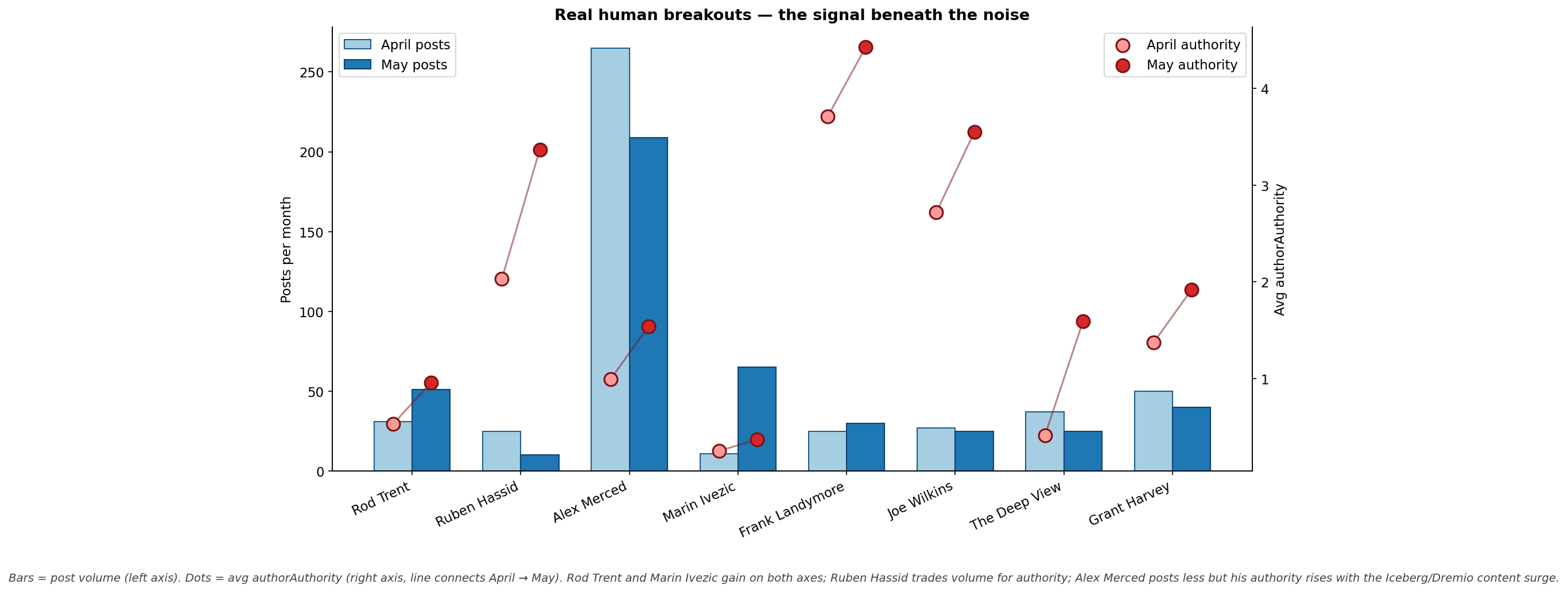
Filter the persona network out and the legitimate signal underneath is modest but interesting.
| Author | Domain | What they do | Apr → May posts | Apr → May authority |
|---|---|---|---|---|
| Rod Trent | rodtrent.substack.com | Microsoft Sentinel / security daily roundup | 31 → 51 (+65%) | 0.53 → 0.96 (+81%) |
| Ruben Hassid | ruben.substack.com | AI commentator (LinkedIn-famous) | 25 → 10 (-60%) | 2.03 → 3.37 (+66%) |
| Alex Merced | datalakehousehub.com | Dremio dev advocate, Apache Iceberg | 265 → 209 (-21%) | 0.99 → 1.54 (+56%) |
| Marin Ivezic | postquantum.com | Post-quantum cryptography expert | 11 → 65 (+490%) | 0.25 → 0.37 (+48%) |
| Frank Landymore | futurism.com | Futurism AI desk | 25 → 30 (+20%) | 3.71 → 4.43 (+19%) |
| Joe Wilkins | futurism.com | Futurism AI desk | 27 → 25 (-7%) | 2.72 → 3.55 (+30%) |
| The Deep View | archive.thedeepview.com | AI newsletter | 37 → 25 (-32%) | 0.41 → 1.59 (+289%) |
| Grant Harvey | theneuron.ai | The Neuron newsletter | 50 → 40 (-20%) | 1.37 → 1.92 (+40%) |
The cleanest pick for "real breakout" by both axes is Rod Trent — a real human running a daily Substack on Microsoft security tooling, whose Skillenai authority score nearly doubled in a month where his volume also rose 65%. He's not the loudest answer; the persona network is. He's the right answer.
Ruben Hassid is the more interesting trade-off case: less than half his April volume, but each post landing 66% harder. Alex Merced is the standing-army case — his volume is huge in absolute terms (200+ posts a month on Iceberg / Dremio / data lakehouse content), and his per-post authority is climbing as the topic surges.
What this means for anyone reading the AI tech blogosphere
Four takeaways:
-
If you're ranking AI bloggers by post count or by per-post authority, you are ranking the content farms. The synthetic-persona network in this analysis is 2.6% of all May authored blog posts — small in share — but its bylines dominate the top of every author leaderboard. Any list of "top AI tech bloggers" that includes a name you can't easily Google to a real human is suspect by default.
-
Anonymous content was the tell. Bylined content is the new tell. In April, the operator's content was easy to filter: no author byline. In May, they fixed that. The next-generation tell is structural: a "blogger" who publishes on 100+ domains, with 1–2 posts per domain, and shares those domains with 5+ other "bloggers," is not a blogger. They're an account.
-
PageRank-style scores need PageRank-era defences. The classic anti-PBN playbook — domain denylists, structural clique detection, citation diversity penalties, domain-authority floors — translates directly from Google's 2010s playbook to any AI blog corpus today. None of these defences are novel; they're 20 years of SEO lore being asked to do new work. The vulnerability and the defence both predate ChatGPT by a decade.
-
The 'real' AI tech-blog ecosystem is smaller than it looks. Of 17,000 distinct author bylines in May 2026, the long tail is filled with one-off posts, team accounts, and (now) synthetic personae. The set of human writers consistently publishing high-authority content in a month is in the low hundreds. That's the audience for AI-focused recruiting, AI-focused PR, and AI-focused partnerships — far smaller than the surface-level numbers suggest, and well worth knowing exactly who they are.
Methodology
Data is from prod-enriched-blog, ingested 2026-04-01 → 2026-05-31, queried via the public Skillenai Data Products API. Time field is ingestedAt (crawler timestamp; for this corpus ingestion lags publication by ≤ 1 day for most domains).
Author cleaning drops empty strings, generic placeholders (admin, Unknown, Guest, Team), team accounts (*Team, *Editors), email-as-author, HTML fragments, domain-as-author, multi-comma multi-author blobs, and a small list of known bot accounts. A small denylist of known junk source domains is also applied before aggregation.
The persona network was identified by: pulling top-2,000 author bylines for each month, flagging "breakout" candidates (April count < 3 AND May count > 30), then for each candidate computing the distinct-domain count and the cross-persona domain overlap. 141 / 333 domains host ≥ 2 personae — the structural signature of a coordinated farm rather than independent bloggers sharing a byline service. Re-running the same domain set for April returned 8,583 posts with 99.6% no-byline coverage, confirming the May change as an attribution-layer addition rather than a new infrastructure rollout.
The authorAuthority distribution was computed on the ~31,632 May 2026 posts with the field populated (P50 = 0.40, P75 = 0.73, P90 = 1.51, P95 = 2.74, P99 = 4.82, max = 7.32). The real-author shortlist was generated from the same Apr–May join, persona-network domains and byline patterns removed, keeping authors with ≥ 5 posts in both months and ranking by combined volume change and authority change.
Limitations. We can't prove operator identity, motive, or whether April / May infrastructure share the same beneficial owner — only that the domains, content style, and templated title patterns are identical. We also haven't yet quantified downstream pollution of entity / topic / influence analyses — that's a follow-up.
Full data, figure-generation script, and the 333-domain seed denylist