
Anatomy of two AI model launches: how Anthropic ran a 63-day narrative campaign
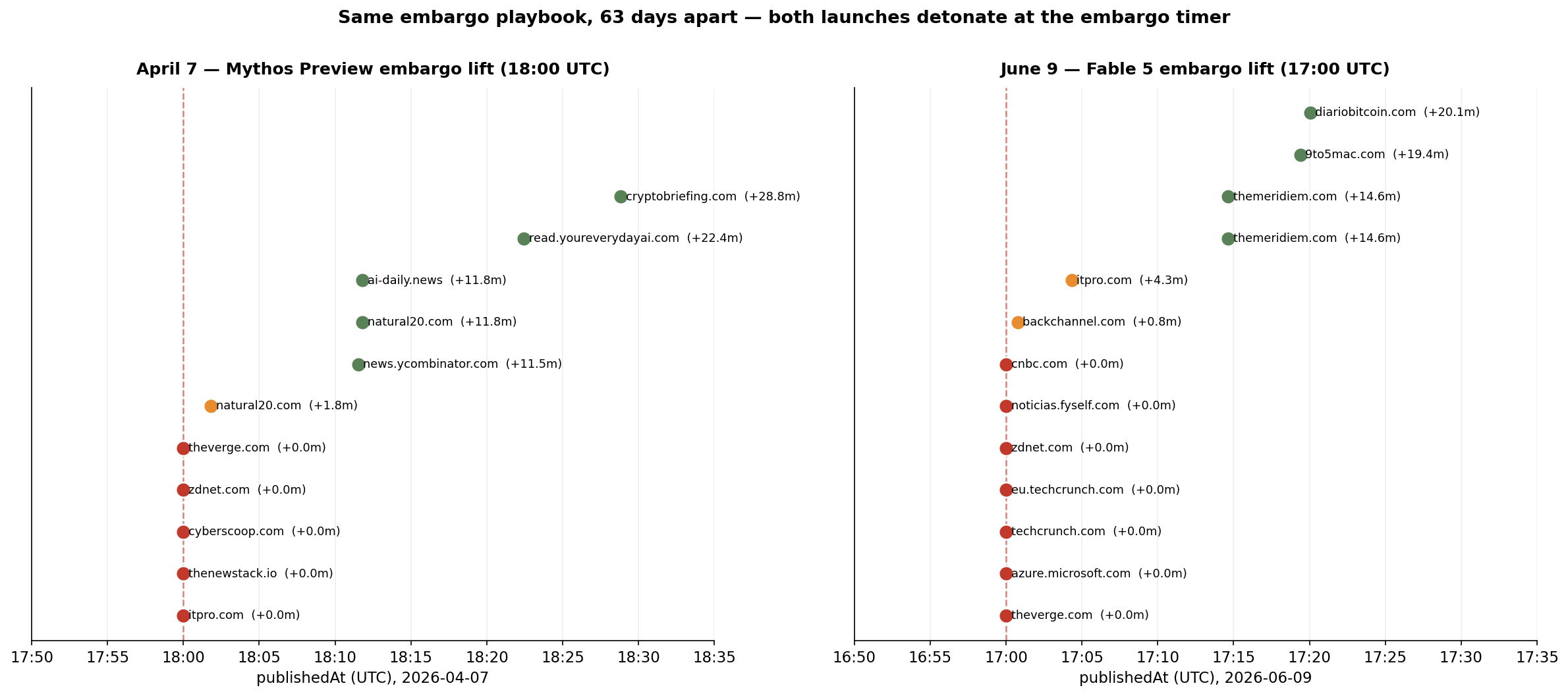
At exactly 17:00:00 UTC on Tuesday, June 9, 2026, Anthropic released Claude Fable 5. In the same second, six tier-1 outlets (The Verge, Azure, ZDNet, TechCrunch, eu.techcrunch.com, noticias.fyself.com) published their pre-written launch stories. CNBC followed +1 second later. Backchannel at +46 seconds.
That kind of clustering doesn't happen in organic diffusion. It happens when an embargo timer fires.
But the more interesting finding from our data isn't that one launch. It's that the same playbook had already fired 63 days earlier, on April 7, when Anthropic announced Claude Mythos Preview and Project Glasswing. That launch detonated a 2,500-article news cycle that pulled in the US Treasury, the IMF, executive-order discussion, and "irreversible power shift" framing.
The June 9 release isn't an isolated launch. It's the closing act of a 63-day narrative campaign that Anthropic itself opened on April 7 — orchestrated using a single repeatable PR playbook.
To map this we pulled every blog and news article in our corpus mentioning "Claude Mythos", "Project Glasswing", "Mythos-class", "Claude Fable", "Fable 5", or "Mythos 5" alongside Anthropic. The result is 3,479 articles — and the picture they paint is of an integrated 63-day campaign, not two unrelated product releases.
Get an email when we publish a new post. No account needed, unsubscribe anytime.
Act 1 — April 7: the Mythos Preview detonation
At 17:00 UTC on April 7, AWS Bedrock published its catalog entry: "Amazon Bedrock now offers Claude Mythos Preview (Gated Research Preview)." One hour later — at 18:00:00 UTC — five tier-1 outlets published in the same second:
- The Verge — "A new Anthropic model found security problems in every major operating system"
- ZDNet — "Apple, Google, and Microsoft join Anthropic's Project Glasswing to defend world's most critical software"
- CyberScoop — "Tech giants launch AI-powered 'Project Glasswing' to identify critical software [vulnerabilities]"
- ThenewStack — "Anthropic's Claude Mythos is now available, but not for you"
- ITPro — "Anthropic is worried hackers could abuse its Claude Mythos AI model"
Within the next 30 minutes, the cascade fanned out — SecurityWeek, ArsTechnica, Tom's Hardware ("thousands of zero-day vulnerabilities"), 9to5Mac, HackerNews, CNBC.
The political fallout was fast. Within 72 hours, the story crossed from tech press into financial press into government:
- Apr 8 — The Guardian: "Too powerful for the public: Inside Anthropic's bid to win the AI publicity war."
- Apr 10 — The Guardian: "US summons bank bosses over cyber risks from Anthropic's latest AI model." CNBC: "Powell, Bessent discussed Anthropic's Mythos AI cyber threat with major U.S. banks." news.google.com: "IMF chief concerned about cybersecurity risks posed by Anthropic's AI model Mythos."
- Apr 13 — LessWrong: "The policy surrounding Mythos marks an irreversible power shift." Stratechery: "Mythos, Muse, and the Opportunity Cost of Compute."
By Apr 13, the Treasury Secretary, the Federal Reserve Chair, the IMF Managing Director, and the heads of major US banks had all been pulled into the story. An AI model so capable existed that central banks were rethinking cybersecurity policy. That framing moved from rumor to financial-system reality in six days.
Act 2 — 63 days of narrative consolidation
What happens between Apr 14 and Jun 6 is the part most launch-coverage analyses miss. It's not a vacuum — it's where the terms of the eventual June 9 launch were established.
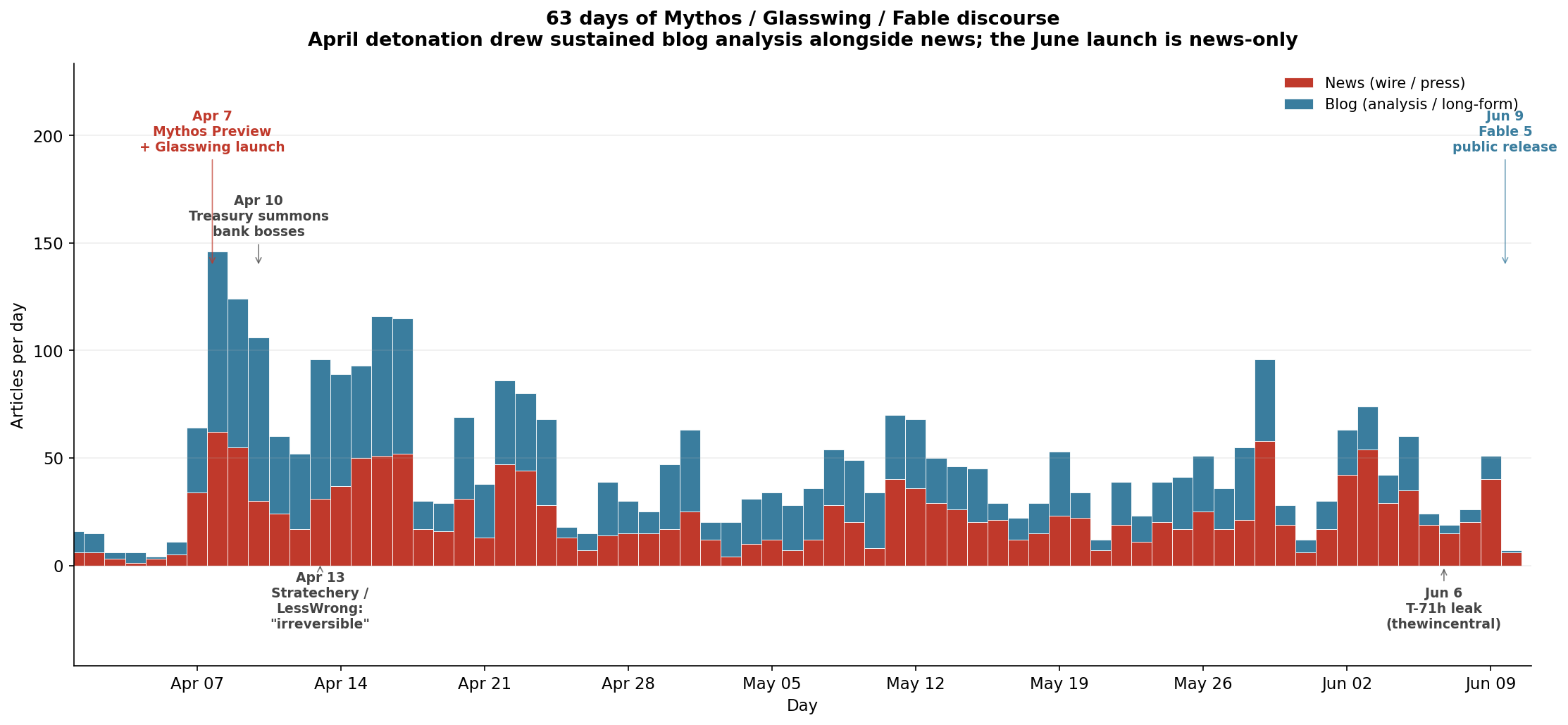
The plateau through April-May sustains at ~50-100 articles per day for two months straight. Notice the blog/news split shifts noticeably across the cycle: the April detonation was 61% blog / 39% news — Substack writers, security blogs, and policy commentators wrote sustained long-form analysis alongside the wire press. The June launch so far is 79% news / 21% blog — the analyst class hasn't had time to write yet, but the political angle that drove the April-May blog plateau is also unlikely to repeat at the same volume because it was already exhausted in April.
A few things consolidated in the plateau window:
-
The "Mythos-class" vocabulary became default. Outlets started using it without quotation marks to refer to a tier of AI capability, the way "GPT-4-class" entered the lexicon in 2024. Anthropic seeded that terminology on April 7; the trade press normalized it over six weeks.
-
The "too dangerous to release" framing went uncontested. No major outlet challenged the premise that Anthropic was correct to gate Mythos. When OpenAI gated GPT-2 in 2019, the immediate "publicity stunt" counter-frame was equally widespread. Mythos didn't get that counter-frame — the Treasury / IMF / executive-order discourse made the gating look like a regulatory necessity rather than marketing.
-
The "safe public version" expectation got planted early. From Apr 10 onward, multiple outlets reported that Anthropic was working on a "guarded" or "restricted" public release. The June 9 Fable 5 announcement walked into a slot already prepared for it.
-
Project Glasswing kept generating its own coverage. Throughout May, Anthropic announced Glasswing expansions: 150 partner organizations by early June. Each expansion announcement drove a small coverage spike, keeping the corpus at ~50 articles/day.
By June 6 — the moment thewincentral.com published "Claude-Mythos-5 Briefly Appears Online," the T-71-hour pre-empt leak — the narrative groundwork was complete. The press already knew what the story would be: the safe version of Mythos is here.
Act 3 — June 9: Fable 5 closes the loop
The same playbook executed again, 63 days later.
Channel 1 — AWS service catalog (14:15 UTC). AWS /whats-new/ publishes the Fable 5 announcement 2 hours 45 minutes before press embargo. This is structural; the previous Anthropic-on-AWS launch (Claude Platform on AWS, 2026-05-11) used the same channel at 14:00:00 UTC. The /whats-new/ channel is driven by internal release engineering, not press cycle.
Channel 2 — Press embargo (17:00:00 UTC). Six tier-1 outlets in the same second: The Verge, Azure, ZDNet, TechCrunch (×2 editions), noticias.fyself.com. CNBC at +1.0s. Backchannel at +46s. ITPro at +4 minutes. The Meridiem auto-published two pre-written articles 217 milliseconds apart at +14:37 — a CMS pipeline firing on the embargo timer.
Channel 3 — Amazon News Room (17:41:41 UTC). The corporate news room published 41 minutes after press embargo — the third channel, serving the corporate-communications surface.
Same architecture as April 7. Same 1-second cluster at the embargo timer. Same AWS pre-press channel. Different launch, identical playbook.
Why the June news cycle is smaller — and why that's by design
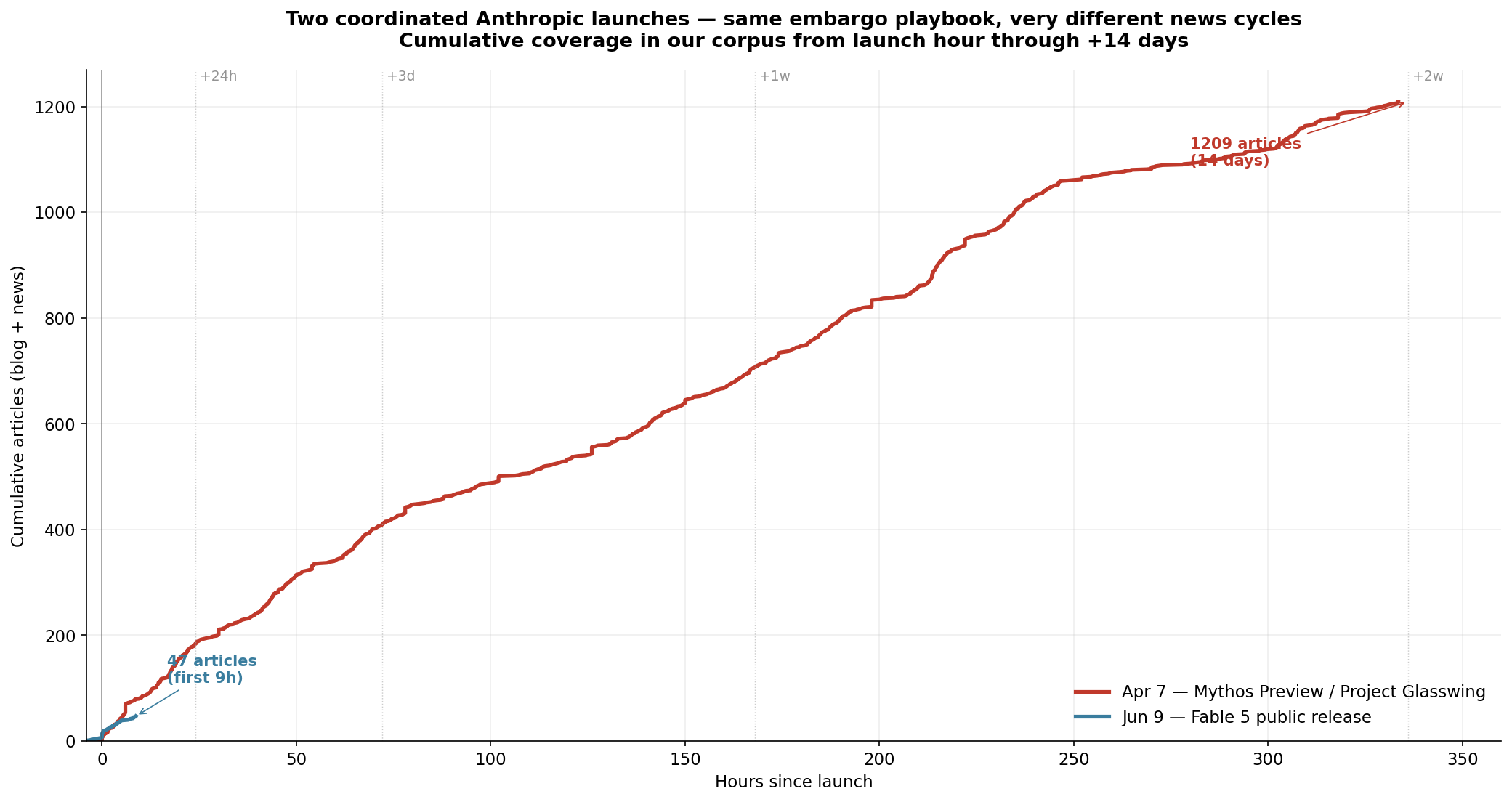
The June launch produced a substantial but visibly smaller news cycle than the April Mythos announcement. At matched time horizons:
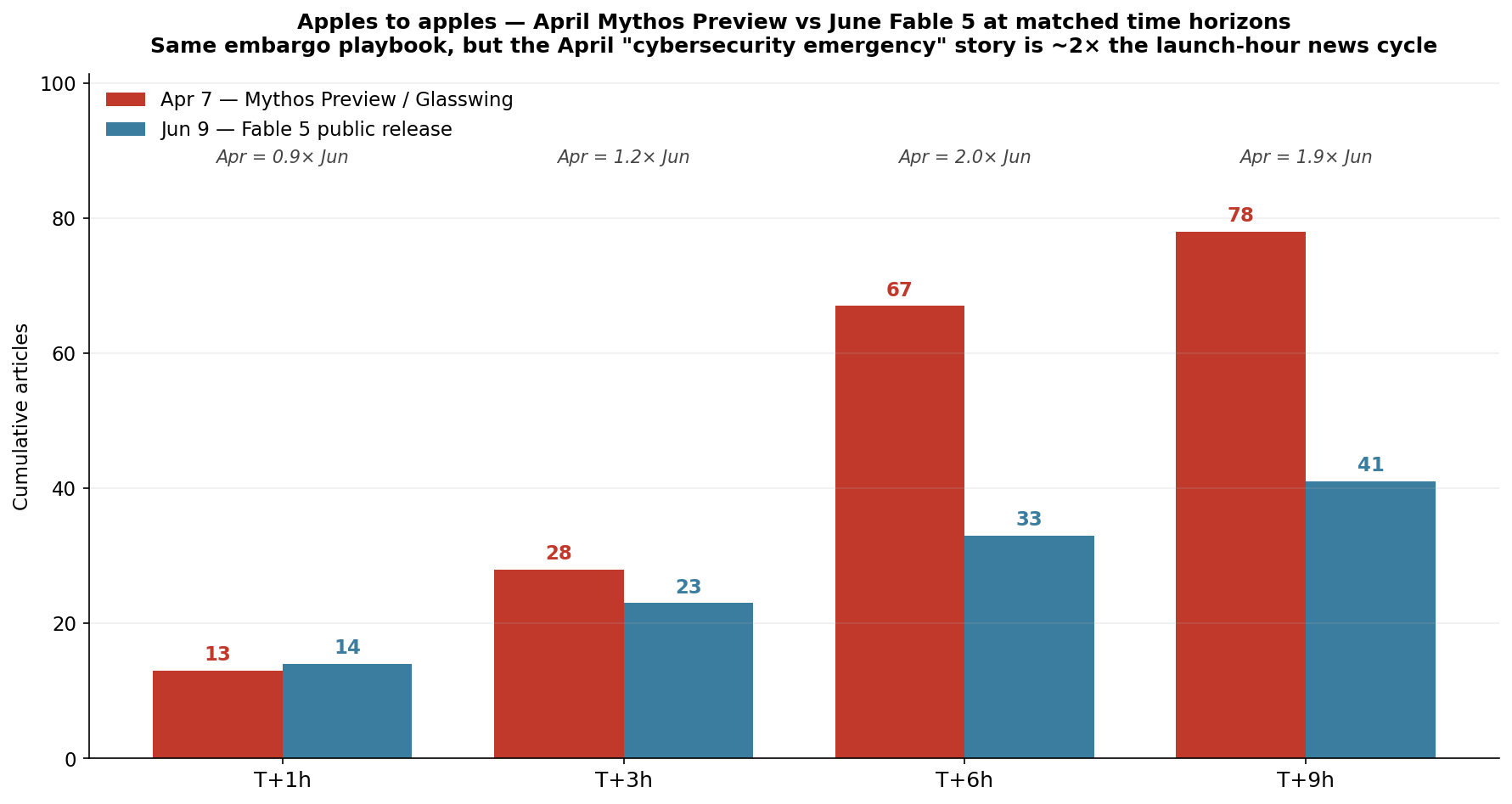
| Horizon | Apr Mythos | Jun Fable 5 | Ratio |
|---|---|---|---|
| T+1 hour | 13 | 14 | Jun slightly ahead |
| T+3 hours | 28 | 23 | Apr +22% |
| T+6 hours | 67 | 33 | Apr 2.0× |
| T+9 hours | 78 | 41 | Apr 1.9× |
At T+1 hour the two launches are essentially identical — same embargo, same tier-1 cluster, same launch-day press release. The two stories start at the same volume. After that, April pulls away because the April story has many more news vectors than June:
- April vectors: "model too capable" + "gated access" + "Apple/Google/Microsoft coalition" + "Treasury summons banks" + "executive order debate" + "IMF concern" + "policy shift." Seven distinct news angles, each generating its own coverage tail.
- June vector: "Fable 5 is the public version of Mythos." One angle. The political angle was already exhausted by April 13.
The June launch isn't failing — 41 articles in 9 hours from a single product release is well above average. But June was always going to be smaller than April by design. April was where Anthropic spent the political capital. June was where they cashed it in.
The integrated picture — what Anthropic actually did
Looking at June 9 alone, "coordinated launch" is the story. Looking at April 7 + June 9 together, "coordinated 63-day narrative campaign" is the story. Three phases:
- Apr 7 launch + 6-day political fallout. Drop the maximum-capability claim. Gate access. Attach a partner coalition (Apple/Google/Microsoft). Let the Treasury/IMF/executive-order discourse establish "regulated AI" as the operating frame.
- Apr 14 – Jun 6 plateau. Reinforce vocabulary ("Mythos-class," "safe version"). Expand Project Glasswing partner count weekly. Keep the trade press warm.
- Jun 9 release. Drop the "safe version" into the slot prepared for it. Use the same multi-channel embargo playbook as April. The press already knows the frame.
The visible artifact of this campaign — the part that surfaces in search engines and historical archives — is two model releases 63 days apart with similar PR architecture. The invisible artifact is the uncontested frame in which both were covered. Every June 9 article that uses the phrase "Mythos-class" is a downstream effect of April 7-13 work that most readers will never trace back to its origin.
For anyone tracking AI launches in real time, the lesson is that the press cycle isn't the launch — it's the second-to-last week of the launch. The actual launch began ten weeks earlier.
What this means for AI launch coverage going forward
-
A 1-second tier-1 cluster is a coordination fingerprint. When you see six major outlets publish at the same exact second, that's embargo. The size and composition of the cluster tells you the tier of access. April was a 5-outlet cluster; June was 6-outlet — both top-of-press distribution.
-
The interesting time scale is T+6 hours, not T+1 hour. At T+1h, two launches by the same company can look identical. Divergence at T+6h is where the underlying news structure shows itself.
-
AWS catalog timestamps lead press embargoes by hours. The
/whats-new/feed is the leading public signal for any AWS-distributed model launch. If you're trying to spot a launch in real time, watch that channel. -
Pre-launch frame-seeding is the real campaign. What looks like a "rumor cycle" in the weeks before a launch is often a coordinated narrative-prep operation. The Mythos discourse from April 14 to June 6 is what made the June 9 launch coverage uniform — it was the rehearsal for the actual story Anthropic wanted told on launch day.
-
For any future AI launch, search broadly. A literal search for the launch product name will miss the campaign that preceded it. The right approach is to find the codename or program name the company seeded earlier, query that, and look 60-90 days back.
Data: 3,479 articles drawn from the Skillenai data products API, deduplicated by URL across blog and news indices, with buildfastwithai.com SEO content excluded. Full methodology, charts, and underlying timeline CSV: github.com/skillenai/skillenai-notebooks/tree/master/fable5-launch-diffusion.