
The Most Influential Bloggers in Tech: Three Rankings That Don't Overlap
Get an email when we publish a new post. No account needed, unsubscribe anytime.
TL;DR
There is no single "most influential tech blogger" — there are three almost-disjoint populations, depending on how you measure influence. Across 335,373 enriched blog documents in the Skillenai content index, the top-20 by post volume and the top-20 by per-post authority share exactly one name (Jaccard = 0.026).
- Volume rewards content farms and podcast feeds — the top-of-list names are mostly unfamiliar to working tech readers.
- Per-post authority rewards Substack newsletters and personal sites — and produces the list of names you'd actually recognize: John Gruber, Gergely Orosz, Lenny Rachitsky, Simon Willison, Nathan Lambert, Ethan Mollick, Ksenia Se, Drew Breunig, José Valim, Noah Smith, Melanie Mitchell, Jack Clark.
- Volume × authority rewards a small bridge population — almost entirely tech podcasters (Tobias Macey, Sam Charrington, Wes Bos & Scott Tolinski, Andreas + Michael Wittig).
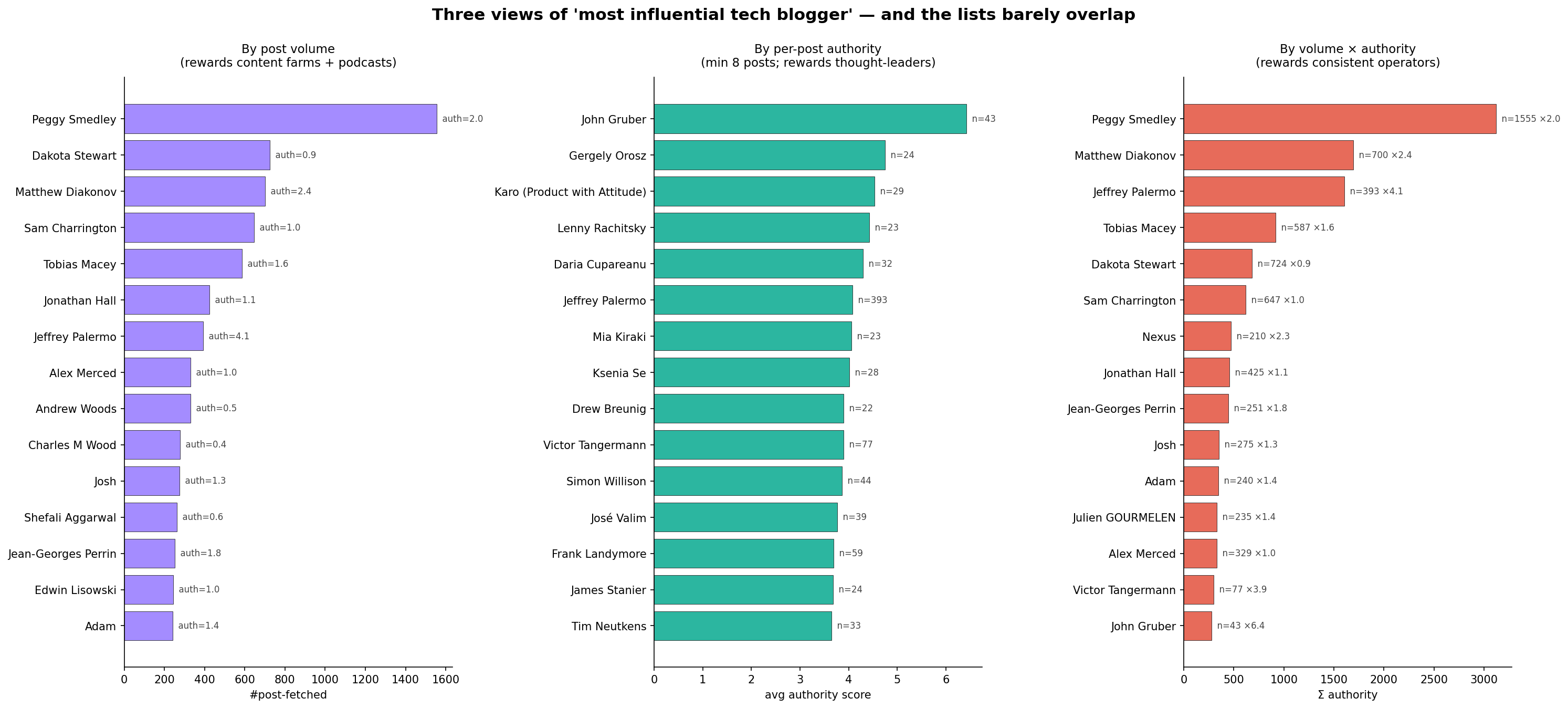
The blog form has bifurcated. Substack carries the bylines. Traditional CMS-driven blogs carry the volume. Almost no individual writer manages both.
How we measured influence
We pulled every document in the Skillenai blog index — 335,373 enriched docs — and aggregated by author byline. Two filters mattered:
- Author present. Only 41% of blog documents have an
authorfield at all (138,586 of 335,373). RSS feeds are inconsistent about exposing bylines, and many real authors are buried in HTML. - System authority signal. Each document carries a pre-computed
authorAuthorityscore from the enrichment pipeline (a relevance × diversity composite). 99,916 documents have it.
We then computed three rankings on the cleaned set (≥ 5 posts per author, junk authors and mis-classified non-blog domains removed):
- Volume: total posts in the index.
- Per-post authority: average
authorAuthority(rewards quality over throughput). - Σ authority: sum of
authorAuthorityacross all of an author's posts (rewards consistent on-topic operation).
The rankings barely overlap
Jaccard overlap between the top-20 lists:
| Comparison | Overlap | Jaccard |
|---|---|---|
| Volume vs Authority | 1 / 20 | 0.026 |
| Authority vs Σ | 4 / 20 | 0.111 |
| Volume vs Σ | 15 / 20 | 0.600 |
Volume and Σ share most of their top-20 because Σ is dominated by raw count when authority levels off. The interesting number is the first one: 0.026. Volume rankings and authority rankings are essentially measuring different populations.
The L-shape
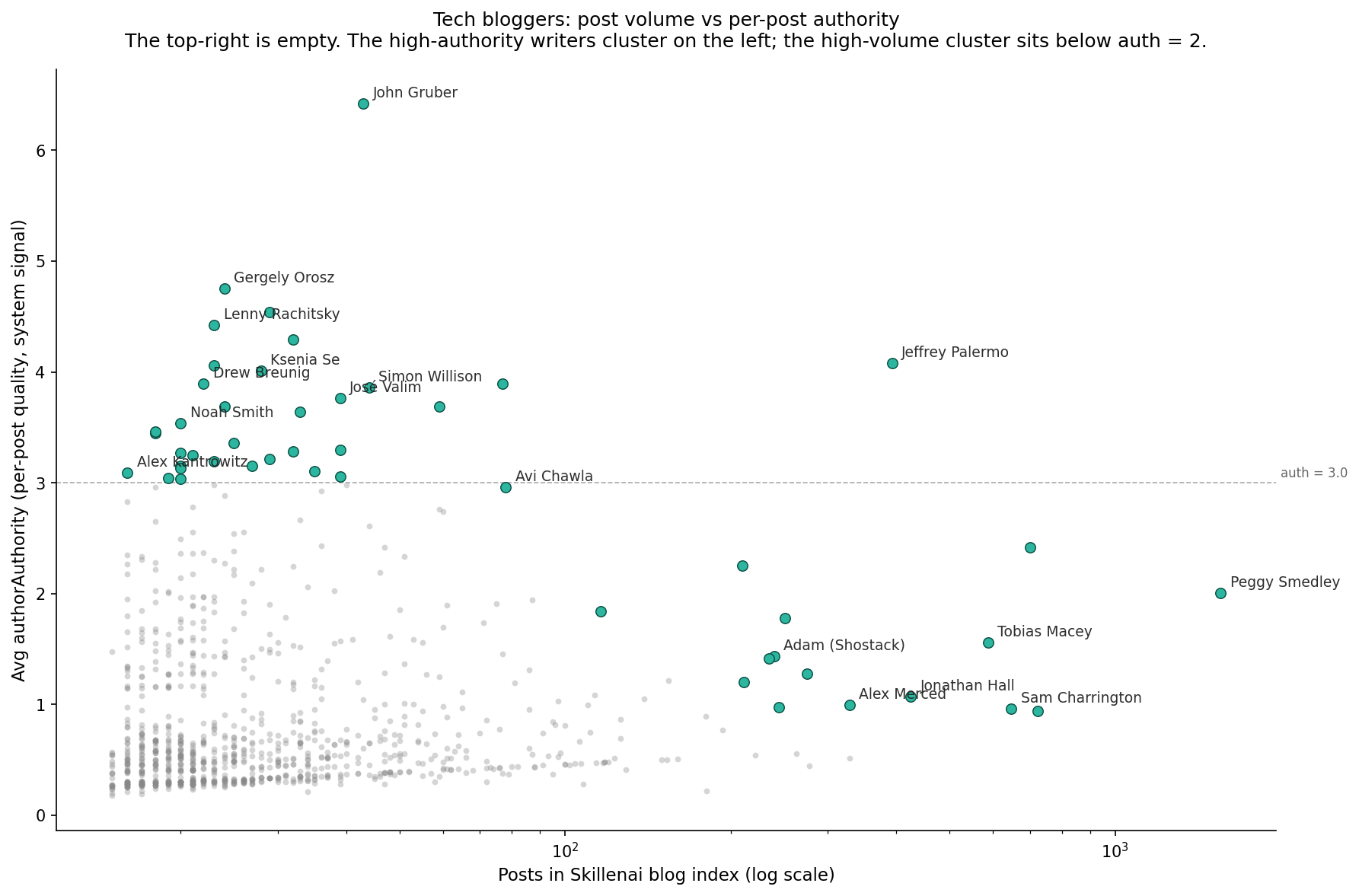
Plot every author with ≥ 5 posts on log-volume vs per-post authority and the top-right is empty:
The high-authority writers all sit in the upper-left at 8–60 posts. The high-volume writers all sit in the lower-right below authority = 2.0. The single bridging name is Jeffrey Palermo (393 posts at authority 4.08), who runs the Azure DevOps Show podcast — the rare both-quantity-and-quality outlier.
Top 25 by per-post authority — the names you'd actually recognize
Minimum 8 posts to filter incidental drive-by authors.
| Rank | Author | Posts | Avg authority | Primary publication |
|---|---|---|---|---|
| 1 | John Gruber | 43 | 6.42 | Daring Fireball |
| 2 | Gergely Orosz | 24 | 4.75 | blog.pragmaticengineer.com |
| 3 | Karo (Product with Attitude) | 29 | 4.54 | karozieminski.substack.com |
| 4 | Lenny Rachitsky | 23 | 4.42 | lennynewsletter.com |
| 5 | Daria Cupareanu | 32 | 4.30 | aiblewmymind.substack.com |
| 6 | Jeffrey Palermo | 393 | 4.08 | azuredevops.show |
| 7 | Mia Kiraki | 23 | 4.06 | robotsatemyhomework.substack.com |
| 8 | Ksenia Se | 28 | 4.01 | turingpost.substack.com |
| 9 | Drew Breunig | 22 | 3.90 | dbreunig.com |
| 10 | Victor Tangermann | 77 | 3.90 | futurism.com |
| 11 | Simon Willison | 44 | 3.86 | simonwillison.net |
| 12 | José Valim | 39 | 3.77 | dashbit.co |
| 13 | Frank Landymore | 59 | 3.69 | futurism.com |
| 14 | James Stanier | 24 | 3.69 | theengineeringmanager.substack.com |
| 15 | Tim Neutkens | 33 | 3.64 | rc.nextjs.org |
| 16 | Noah Smith | 20 | 3.54 | noahpinion.substack.com |
| 17 | Neil Perkin | 18 | 3.46 | onlydeadfish.substack.com |
| 18 | James Wang | 18 | 3.45 | weightythoughts.com |
| 19 | Karen Spinner | 25 | 3.36 | wonderingaboutai.substack.com |
| 20 | Jenny Ouyang | 39 | 3.30 | buildtolaunch.substack.com |
| 21 | Dheeraj Sharma | 32 | 3.28 | genaiunplugged.substack.com |
| 22 | Eric Newcomer | 20 | 3.27 | intellyx.com |
| 23 | Heather Baker | 21 | 3.25 | thehumansintheloop.ai |
| 24 | Devansh | 29 | 3.21 | artificialintelligencemadesimple.com |
| 25 | Kendra Ramirez | 23 | 3.20 | kendratech.substack.com |
This is roughly the canonical list of contemporary tech commentary in 2026. It's also a list almost no one would compose by hand if they were sorting on "who posts the most" — most of these writers publish 1–4 posts a month.
Top 20 by raw post volume — and why most names don't ring a bell
Same corpus, different ranking.
| Rank | Author | Posts | Avg authority | Primary publication |
|---|---|---|---|---|
| 1 | Peggy Smedley | 1,555 | 2.01 | peggysmedleyshow.com |
| 2 | Dakota Stewart | 724 | 0.94 | the-oracleai.com |
| 3 | Matthew Diakonov | 700 | 2.42 | fazm.ai |
| 4 | Sam Charrington | 647 | 0.96 | twimlai.com |
| 5 | Tobias Macey | 587 | 1.56 | dataengineeringpodcast.com |
| 6 | Jonathan Hall | 425 | 1.07 | jhall.io |
| 7 | Jeffrey Palermo | 393 | 4.08 | azuredevops.show |
| 8 | Alex Merced | 329 | 1.00 | datalakehousehub.com |
| 9 | Andrew Woods | 329 | 0.52 | supplychainstrategy.media |
| 10 | Charles M Wood | 278 | 0.45 | javascriptjabber.com |
| 11 | Josh | 275 | 1.28 | aisdr.com |
| 12 | Shefali Aggarwal | 263 | 0.56 | qubole.com |
| 13 | Jean-Georges Perrin | 251 | 1.78 | jgp.ai |
| 14 | Edwin Lisowski | 245 | 0.98 | addepto.com |
| 15 | Adam (Shostack) | 240 | 1.44 | shostack.org |
| 16 | Julien GOURMELEN | 235 | 1.41 | wizops.fr |
| 17 | aiforgoodstg2 | 222 | 0.54 | aiforgood.itu.int |
| 18 | Waylon Walker | 211 | 1.20 | waylonwalker.com |
| 19 | Nexus | 210 | 2.25 | nexusconnect.io |
| 20 | Artur Haponik | 193 | 0.77 | addepto.com |
A few legitimate domain-specific influencers are here — Tobias Macey runs the Data Engineering Podcast, Sam Charrington runs TWIML AI, "Adam" at shostack.org is Adam Shostack of Threat Modeling: Designing for Security. But the bulk of the list is unfamiliar to most working tech readers because the bulk of the list is content farms (addepto.com, the-oracleai.com, fazm.ai) and niche-industry RSS feeds.
Where the high-authority bloggers actually publish
Of the top 25 bloggers by per-post authority:
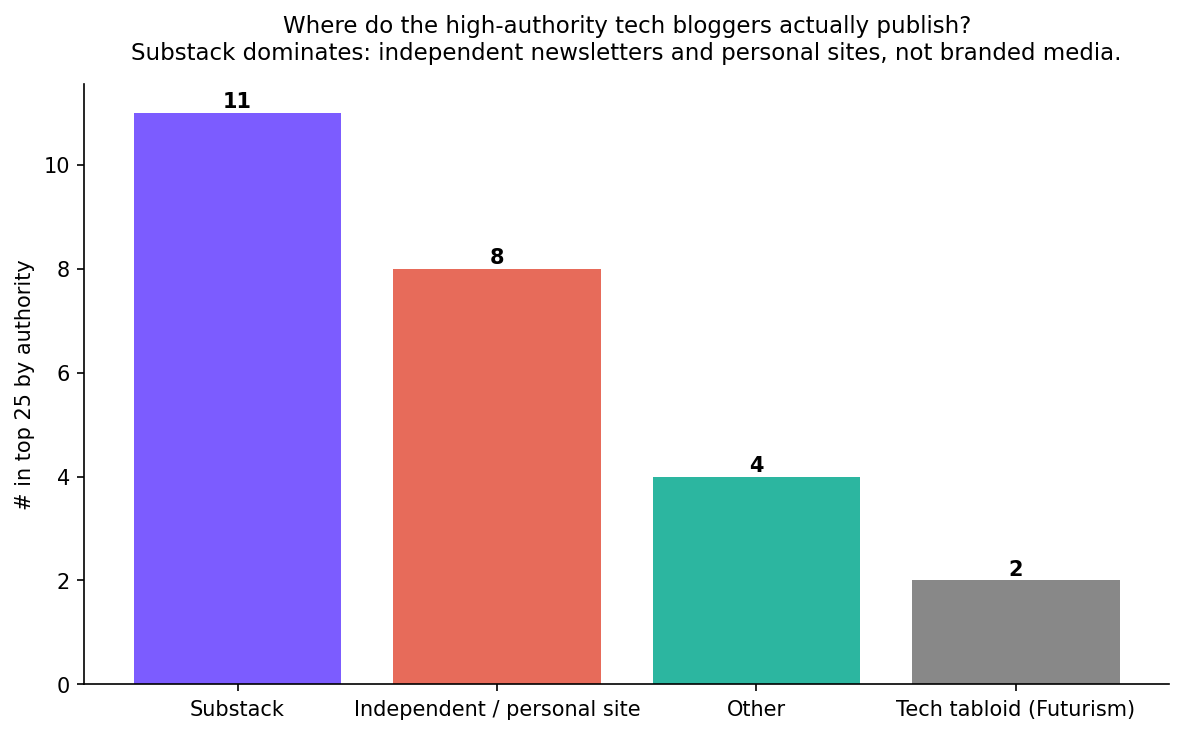
- 11 publish on Substack (
lennynewsletter,noahpinion,turingpost,theengineeringmanager,onlydeadfish,wonderingaboutai,buildtolaunch,genaiunplugged,kendratech,karozieminski,aiblewmymind). - 8 publish on independent personal sites (
simonwillison.net,dashbit.co,dbreunig.com,weightythoughts.com,thehumansintheloop.ai,intellyx.com,artificialintelligencemadesimple.com,blog.pragmaticengineer.com). - Only 2 are on traditional tech-press domains — both at Futurism.
The traditional tech press doesn't surface in the byline-level top 25 at all. Its authority shows up at the publication level, where openai.com, huggingface.co, aws.amazon.com, theverge.com, and dev.to all score in the top 5 by domain authority — but the individual writers behind those bylines never break the author-level top 25.
Same split at the publication level
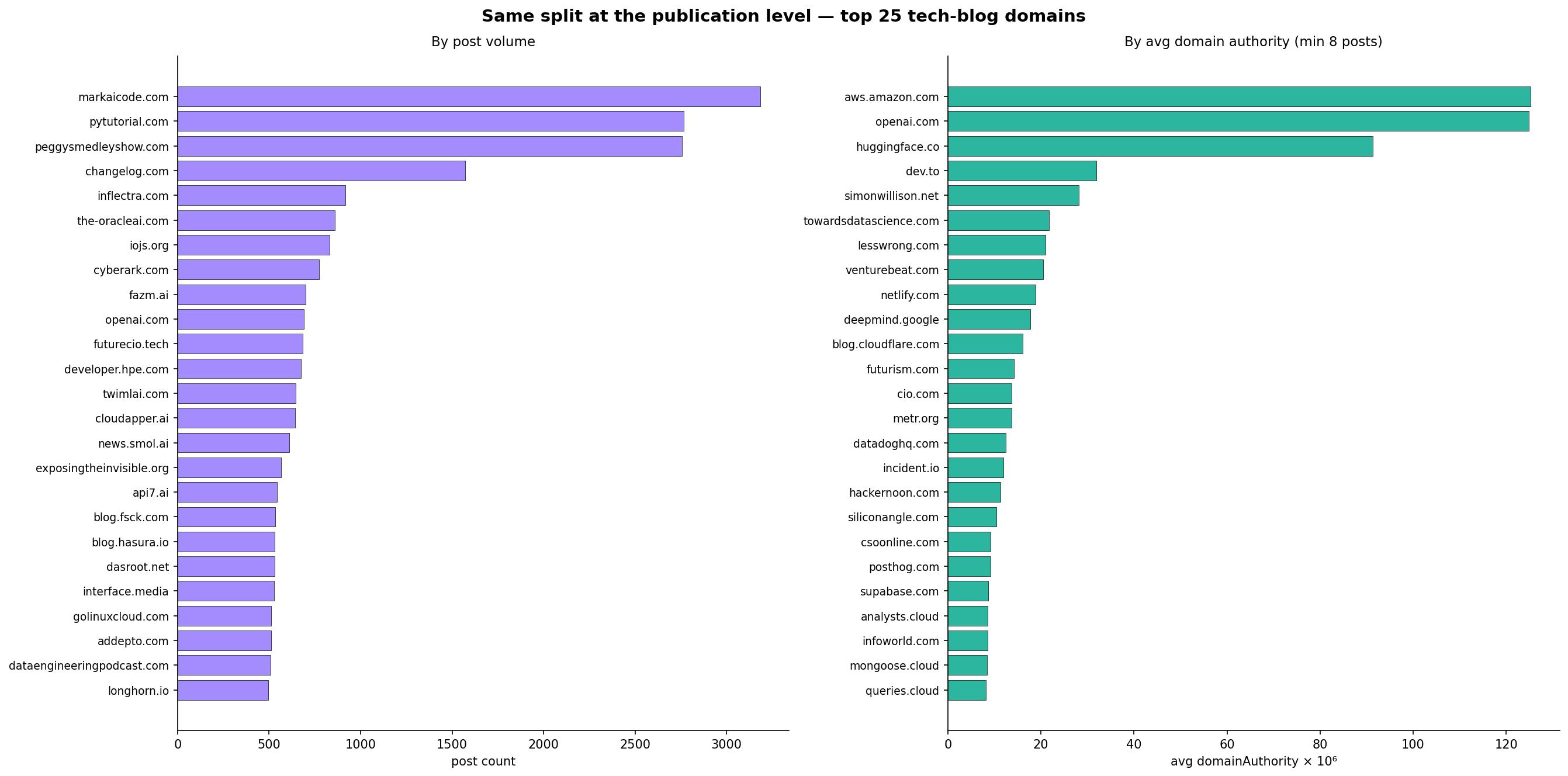
Domain rankings repeat the L-shape: top-volume sites are content farms (markaicode.com, pytutorial.com) and niche shows (peggysmedleyshow.com); top-authority domains are research labs (openai.com, huggingface.co, aws.amazon.com), platforms (medium.com, dev.to, news.ycombinator.com), and a single notable personal site — simonwillison.net ranks #11 on authority with 92 posts.
What this means
If you're trying to identify the signal-to-noise layer of tech writing in 2026, three things stand out:
- Don't sort by post count. It will surface SEO content farms and niche industry feeds before it surfaces names like Simon Willison, Lenny Rachitsky, or Gergely Orosz — all of whom publish far less than the top-20-by-volume writers but carry massively more weight per post.
- Substack is where the bylines live. 44% of the top-25-by-authority list is Substack-hosted. Personal-domain blogs are second; traditional CMS-driven tech-press blogs are effectively absent from byline-level rankings.
- Tech podcasters are the bridge population. If you want both volume and quality in one writer, you're looking at people who publish weekly show notes for an existing podcast — Tobias Macey, Sam Charrington, Wes Bos & Scott Tolinski, the Wittig brothers, Jeffrey Palermo. The set is small.
Methodology and caveats
- Source. Skillenai blog index (
prod-enriched-blog), 335,373 enriched documents as of 2026-05-08. - Author coverage. Only 41% of blog docs have an
authorfield. RSS feeds are inconsistent; the rankings only see what was exposed. - Selection bias. The corpus is the subset of tech-relevant content the Skillenai crawler discovered through public RSS feeds. Walled-garden newsletters, podcast-only surfaces, and writers who don't expose feeds are under-represented.
- Author-string cleaning. Initial passes surfaced HTML fragments, Gravatar URLs, raw email addresses, generic placeholders ("admin", "Author", "Unknown"), team accounts ("FutureCIO Editors", "Cribl", "BigPanda", "OpenClaw Team"), and multi-author byline blobs. All filtered before ranking.
- Authority signal.
authorAuthorityis the system's own pre-computed score (likely a relevance × entity-diversity composite over the author's posts). Face validity is strong — the highest-authority list contains the canonical names of contemporary tech commentary — but it is not a measure of citations, social sharing, or external influence; it's an internal embedding-derived signal. - Volume is posts in our index, not posts ever published. A blogger with a decade of archives may only have their last year of posts crawled. Simon Willison, for example, has 92 posts on his domain in our index but his actual blog goes back to 2002.
Full methodology, ranked datasets, and reproducer scripts on GitHub.