
Does Remote Work Pay Less? What 46,873 Job Postings Say
Remote job postings advertise a median of $190,000. Onsite postings advertise $178,500. That is a 6.4% remote premium, and it is almost entirely fake.
Control for what the job actually is — the role family and the seniority rung — and the gap falls to +0.5%, an interval that straddles zero. Remote roles pay more in the raw data because remote hiring is tilted toward senior people, not because remote work pays a premium.
But the interesting part is what doesn't collapse.
 If remote work had unbundled pay from geography, the state named on a remote posting would stop predicting what it pays. It doesn't. Remote pay is as geographically dispersed as onsite pay, and the state hierarchy survives the switch almost perfectly.
Going remote doesn't change what you're paid. It changes whose location decides it.
Get an email when we publish a new post. No account needed, unsubscribe anytime.
The premium is a composition artifact
We looked at 46,873 US tech postings carrying a structured USD pay range, a work-model label, and a seniority rung. Adding one control at a time to the same regression:
| Control set | Remote vs. onsite | 95% CI |
|---|---|---|
| Raw, no controls | +7.0% | +6.2% to +7.7% |
| + seniority rung | +3.3% | +2.7% to +4.0% |
| + role family | +0.5% | −0.0% to +1.1% |
| + platform | +0.8% | +0.3% to +1.4% |
| + state (full model) | +2.0% | +1.4% to +2.5% |
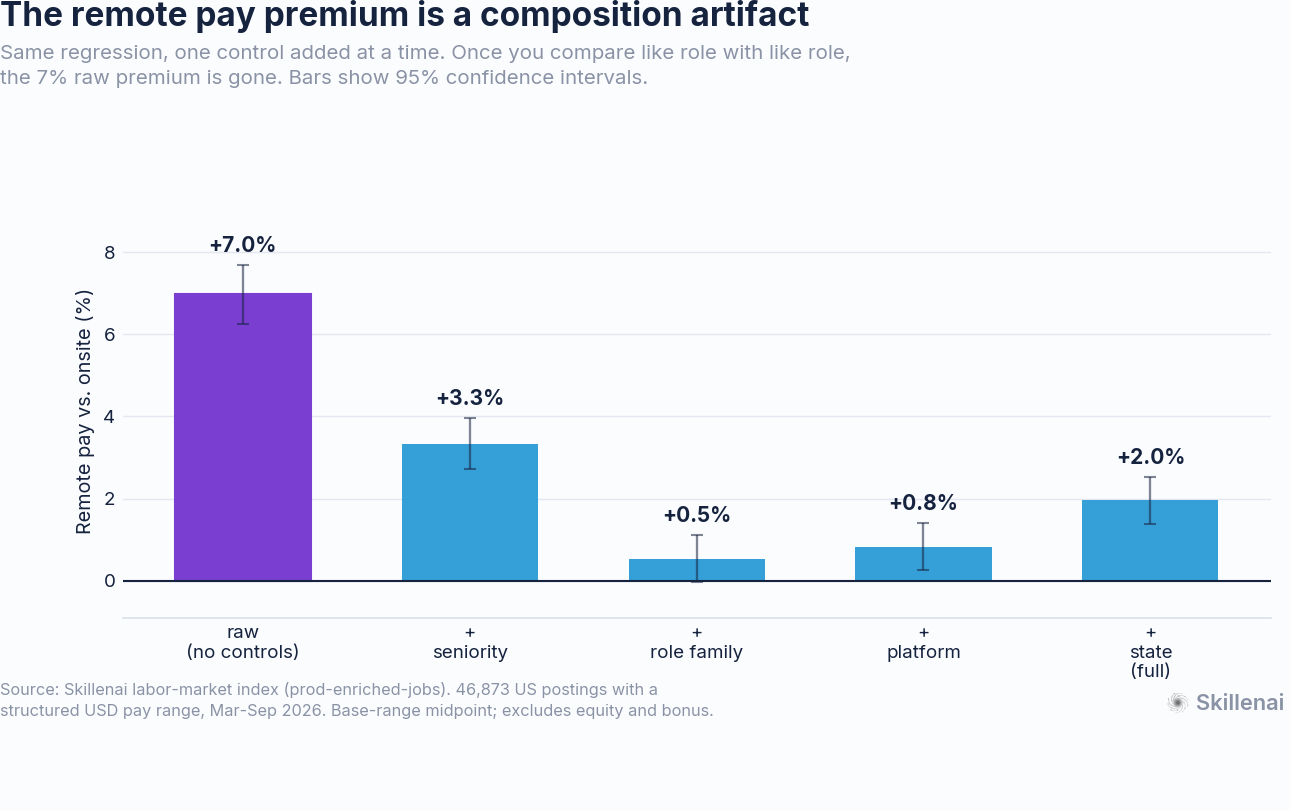 Role family does more work than seniority here. Once you compare a backend engineer to a backend engineer, the premium is statistically indistinguishable from zero.
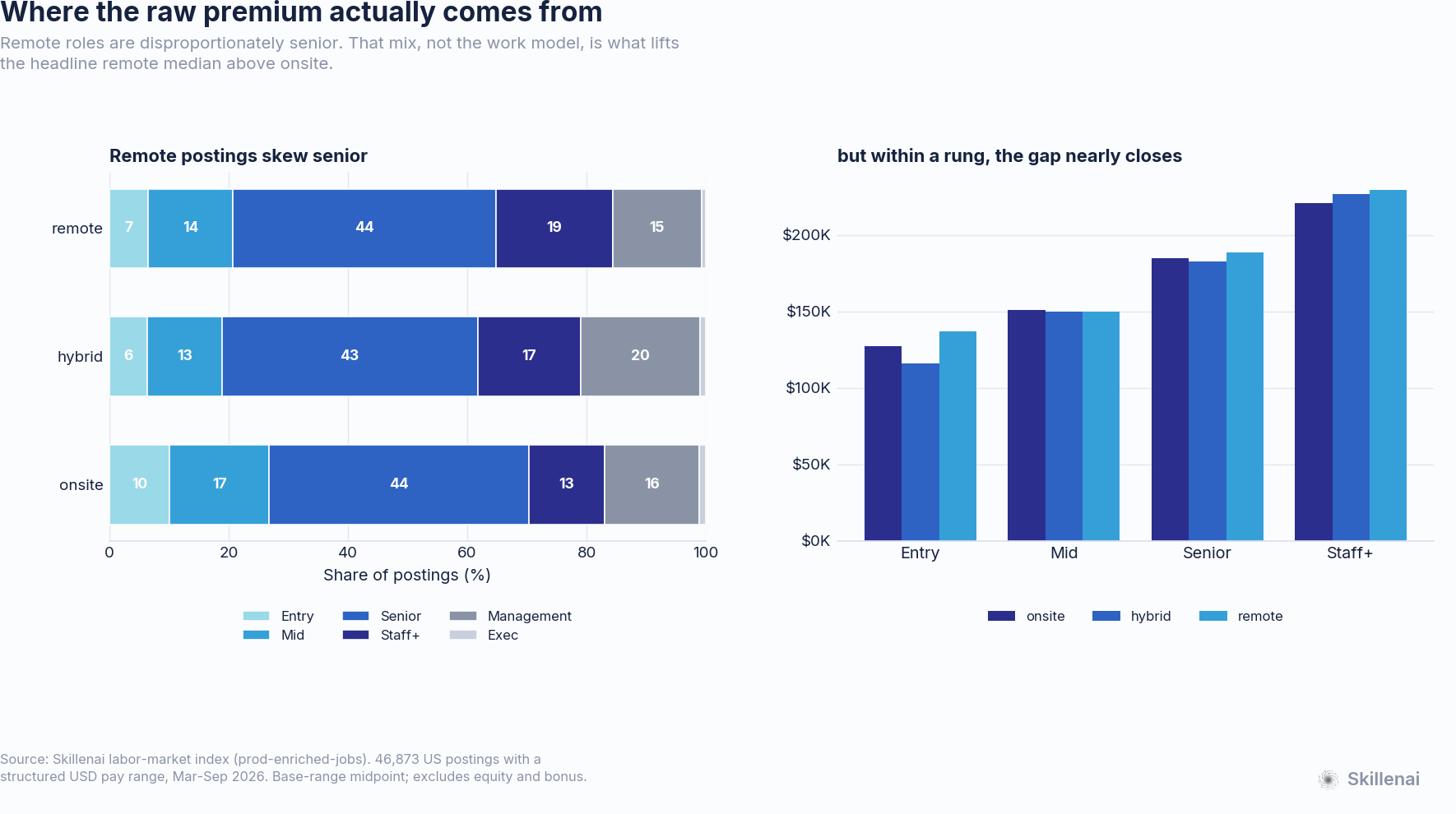
The mix explains it. Remote postings are 19.4% Staff-and-above against 12.6% onsite, and 6.6% entry-level against 10.2% onsite. Remote hiring skews up the ladder, and the ladder is where the money is.
 | Rung | Onsite | Hybrid | Remote |
| --- | --- | --- | --- |
| Entry | $127,500 | $116,500 | $137,250 |
| Mid | $151,500 | $150,000 | $150,000 |
| Senior | $185,000 | $183,000 | $189,182 |
| Staff+ | $221,300 | $227,175 | $230,000 |
For scale: our analysis of what tech roles actually pay in 2026 put a single promotion at $40,000 to $65,000. The work-model effect is an order of magnitude smaller than the rung effect. If you are optimizing for pay, the ladder matters and the work model does not.
Why we won't print one number for the remote gap
Here is the part most analyses would bury. We ran the same model separately on each of our three posting sources, and they disagree:
| Source | n | Remote vs. onsite, same role and rung | 95% CI |
|---|---|---|---|
| greenhouse | 16,265 | −2.3% | −3.3% to −1.3% |
| ashby | 5,395 | +0.1% | −1.4% to +1.6% |
| schema_org | 25,213 | +5.0% | +4.3% to +5.8% |
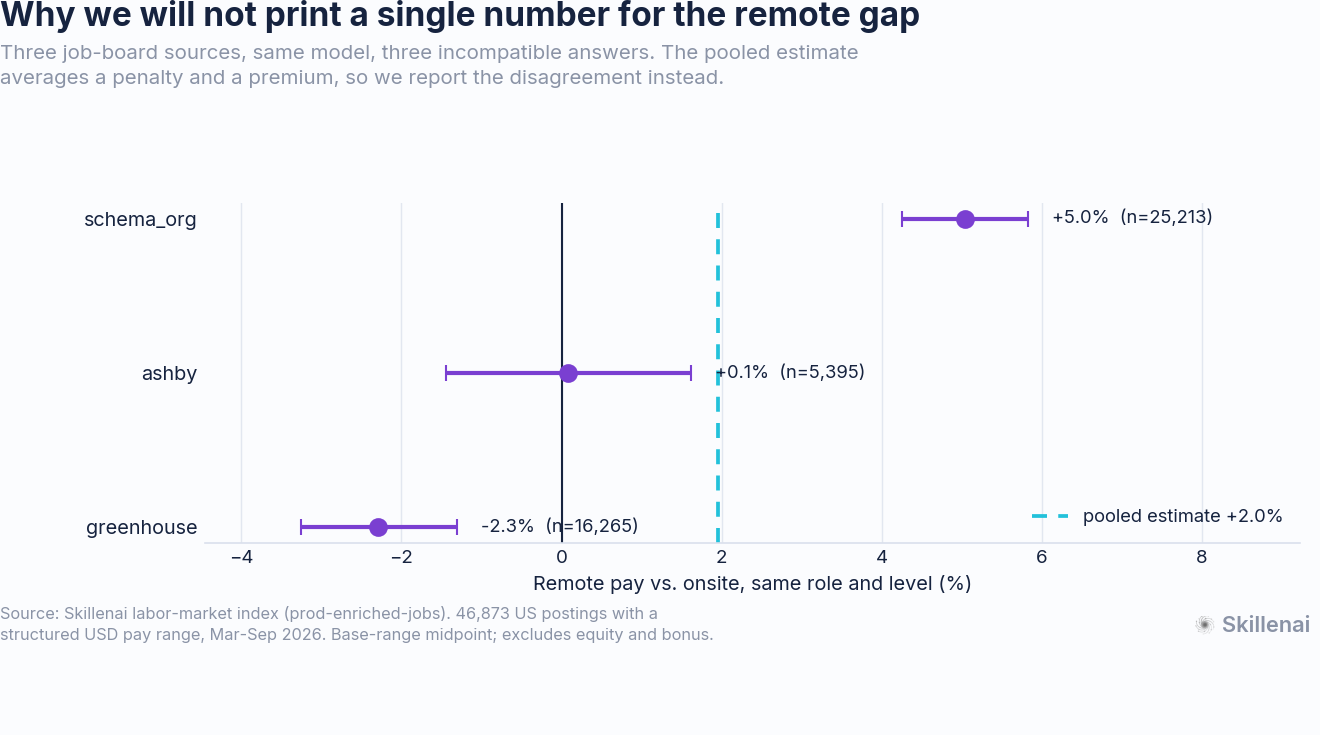 Three sources, one model, three incompatible answers, and the confidence intervals don't overlap. The pooled +2.0% is an average of a penalty and a premium. Quoting it alone would imply a precision we don't have.
We don't know the mechanism. Salary disclosure rates differ sharply by source and by work model — on schema_org 48.2% of remote postings disclose pay versus 24.8% of onsite ones, while on greenhouse that ordering reverses. Which postings are visible to a pay analysis is not random, and it varies along exactly the axis we're studying. That's a plausible driver, not a demonstrated one.
What survives is a bound, and it's still useful: whatever the remote pay gap is, it is small, and it is not the 6% the raw numbers advertise. If you are negotiating, do not expect the work model to move your number much in either direction.
Geography didn't go away
Now the finding that held up.
We stripped out role, rung and platform, leaving only location, then measured how much each state moves what's left.
| Work model | States | Postings | Spread of state effect |
|---|---|---|---|
| Onsite | 14 | 17,371 | 6.5% |
| Hybrid | 9 | 5,836 | 9.5% |
| Remote | 12 | 14,636 | 9.2% |
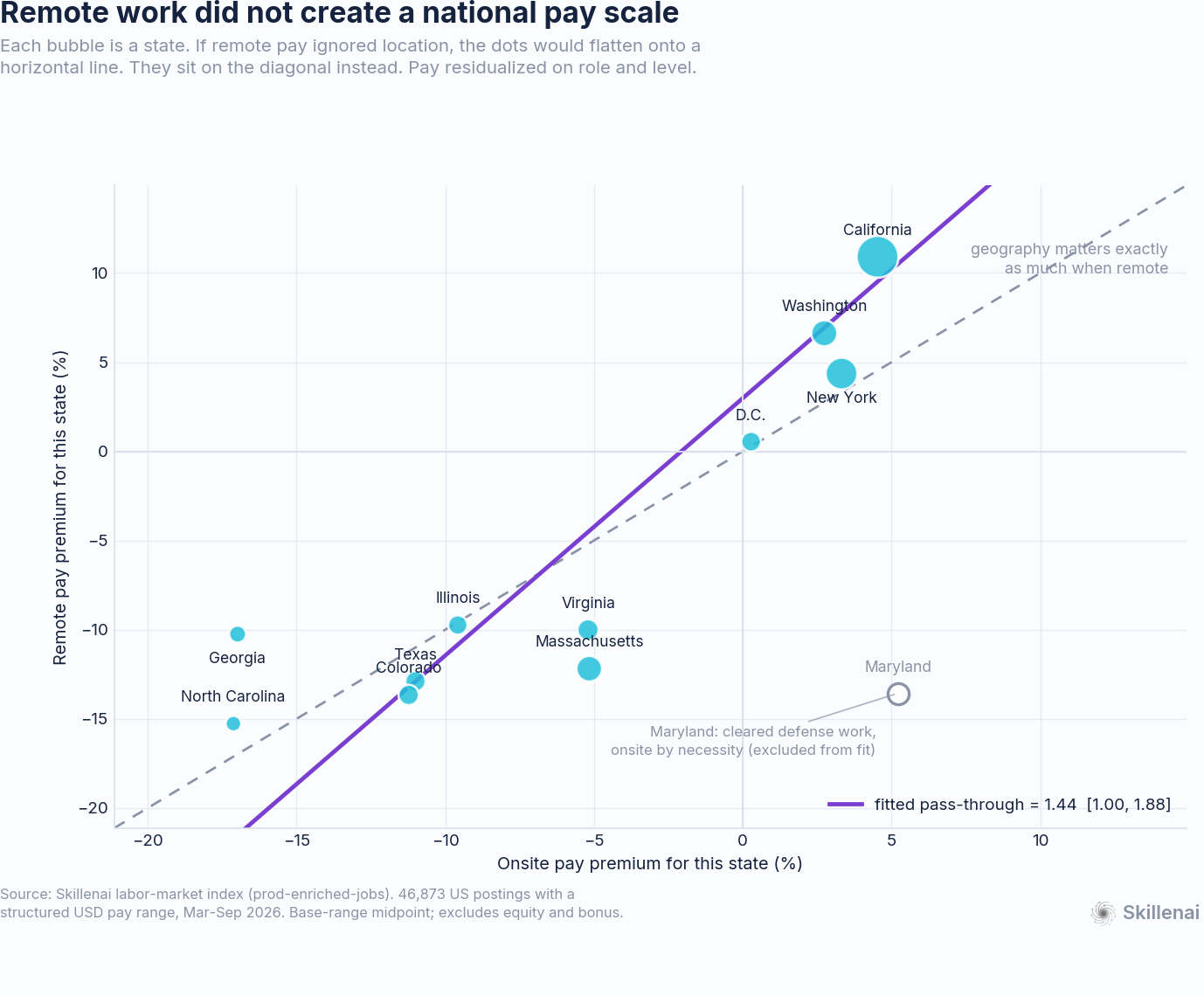
Remote pay varies across states at least as much as onsite pay does. Plot each state's remote premium against its onsite premium and the pass-through slope is 1.44 (95% CI 1.01 to 1.88).
- Against zero pass-through, the idea that remote pay is location-blind: rejected, p < 0.0001.
- Against full pass-through, location mattering exactly as much as it does onsite: not rejected.
California remote postings carry a +10.9% premium where California onsite postings carry +4.5%. Washington: +6.6% remote against +2.7% onsite. Colorado: −13.7% remote against −11.2% onsite. The rank order of expensive and cheap states survives the switch to remote intact.
The check that could have killed this
A weak pass-through would have been the better headline, and it is also what a measurement artifact would produce. If the state on a remote posting were just a noisier label, every state's average would drift toward the national mean and the slope would shrink on its own — a real-looking finding manufactured by bad data.
So we used hybrid as a placebo. A hybrid employee has to physically commute, so a hybrid posting's state has to be real. If anchor states were meaningless labels, hybrid would flatten too.
It does the opposite: slope 1.78, correlation 0.92 — the strongest geographic signal of the three. Location labels carry real information when presence is required, which means the near-unity remote slope isn't a label-noise artifact.
Whose ZIP code?
Two results locate that geography in the employer rather than the worker.
The state on a remote posting is usually the employer's own. Among 1,008 companies with a clear dominant onsite location, 64.0% of their remote postings carry that same state, against a 33.2% chance baseline. Remote postings aren't anchored to nowhere. They're anchored to headquarters.
And once you know the employer, the state stops telling you much. With role family, rung and platform already controlled, here is what each factor adds on remote postings:
| Model | R² | Adjusted R² |
|---|---|---|
| Role family + rung + platform | 0.420 | 0.416 |
| + which state (12 levels) | 0.504 | 0.500 |
| + which employer, shuffled placebo | 0.445 | 0.416 |
| + which employer (495 levels) | 0.769 | 0.757 |
| + both | 0.773 | 0.762 |
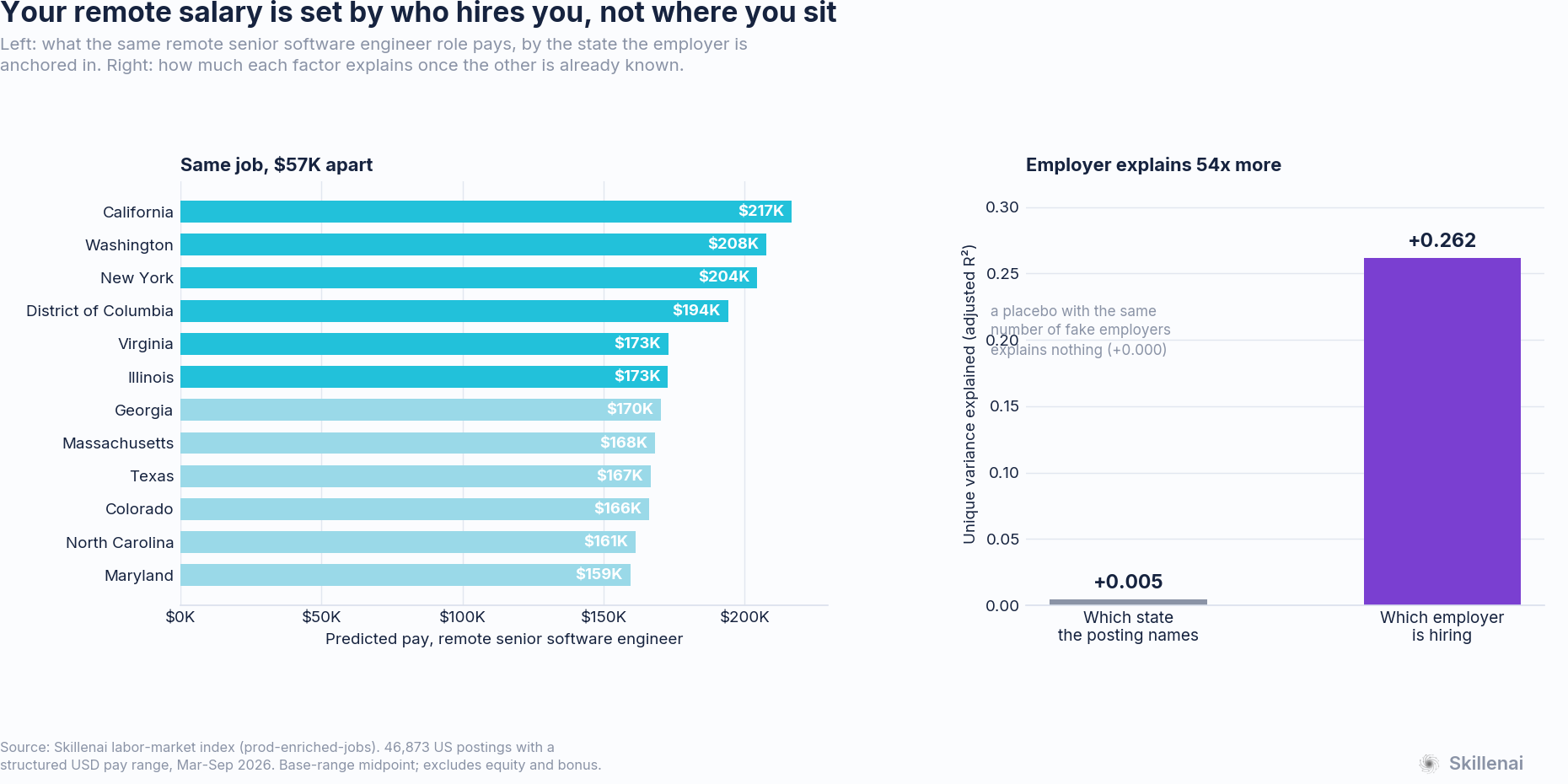
Measured against each other, the unique contributions are +0.005 for state and +0.262 for employer. About fifty-four to one.
A 495-level factor will beat a 12-level factor on degrees of freedom alone, so that comparison means nothing without a control. We built one: shuffle the company labels across postings at random while preserving the company-size distribution exactly, giving a fake employer variable with an identical parameter count. It lands at an adjusted R² of 0.416, which is the base model to three decimals. Averaged over five seeds it moves adjusted R² by +0.0001. Degrees of freedom explain none of the employer effect.
What that is worth in dollars. Hold role, rung and platform fixed and vary only the employer's anchor state:
| Employer anchored in | Predicted pay, remote senior software engineer |
|---|---|
| California | $216,534 |
| Washington | $207,776 |
| New York | $204,442 |
| District of Columbia | $194,122 |
| Virginia | $172,905 |
| Illinois | $172,743 |
| Georgia | $170,299 |
| Massachusetts | $168,111 |
| Texas | $166,734 |
| Colorado | $166,144 |
| North Carolina | $161,434 |
| Maryland | $159,452 |
Top to bottom is $57,082, or 35.8%, for the same job. That is wider than a full seniority rung, which our tech role pay analysis puts at $40K to $65K.
But almost all of that spread is which companies sit where, not location pricing. Of the 36 employers posting remote roles against three or more states, the median within-employer spread is just 7.9%. Location banding inside firms is real and small. Which firm you join is the large term.
So remote work didn't detach pay from a map. It made the employer's address the one that counts, and the employer is the part you actually choose.
Remote as a recruiting instrument
Dylan Hughes, who leads the market insights program at Sequoia and writes the Comp & Benefits, Plotted newsletter, came at the same question from the employer's side. Across 581 companies he found that AI companies are far more likely to be fully remote than other software companies at every size band: 25% against 15% under 50 employees, 15% against 9% in the 100 to 499 band, with the gap closing as headcount grows until fully remote is rare in either group past 1,000. His read is that remote is a competitive lever. AI companies already win on cash and equity, so for everyone else, offering remote is a way to stay in the fight for the same people.
Put that next to our numbers and the shape of the thing resolves. Remote is a recruiting instrument, not a pricing instrument. Companies deploy it to reach talent they would otherwise lose, and the postings show it carries almost no pay consequence when they do: +0.5% once you compare like role with like role. If remote were being priced, as a discount for cheaper geography or a premium for scarcity, it would surface in the advertised bands. It doesn't. What surfaces is which company is doing the hiring.
The two datasets are not measuring the same object. His unit is a company that is fully remote; ours is a posting labelled remote, and a company can advertise remote roles without being remote itself. But they answer adjacent halves of one question: who offers remote, and what it costs you to take it. His half says the offer is a recruiting decision. Ours says the cost is close to zero, and the thing you should actually be negotiating over is sitting somewhere else entirely.
One more thing: the bands got wider
| Work model | Median band width | Controlled vs. onsite |
|---|---|---|
| Hybrid | 26.4% | −2.2pp |
| Onsite | 28.8% | — |
| Remote | 29.1% | +1.3pp |
Band width is the advertised range divided by its midpoint. Remote postings quote wider ranges than onsite for the same role, rung, state and platform. Hybrid quotes the narrowest of all.
That is what unresolved location policy looks like in practice. A remote req that might be filled from several pay markets has more to hedge. A hybrid req tied to one office has the least. The uncertainty shows up in the spread, not the level. We flag this as a single-instrument result — it hasn't been cross-checked the way the geography finding has.
What this means for you
If you're taking a remote job: don't expect a penalty, and don't expect a windfall. Expect roughly what the same role and rung pays onsite. Do expect a wider quoted band, which means more of the outcome rides on the negotiation rather than the posting.
If you moved somewhere cheap to work remotely: your pay is indexed to your employer's market, not yours. Good news if you left San Francisco and kept the job. Bad news if you're applying fresh to a company headquartered in a low-cost state and expecting coastal pay because the listing says remote. The lever is the employer, not the move.
If you're setting comp policy: your peers are not converging on a national scale. The geographic structure in remote pay is as strong as it is for onsite roles, and most of it is between-company rather than within. Whatever your location policy says, the market is still pricing by employer address.
If you're optimizing for pay: rank the levers honestly. The rung is worth ten times the work model, and the employer's anchor market is worth more than a rung. Going remote is close to free either way. Choosing which company to go remote for is the expensive decision.
Methodology
46,873 US postings from the Skillenai labor-market index carrying a structured USD pay range, a work-model label and a usable seniority rung, collected March to September 2026. The measure is the midpoint of the advertised base range and excludes equity and bonus — which is exactly where a location policy might live instead, so treat this as a floor on geographic effects, not a ceiling.
Models are OLS on log midpoint with HC1 robust standard errors, controlling for role family, seniority rung, state and posting source. Geographic premiums are residuals from a role-family + rung + platform model, aggregated to states with at least 150 postings. Pass-through is a postings-weighted fit of remote-on-onsite state premiums, tested against both slope = 0 and slope = 1.
Hourly ranges are annualized at ×2080; weekly and monthly ranges are undecidable and dropped. The known carpet-bombing spam employer is excluded. Maryland is excluded from the pass-through fit — its onsite postings are dominated by cleared defense work that is well paid and onsite by necessity, making the two work modes different populations rather than one population under different terms. Excluding it strengthens the result; including it gives slope 1.37 and changes no conclusion.
This is a cross-section, not a trend. Too few postings carry a trustworthy original posting date across a wide enough window to say anything about change over time. Nothing here is a claim about remote work rising or falling.
The index is sourced from applicant-tracking feeds and skews toward technology and startup employers, so these are not broad-economy figures. And these are advertised ranges — what employers publish, not what anyone accepted.