
Pay Transparency by State: What 118,706 Job Postings Reveal
Get an email when we publish a new post. No account needed, unsubscribe anytime.
The short answer, by state
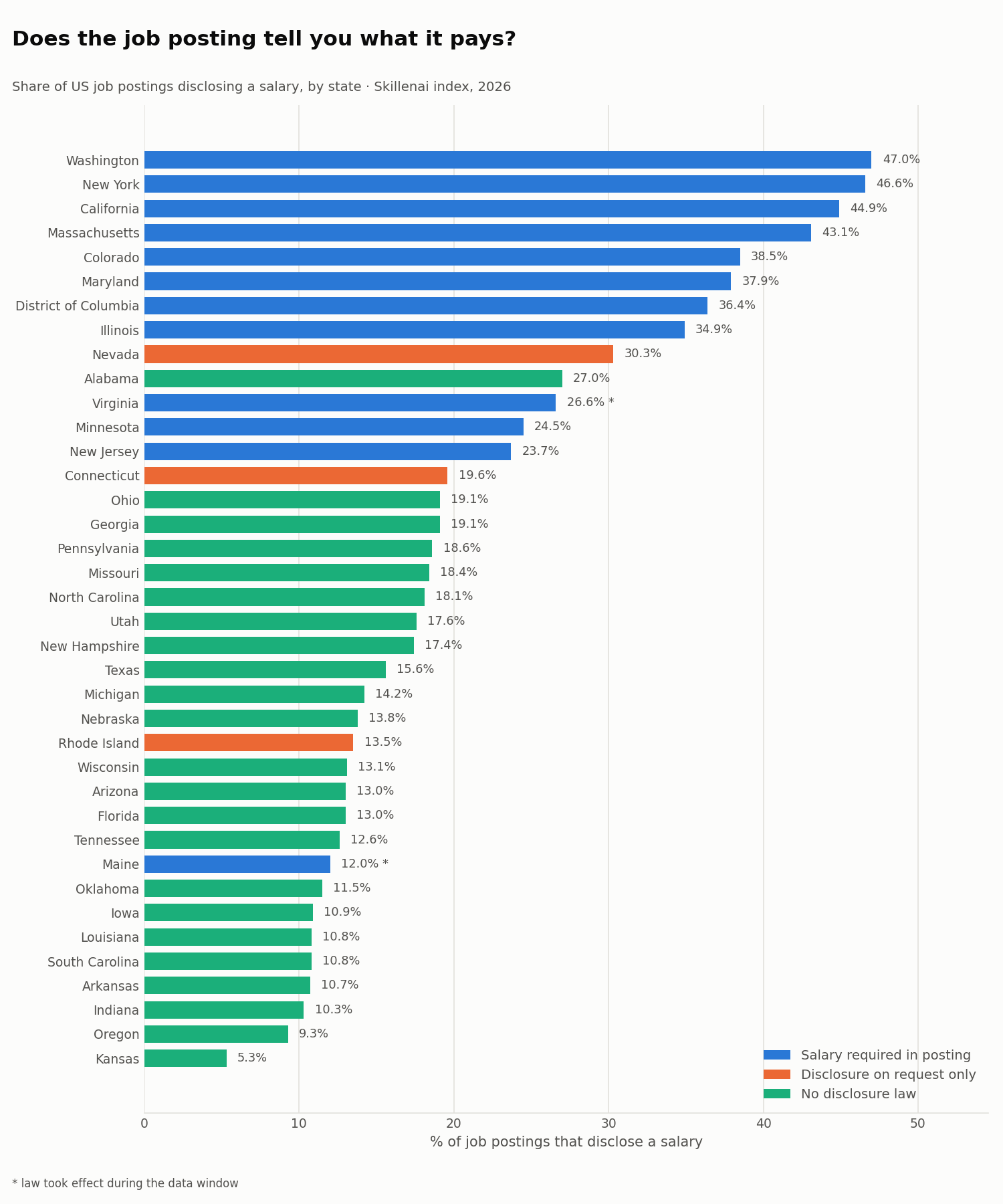
| Where you're applying | States | Postings | Show a salary |
|---|---|---|---|
| Salary required in the posting | 10 | 84,917 | 43.3% |
| Disclosure on request only | 3 | 1,243 | 22.3% |
| No disclosure law | 23 | 28,518 | 15.6% |
The top of the table is entirely mandate states: Washington 47.0%, New York 46.6%, California 44.9%, Massachusetts 43.1%. The bottom is entirely states with no law: Kansas 5.3%, Oregon 9.3%, Indiana 10.3%, Arkansas 10.7%.
North Carolina sits at 18.1%. Texas at 15.6%. Florida at 13.0%.
A wave that is still moving
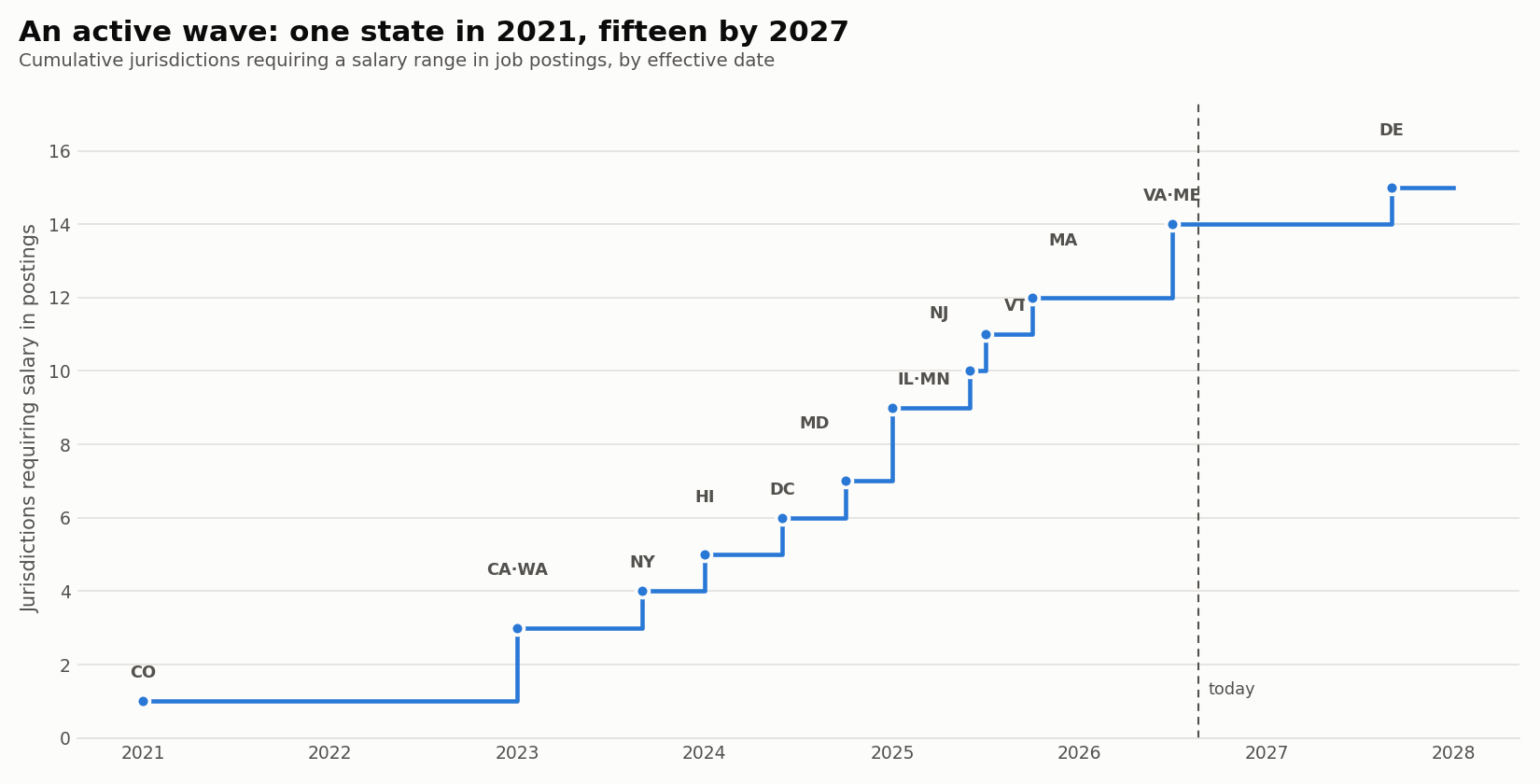
Colorado went first in 2021 and stood alone for two years. Then California, Washington and New York in 2023. Hawaii, DC and Maryland in 2024. Illinois, Minnesota, New Jersey, Vermont and Massachusetts in 2025.
Virginia's took effect July 1, 2026. Maine's followed on July 28. Delaware's arrives in September 2027.
Fourteen jurisdictions require pay in the posting today. Five years ago, none did.
The mandate gap
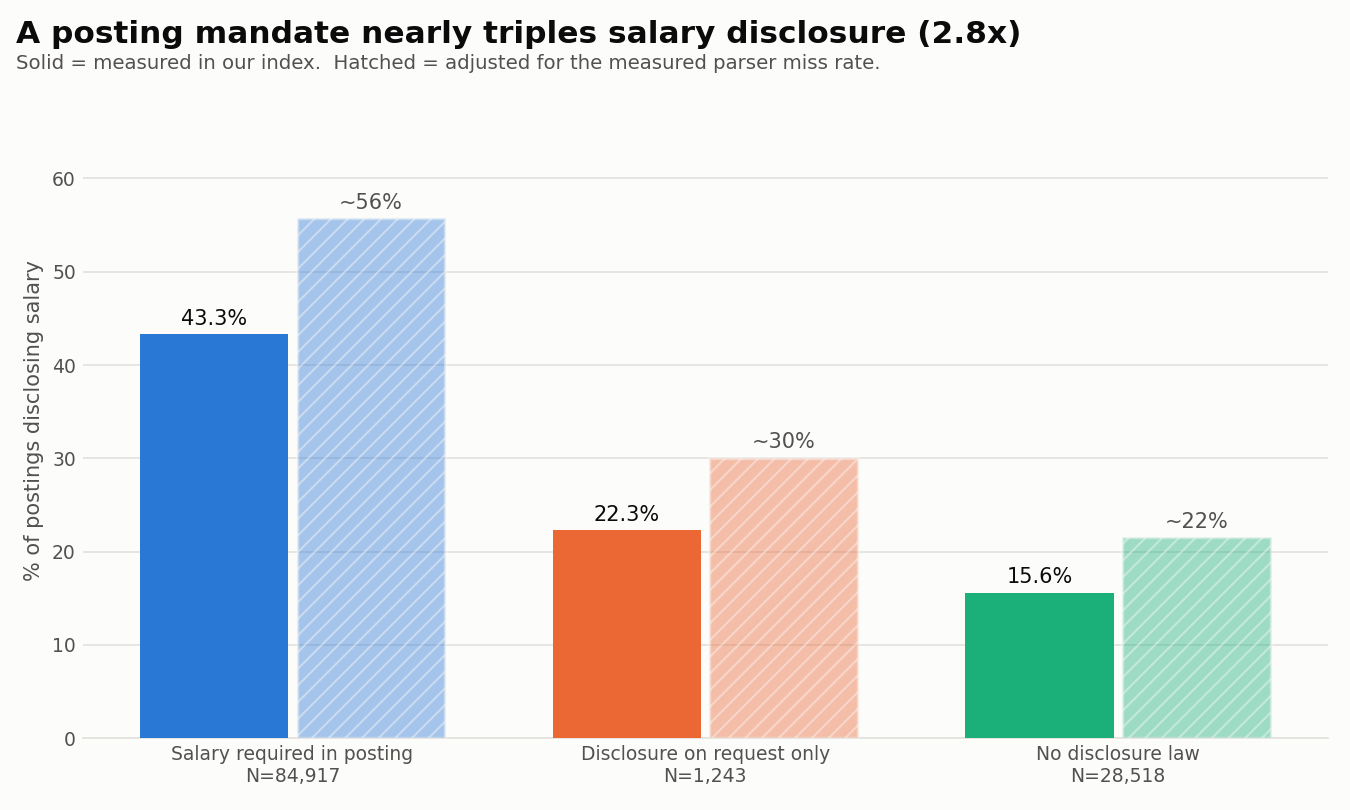
A posting mandate is associated with 2.8x the disclosure rate — 43.3% versus 15.6%. A chi-square test across the three groups returns χ² = 7,188 (p ≈ 0), with a Cramér's V of 0.25.
The middle category is the interesting confirmation. Connecticut, Nevada and Rhode Island require disclosure only if you ask, or after an offer. They land at 22.3% — between the mandate states and the no-law states. A weaker rule produces a weaker result, which is what a real policy effect should look like.
One state breaks the pattern, and it is worth naming rather than hiding. Alabama has no disclosure law and discloses at 27.0% — higher than mandate states New Jersey (23.7%) and Minnesota (24.5%). Alabama's sample is small, and a few large employers can move a state that size. But it is a genuine exception.
So why isn't it 100% where the law requires it?
This was the question we kept asking our own numbers. Four things stack up, and only one of them is employers ignoring the law.
Small employers are exempt. Nearly all of these laws have an employee-count floor: New York 4+, New Jersey 10+, California, Washington and Illinois 15+, Massachusetts 25+, Minnesota 30+, Hawaii 50+. Colorado and Virginia cover essentially everyone.
Minnesota is the cleanest illustration. It has the highest threshold of any mandate state at 30 employees — and it sits near the bottom of the mandate group at 24.5%.
The law follows the job, not the employer. These statutes cover roles performed, or performable, in the state. An out-of-state company hiring for an out-of-state role isn't covered just because the listing shows up in your local search.
Some employers simply don't comply. The Federal Reserve Bank of New York studied this directly and found compliance tops out around 76% among covered postings. Enforcement is largely complaint-driven — somebody has to notice and file.
And some of the gap is us. Our parser doesn't catch every range that appears in posting text. We measured that rather than assuming it: in mandate states, 22.0% of postings we recorded as "no salary" did contain a range we'd missed; in no-law states, 7.0%. Correcting for it lifts the mandate group to roughly 56% and the no-law group to roughly 21% — which barely moves the ratio.
The honest read: in a mandate state, your odds of seeing pay before you apply are about a coin flip. In a no-law state, closer to one in five.
What this means if you're job hunting
Know which regime you're in. If you're applying in Washington, New York, California or Massachusetts, a posting with no salary is now the exception — and worth asking about directly, because the employer may be out of compliance or may be exempt.
If you're in a no-law state, budget for the conversation. At 10–18% disclosure, you will usually be negotiating without an anchor. Sites that aggregate self-reported pay are doing more work for you there than they are in Seattle.
Remote roles can inherit stronger rules. California and Washington laws reach jobs that could be performed in-state, which is why remote postings from covered employers often carry ranges regardless of where you sit.
If your state just changed, the postings haven't caught up yet. Virginia's mandate is seven weeks old as of writing. Expect a lag.
What this analysis cannot tell you
We cannot prove the laws caused the gap. This is a snapshot, not a before-and-after — our index doesn't reach back before these laws took effect, so we can't watch a state's rate rise on its effective date.
That matters, because the mandate states are also states with pre-existing pro-labor policy cultures. They may have disclosed more before their laws, with the statute codifying a norm rather than creating it. We can't separate those two stories here, so we describe this as mandate states disclose more — not mandates cause disclosure.
Outside research does support the causal reading. An NBER study found transparency laws increased postings with salary ranges by about 30 percentage points, and the NY Fed observed a roughly 20-point jump at implementation. Our cross-sectional gap of about 28 points is the same order of magnitude. But that is corroboration from other people's research designs, not proof from ours.
Two more limits. This is a tech-and-professional index, not the whole labor market — levels will differ in retail, hospitality and the trades, even though the legal boundary applies to all of them. And we measure what employers post, not what they'd tell you if you asked.
Methodology
Disclosure is defined as a populated structured salary field, not a text match on the posting body.
We restricted the analysis to job boards where our salary extraction is known-reliable, and excluded three sources whose posting text we don't fully capture — including them would have understated disclosure in whichever states use them most. We also excluded federal USAJOBS postings: federal pay is public by statute rather than state law, and including them would have inflated DC, Maryland and Virginia for reasons unrelated to state policy.
Job-board republishers that re-list other companies' jobs without pay data were filtered out by name and structure. We deliberately did not filter employers by their disclosure rate — that would select on the outcome variable and mechanically inflate the result. Several large defense and semiconductor employers that genuinely never post salary remain in the data, because that's a real finding rather than contamination.
We also dropped nine ambiguous city names that our geocoder resolves to a single default state, discarding the state present in the source text. Statistics: chi-square test of homogeneity, Cramér's V for effect size, and 95% confidence intervals on each state proportion. States with fewer than 200 postings are excluded.
Full methodology, per-state CSV, and the reproducible analysis script