
Software Engineer Pay vs. Company Trajectory in 2026: Why the Offer Number Isn't Enough
Get an email when we publish a new post. No account needed, unsubscribe anytime.
Pay barely predicts a company's trajectory
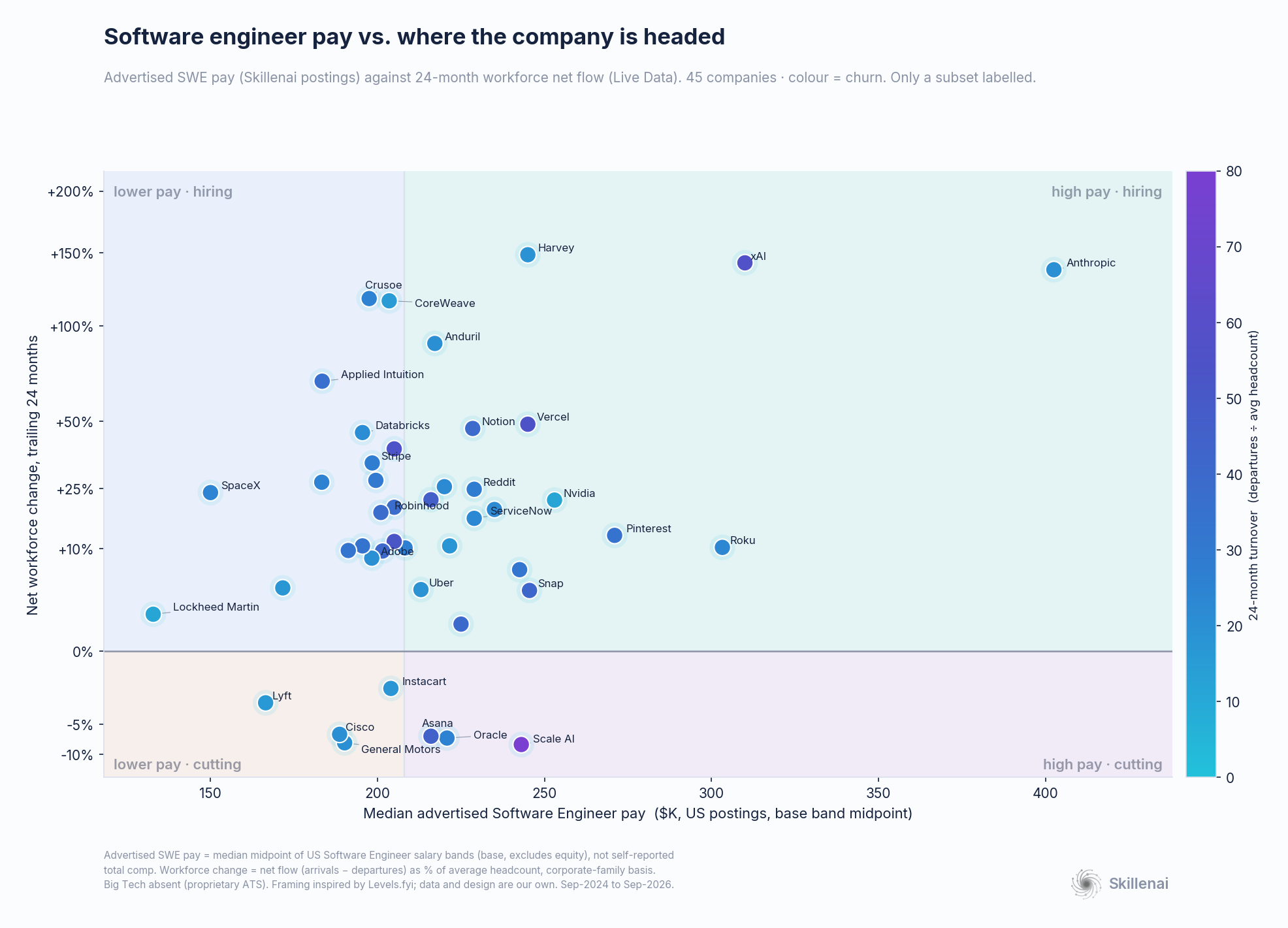
Advertised SWE pay and 24-month workforce change are, statistically, unrelated across these 45 companies. High pay isn't a warning sign, and it isn't a safety signal either — the two axes are essentially independent. The information you actually want is where a company sits on the map, not the size of the offer.
Three AI labs, three completely different bets
The high-pay, still-hiring corner is full of AI labs — but they are not the same bet:
- Anthropic — the richest advertised pay in the set (\~$402K base band), +138% headcount, and low \~20% turnover. Rich, growing, and retaining.
- xAI — the single highest advertised pay ($310K), growing +142% — but 56% turnover, the signature of a company scaling explosively and cycling through people just as fast.
- NVIDIA — $253K, +22% growth, and the lowest turnover in the set (11%): well-paid, growing, and stable.
Same neighborhood on a pay chart. Very different places to actually spend three years.
Scale AI: the big check with the big cut
The company that most needs the second number is Scale AI: top-tier advertised pay (\~$243K), but net-negative headcount and 82% turnover — the highest churn in the entire set — with a median tenure of just 8 months.
Is that churn just people relabeling to Meta after the 2025 deal? It isn't. Of 372 leavers with a recorded next employer, the #1 destination is Mercor, a direct data-labeling rival — Meta is only about 13%, and no single destination accounts for more than 15%. It reads as a genuine unwinding: after the Meta stake, customers pulled work, and talent dispersed to the competitors who picked it up.
The signals a layoff flag can't see
Because we measure continuous flow rather than a yes/no layoff, we can add two things a binary "did they lay off?" can't.
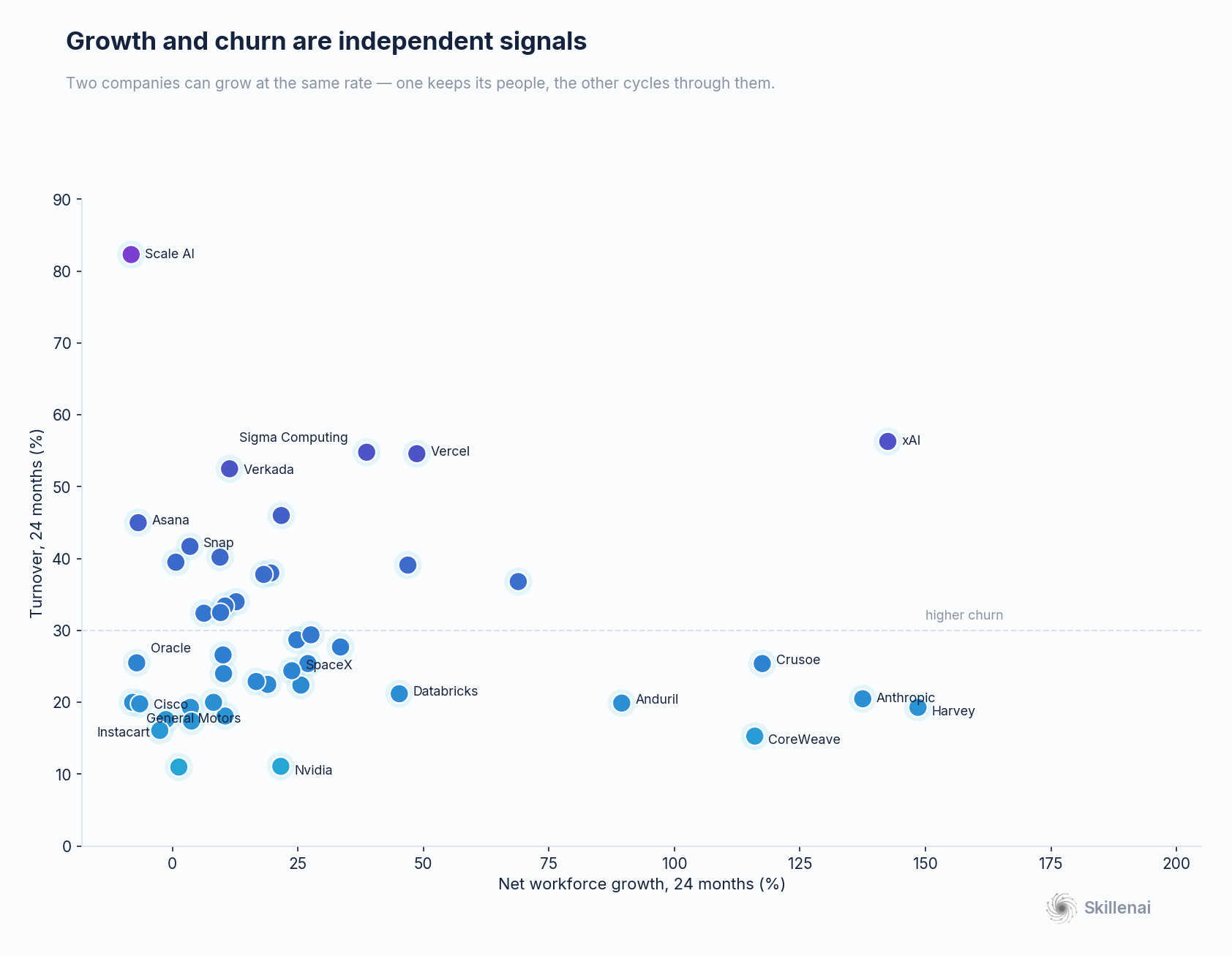
Growth and churn move independently. Two companies can grow at the same rate and be opposite bets: Databricks (+45%, \~20% turnover) is durable growth; Vercel (+49%, \~55% turnover) is hire-and-replace. The clean durable-growth cluster — fast growth, low churn — is Anthropic, NVIDIA, Anduril, CoreWeave, Databricks, and Harvey.
Not all shrinking looks alike, either. Scale AI is shrinking with an 8-month median tenure — rapid, in-and-out churn. General Motors and Cisco are also shrinking, but at roughly 24-month tenure — the slow decline of a long-tenured workforce. Same direction on the map, opposite mechanism underneath.
Legacy giants drift, new defense-tech climbs
The cutting side of the map holds the established names: Oracle (−7%), General Motors (−8%), Cisco (−7%), Lyft, Instacart. Against them, a new-defense and hard-tech cluster is hiring hard at mid-market pay: Anduril (+89%), Applied Intuition (+69%), Axon (+27%), SpaceX (+24%), Skydio (+20%). Old defense sits flat; new defense is one of the fastest-growing corners on the chart.
What this means for your career
- Read the map, not the offer. Two offers at the same number can sit in opposite quadrants.
- Ask about net headcount and turnover, not just "are you hiring." Gross hiring hides churn.
- Among the AI labs, retention is the differentiator — the pay is uniformly high; the churn is not.
- A big check at a shrinking, high-churn company is exactly the case the offer number can't warn you about.
Method
Pay is the median midpoint of advertised US "Software Engineer" salary bands (base; excludes equity and self-reported figures) from the Skillenai job index — a forward-looking measure of what companies are offering now, distinct from self-reported total compensation. Workforce trajectory is net flow (arrivals − departures) over 24 months as a share of average headcount, from a supply-side workforce panel from Live Data Technologies; turnover and tenure from Skillenai's talent graph corroborate it. Big Tech (Google, Meta, Apple, Microsoft, Amazon) is largely absent from the pay axis because those firms hire through proprietary applicant systems, so the set skews scale-up and defense-tech, and per-company samples are modest — treat positions as directional. Full methodology and the complete 45-company table are in the companion repository.