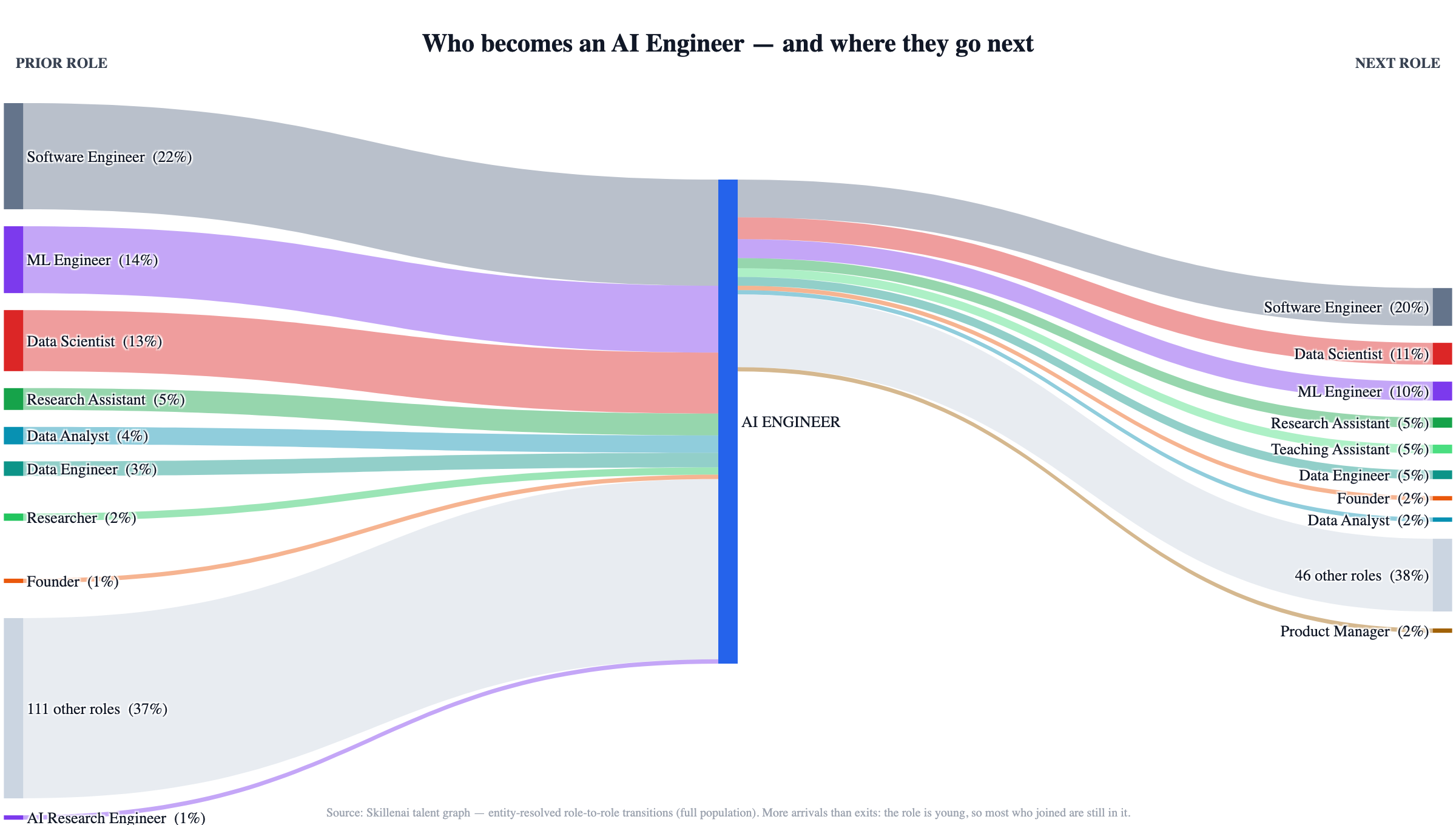
Who Becomes an AI Engineer — and Where They Go Next
We mapped the AI Engineer role from both sides — Skillenai's talent graph and job postings. Who feeds it, where they go next, and why the skills employers ask for don't match what workers list.
Posts tagged AI Engineer.

We mapped the AI Engineer role from both sides — Skillenai's talent graph and job postings. Who feeds it, where they go next, and why the skills employers ask for don't match what workers list.

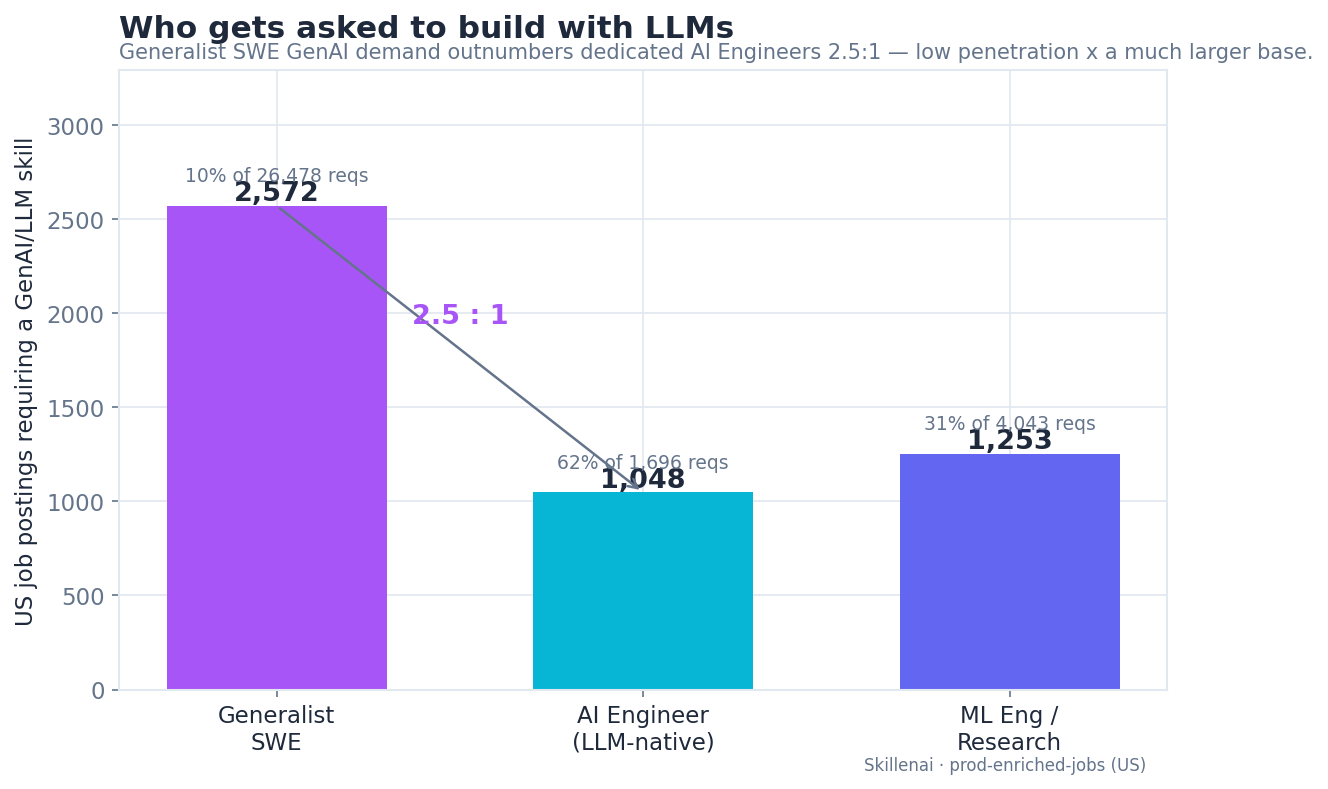
US employers ask 2.5x more generalist software engineers than AI engineers to build with LLMs, and the generalists do it in TypeScript and Ruby, without LangGraph. A demand-side look at who really builds AI.

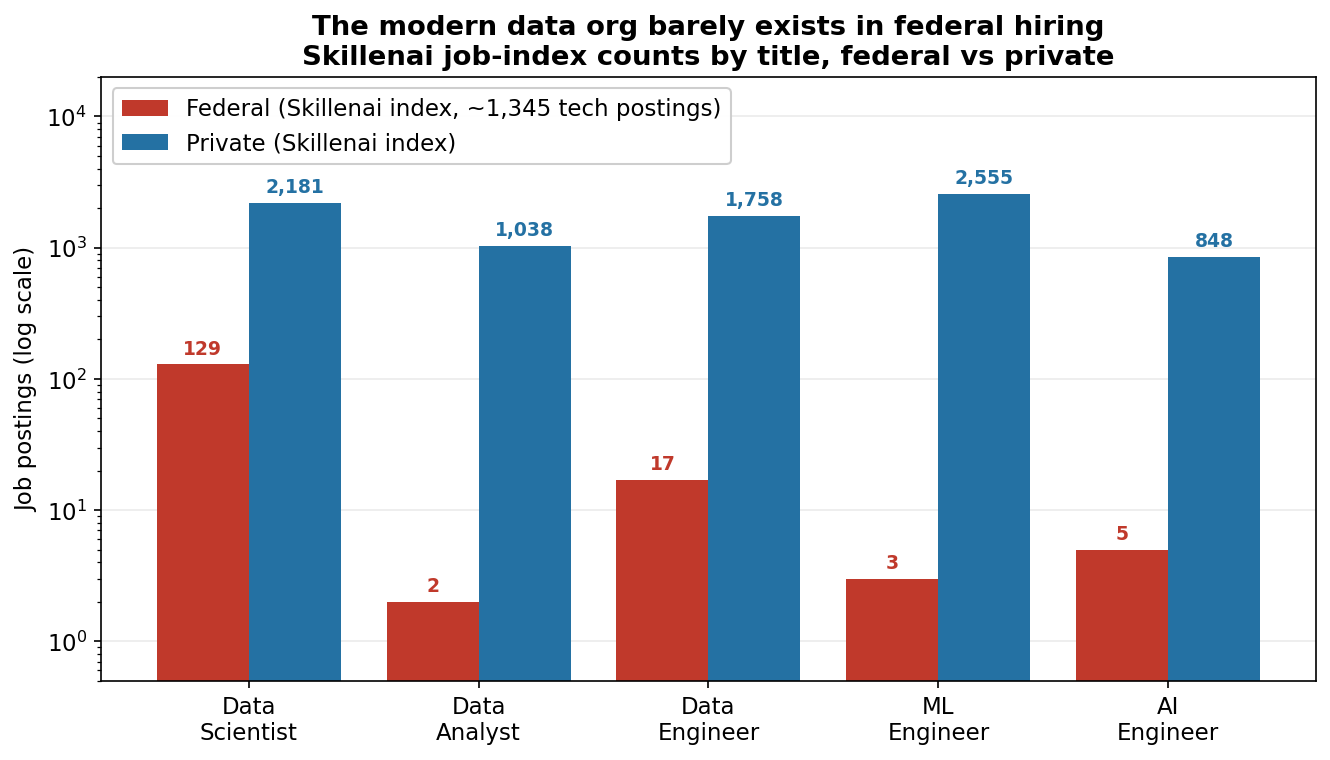
Under identical titles, federal and private tech postings ask for different tools — a federal Data Scientist does statistics and reporting where a private one ships Python and experiments — and several modern data roles barely exist as federal jobs.

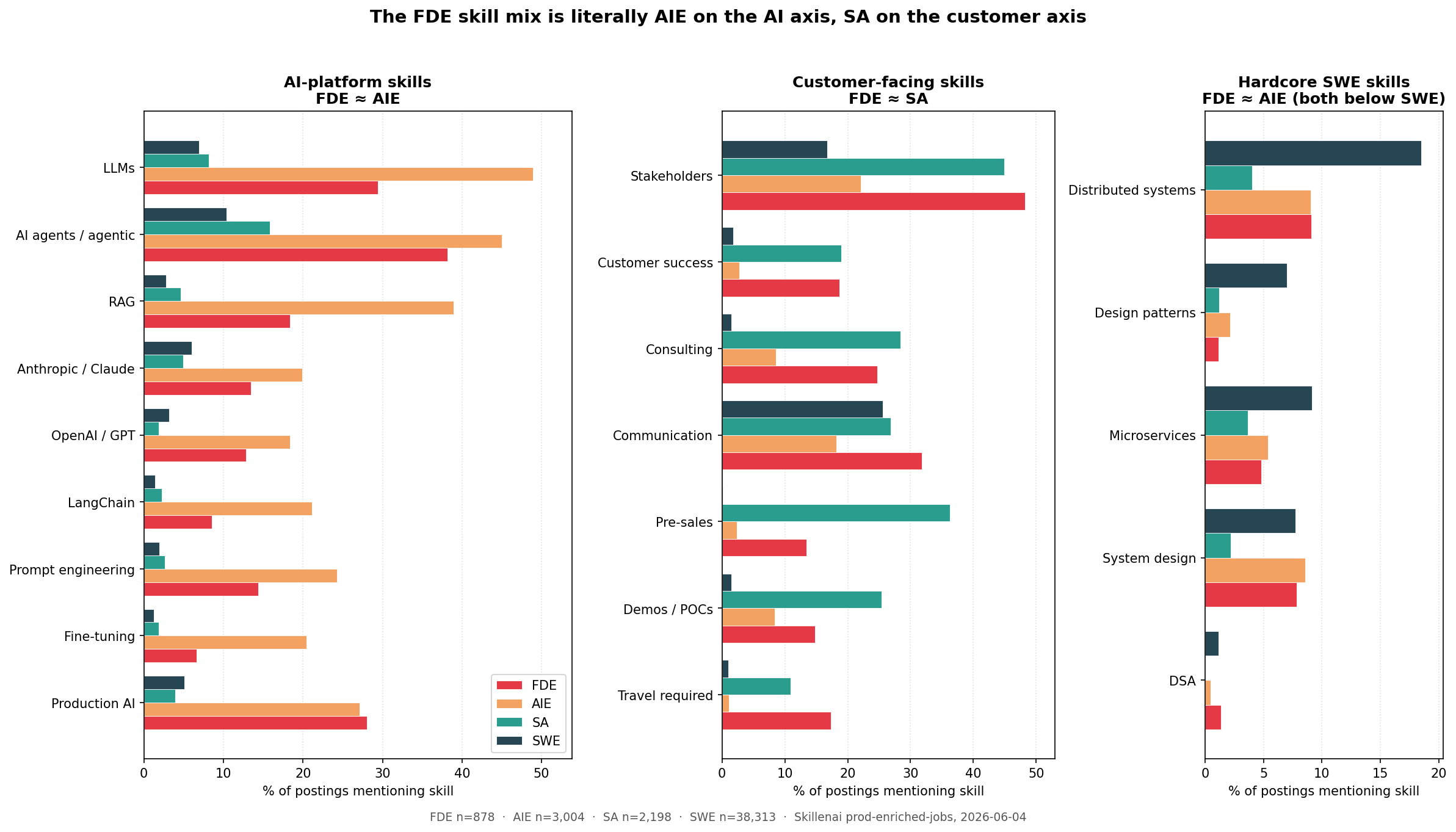
I tested my analogy that Forward Deployed Engineers are to AI Engineers what Solutions Architects were to Software Engineers. Across ~44K postings, the data agrees: FDE is literally AIE on the AI axis, SA on the customer axis. Plus, two twists I didn't expect.

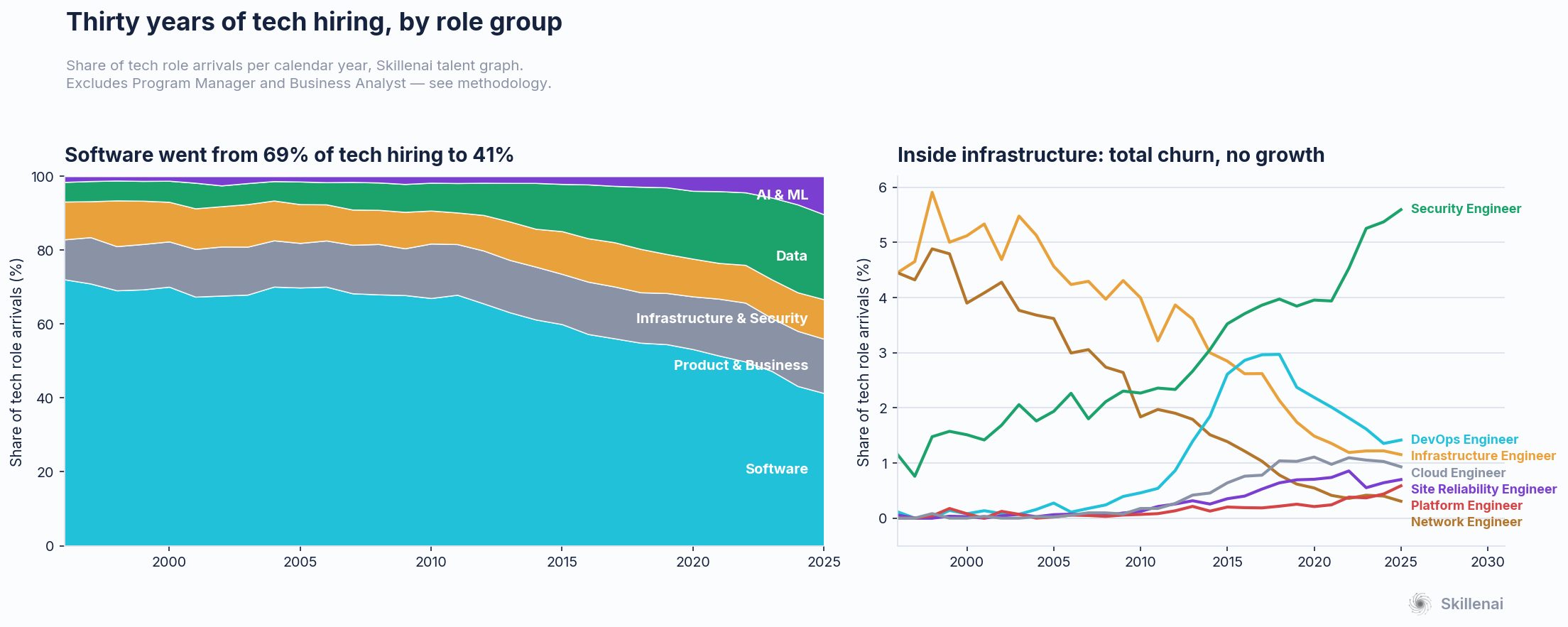
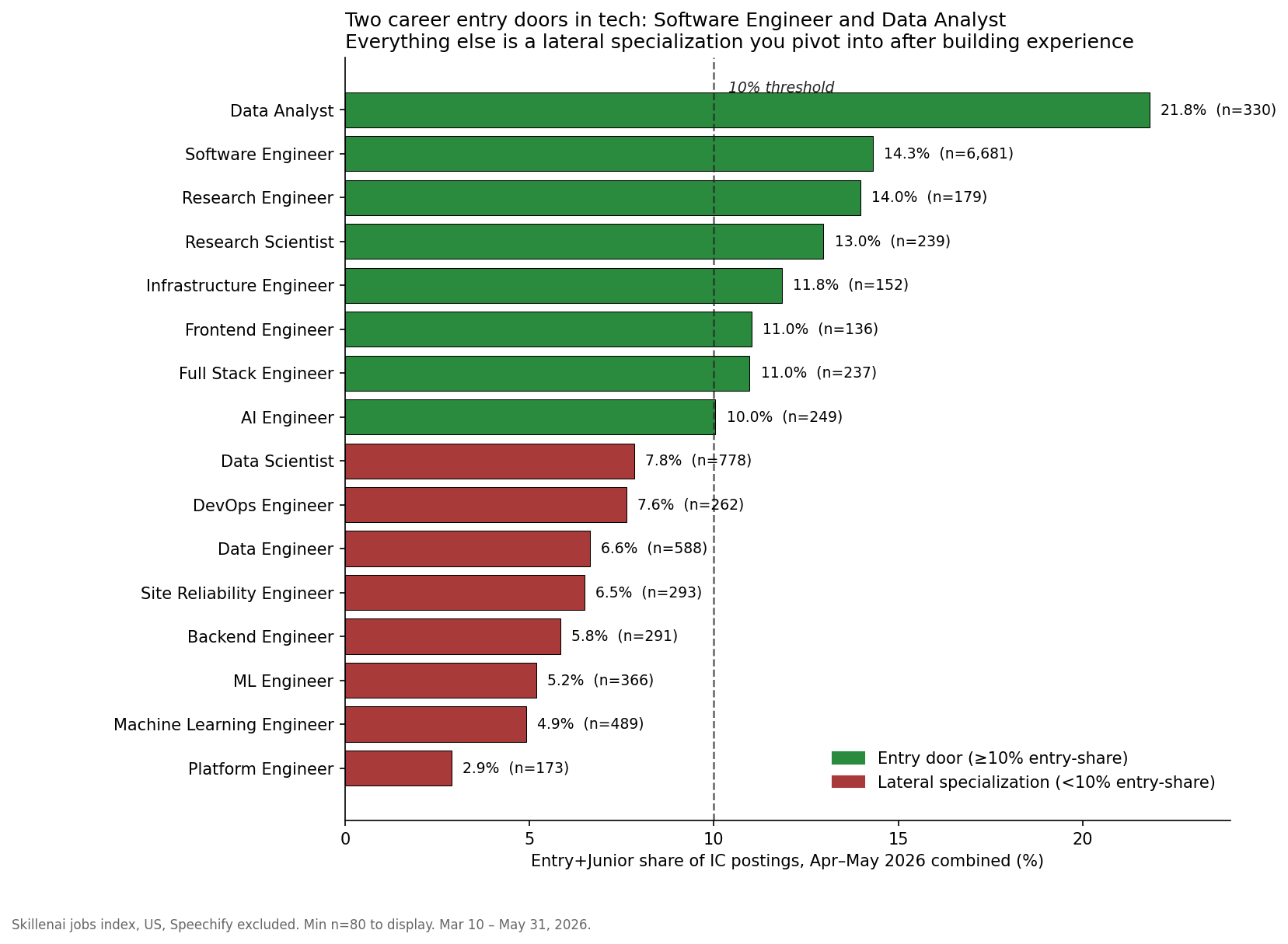
Fortune today: spring 2026 hiring is broad-based. Jensen Huang: "software engineers are increasing." Both right at the aggregate. Drop a level and our US tech corpus shows tech has roughly two career-entry roles — Software Engineer and Data Analyst — and a longer list of post-experience lateral specializations (MLE, Platform, SRE, Backend).

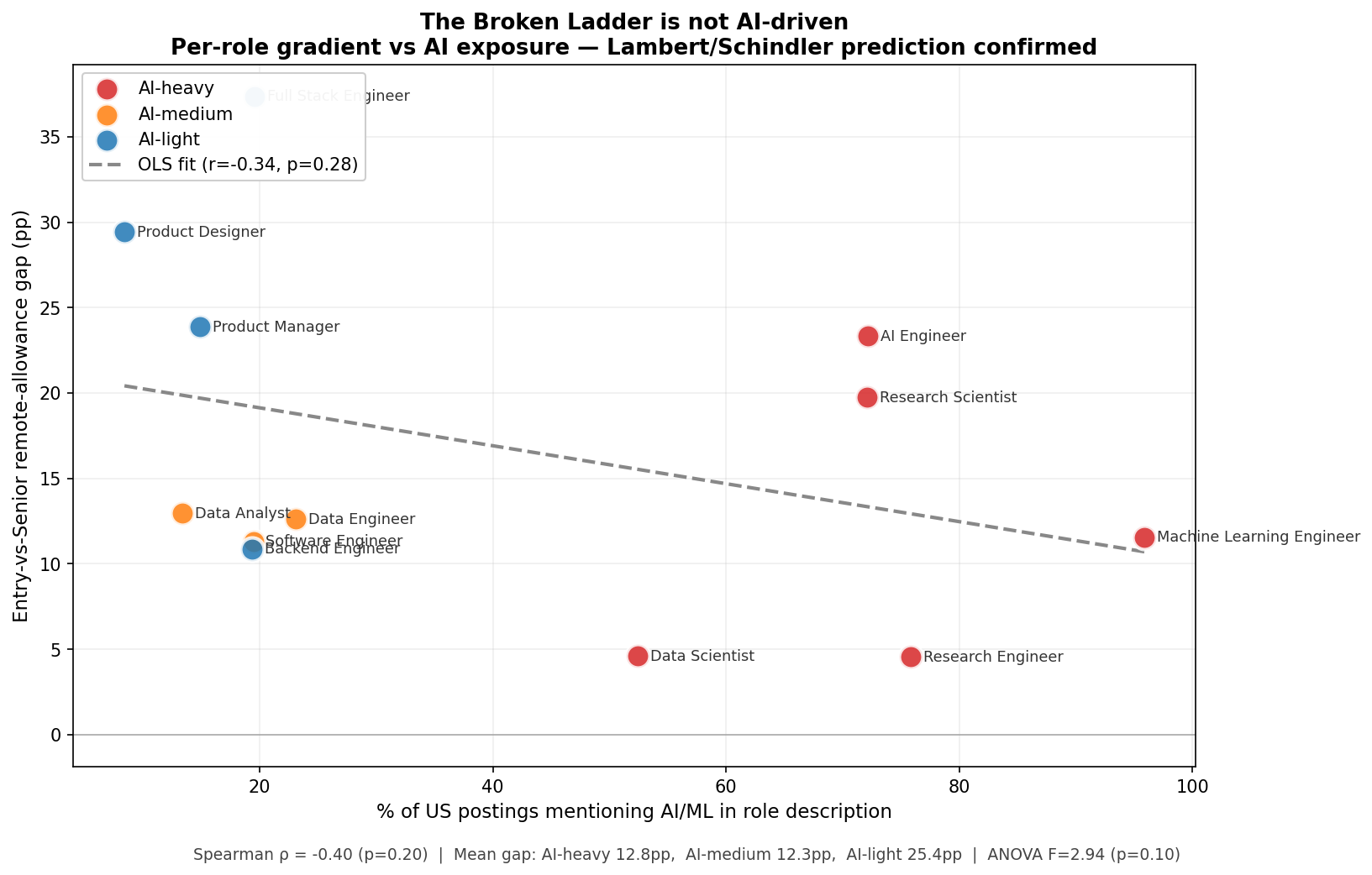
A new LSE working paper used 243M hire records to argue remote work — not AI — caused the entry-level hiring collapse. We tested the prediction in today's US tech job postings, role by role. Every Bonferroni-significant broken ladder is in an AI-light role.

A new NY Fed study argues remote work, not AI, drives most of the post-pandemic rise in youth unemployment. 50,757 US tech postings show the matching supply-side fingerprint: % postings allowing remote rises monotonically from 24.6% at intern to 62.3% at staff, and the gradient holds inside every tech role.

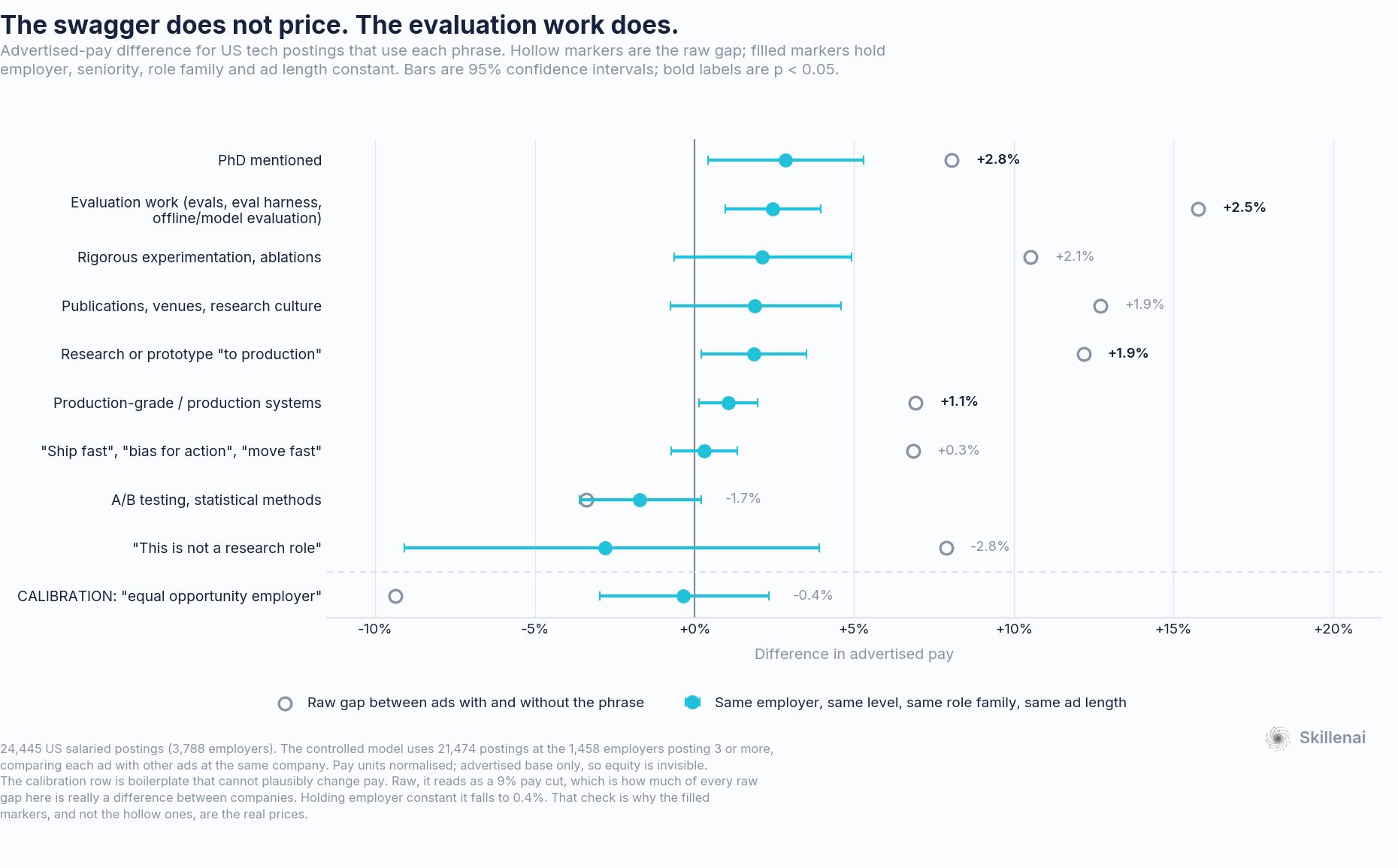
We swept 156,928 job postings and 435,000+ blog and news articles for ~90 LLM-eval frameworks and ~55 evaluation methodologies. The result: hiring names a tiny tool set (LangSmith + Langfuse = 56% of all eval-tool mentions; no framework over 1%), practitioners are converging on LLM-as-a-judge with a rubric, and the benchmarks the press argues about — SWE-bench, MMLU, GPQA — show up in roughly zero job descriptions.

We scored 222 AI/ML/DS skills on five independent difficulty signals. Out of 222, exactly one scores positive on all five: JAX — Google's numerical-computing library that powers Gemini, Gemma, and parts of Claude.

We analyzed 9,000+ job postings across DS, MLE, AIE, Applied Scientist, and Research Scientist. The popular DS-to-AI Engineer narrative has the geometry backwards: it's the longest jump on the board. The shortest jumps run through the training-flavored half of ML Engineer.