
Two career entry doors in tech: Software Engineer and Data Analyst
Get an email when we publish a new post. No account needed, unsubscribe anytime.
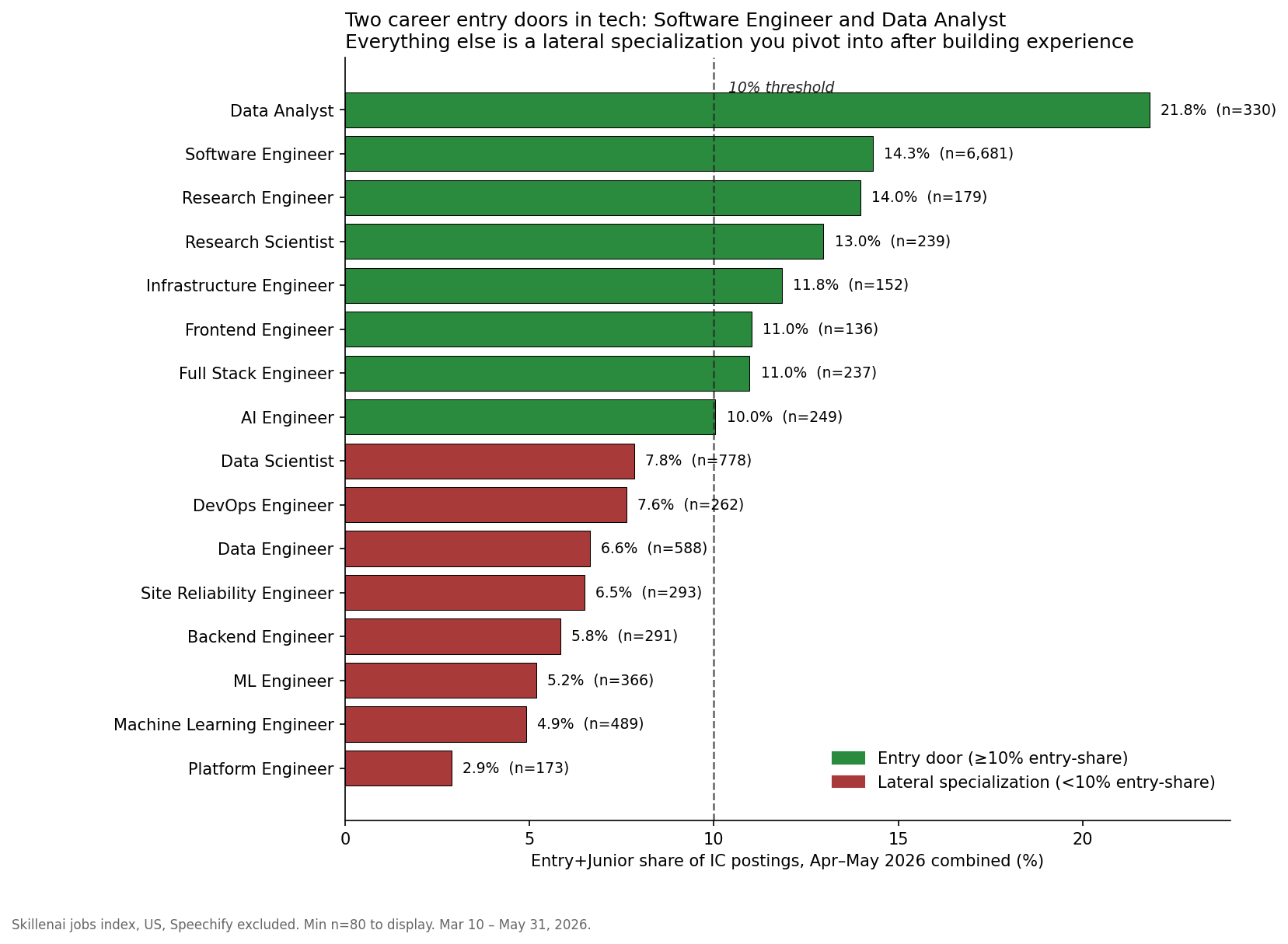
Two entry doors, eight lateral roles
Per-role entry+junior share of US tech IC postings, Apr–May 2026 combined (min n=80):
| Role | n | Entry+Junior |
|---|---|---|
| Data Analyst | 330 | 21.8% |
| Software Engineer | 6,681 | 14.3% |
| Research Engineer | 179 | 14.0% |
| Research Scientist | 239 | 13.0% |
| Infrastructure Engineer | 152 | 11.8% |
| Frontend Engineer | 136 | 10.8% |
| Full Stack Engineer | 237 | 10.5% |
| AI Engineer | 249 | 10.4% |
| — 10% threshold — | ||
| Data Scientist | 778 | 7.8% |
| DevOps Engineer | 262 | 7.6% |
| Data Engineer | 588 | 6.5% |
| Site Reliability Engineer | 293 | 6.1% |
| Backend Engineer | 291 | 5.8% |
| ML Engineer | 366 | 5.2% |
| Machine Learning Engineer | 489 | 4.9% |
| Platform Engineer | 173 | 2.9% |
Above the 10% line: roles companies will hire you into out of school. Below the line: roles companies fill from your existing tech career — lateral specializations, not entry points.
A few non-obvious points:
- Data Analyst is the most entry-receptive technical role in the dataset. At 21.8% entry-share it sits well above SWE's 14.3% — for someone who wants into tech but isn't anchored on a CS-major path, DA is the broadest open door.
- Generic Software Engineer is the largest role in the data (6,681 postings) and the dominant engineering entry door. Its 14.3% entry-share applied to that volume produces roughly 3x more entry-level openings than the next five entry-receptive roles combined.
- Backend Engineer (5.8%) sits with the lateral roles; Frontend (10.8%) is an entry door. Opposite of common career intuition — the tech on-ramp goes through frontend or full-stack first, with backend specialization coming later.
- AI Engineer (10.4%) sits just above the threshold; MLE (5.2%) and Machine Learning Engineer (4.9%) sit well below. The new "AI Engineer" label is more entry-receptive than the older ML titles — but only barely. Both are dominated by lateral hires.
- Research Scientist (13.0%) and Research Engineer (14.0%) read as "entry doors," but the entries are from graduate programs, not undergraduate first jobs.
SW Eng core carries the entry pipeline at the group level
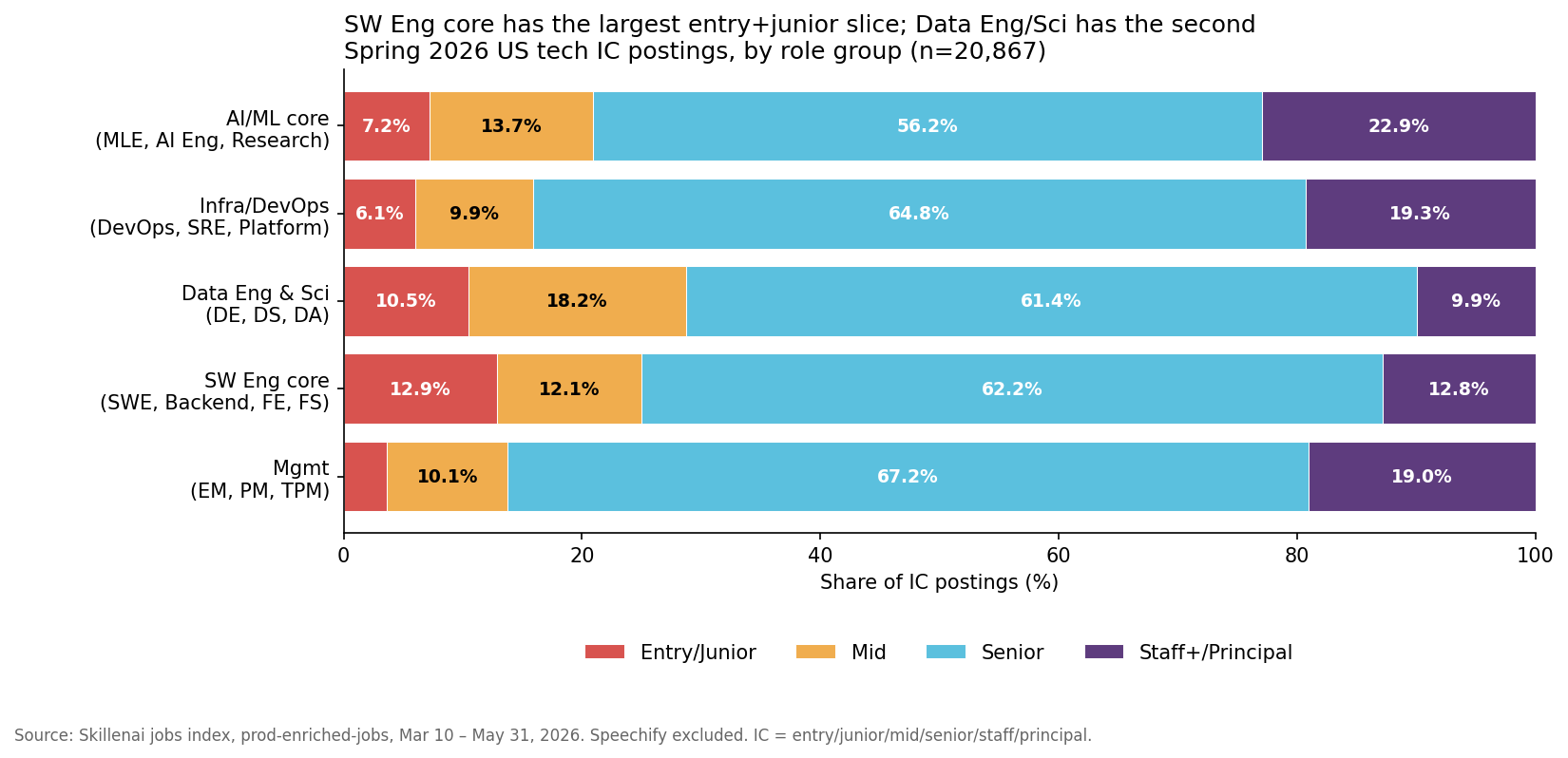
Roll roles up into families and the same story shows at a different scale:
| Role family | Entry+Junior | Mid | Senior | Staff+/Principal | n |
|---|---|---|---|---|---|
| SW Eng core (SWE, Backend, FE, FS) | 12.9% | 12.1% | 62.2% | 12.8% | 11,223 |
| Data Eng & Sci (DE, DS, DA) | 10.5% | 18.2% | 61.4% | 9.9% | 2,372 |
| AI/ML core (MLE, AI Eng, Research) | 7.2% | 13.7% | 56.2% | 22.9% | 2,518 |
| Infra/DevOps (DevOps, SRE, Platform) | 6.1% | 9.9% | 64.8% | 19.3% | 1,370 |
| Mgmt (EM, PM, TPM) | 3.7% | 10.1% | 67.2% | 19.0% | 3,384 |
SW Eng core carries the entry pipeline for the whole tech ladder: 12.9% entry-share across 11,223 IC postings. That's the bucket Huang's "software engineers are increasing" claim most plausibly points at — and it's the bucket new grads should be aiming for.
The entry door widened slightly April → May
April → May, both SW Eng and AI/ML cores showed a statistically significant entry-share gain:
| Group | Apr early% | May early% | Δ | χ² | p |
|---|---|---|---|---|---|
| AI/ML core | 6.4% | 9.9% | +3.5pp | 6.73 | 0.009 |
| SW Eng core | 12.9% | 14.9% | +2.0pp | 6.29 | 0.012 |
Fortune's read holds at the door: the SW Eng entry-share widened to 14.9% in May. AI/ML's lateral-only structure didn't change. The lateral roles stayed lateral.
What this means
- For new grads: the highest-probability entry doors into tech are Software Engineer (huge volume, 14.3% entry-share) and Data Analyst (highest entry-share at 21.8%). Aim there first. MLE, Platform Engineer, SRE, and Backend Engineer postings are mostly looking for lateral candidates with prior experience — not your first stop.
- For Huang's claim: generic SWE is the engineering role most plausibly meant by "software engineers are increasing," and it both holds the largest entry door in the corpus and widened that door April → May (12.9% → 14.9% entry-share). On that read he's right.
- For Fortune's framing: the opening is reaching the entry rung — visible at SW Eng core's 14.9% May entry-share. The aggregate read holds with role-level texture.
- For the broken-ladder thesis (broken-ladder-roles, 2026-06-02): the entry-share squeeze applies at the actual entry doors — SWE, DA, Frontend, Research. The low entry-share at MLE / Platform / SRE / Backend isn't broken-ladder evidence; those roles structurally hire laterally, not from the new-grad pool.
Methodology
- Index: Skillenai jobs index (
prod-enriched-jobs), snapshot 2026-06-03; 83,550 US postings ingested 2026-03-10 → 2026-06-03 after Speechify exclusion. - IC track:
seniorityLevel ∈ {entry, junior, mid, senior, staff, principal}. Management and intern excluded. - 10% entry-share threshold is descriptive, not normative — it happens to land on a clean gap in the per-role distribution. A 8% or 12% threshold would reshuffle a couple of borderline roles but not the headline.
- Stats: 2x2 chi-square of independence for within-group Apr-vs-May temporal change.
- No YoY comparison. Our ingest window starts 2026-03-10. The reading here is structural ("which roles are entry vs lateral right now"), not trend.
- Big Tech coverage gap. Google, Apple, Microsoft, Netflix, Nvidia mostly absent (proprietary ATS). New-grad SWE programs at those companies are not in the data; their inclusion would likely raise SW Eng entry-share further.
Full analysis, data files, and statistical detail on GitHub.