
Same Job Title, Different Job: Inside Federal vs Private Tech Hiring
Get an email when we publish a new post. No account needed, unsubscribe anytime.
The roles that barely exist
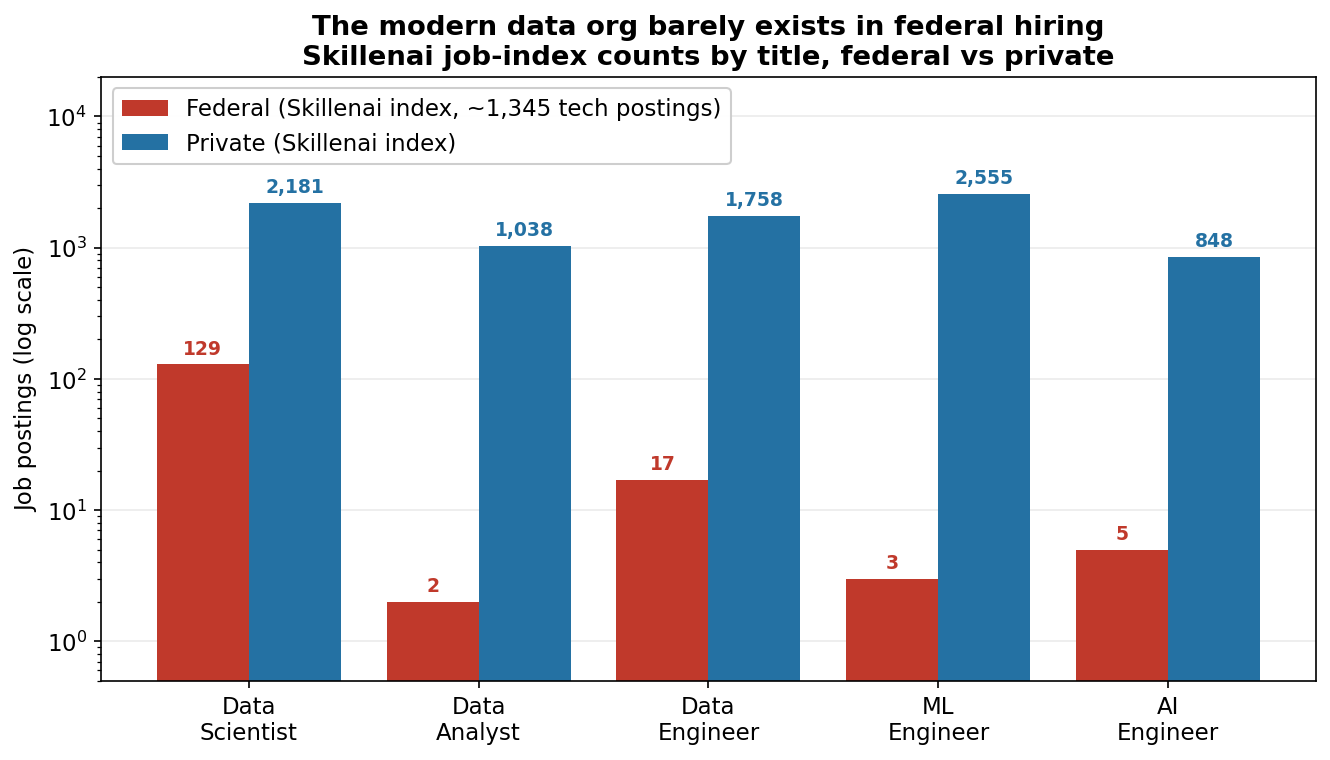
How many of each data role does federal hiring actually post? In our federal tech index (~1,345 postings) versus the private index:
| Title | Federal | Private |
|---|---|---|
| Data Scientist | 129 | 2,181 |
| Data Analyst | 2 | 1,038 |
| Data Engineer | 17 | 1,758 |
| Machine Learning Engineer | 3 | 2,555 |
| AI Engineer | 5 | 848 |
| MLOps (any title) | 0 | — |
Data Engineer, ML Engineer, AI Engineer, MLOps — the backbone of a modern private data organization — are functionally not federal jobs. And our federal index is already filtered for tech relevance, which would tend to keep such roles if they existed, so single-digit counts are a signal, not an artifact. The federal data workforce is the analyst-and-researcher lineage: Data Scientists, Operations Research Analysts, and Statisticians.
Same title, different job: the federal Data Scientist
Take the one title that exists on both sides and read what the postings ask for. (Federal N=143, private N=2,000; every gap is statistically significant.)
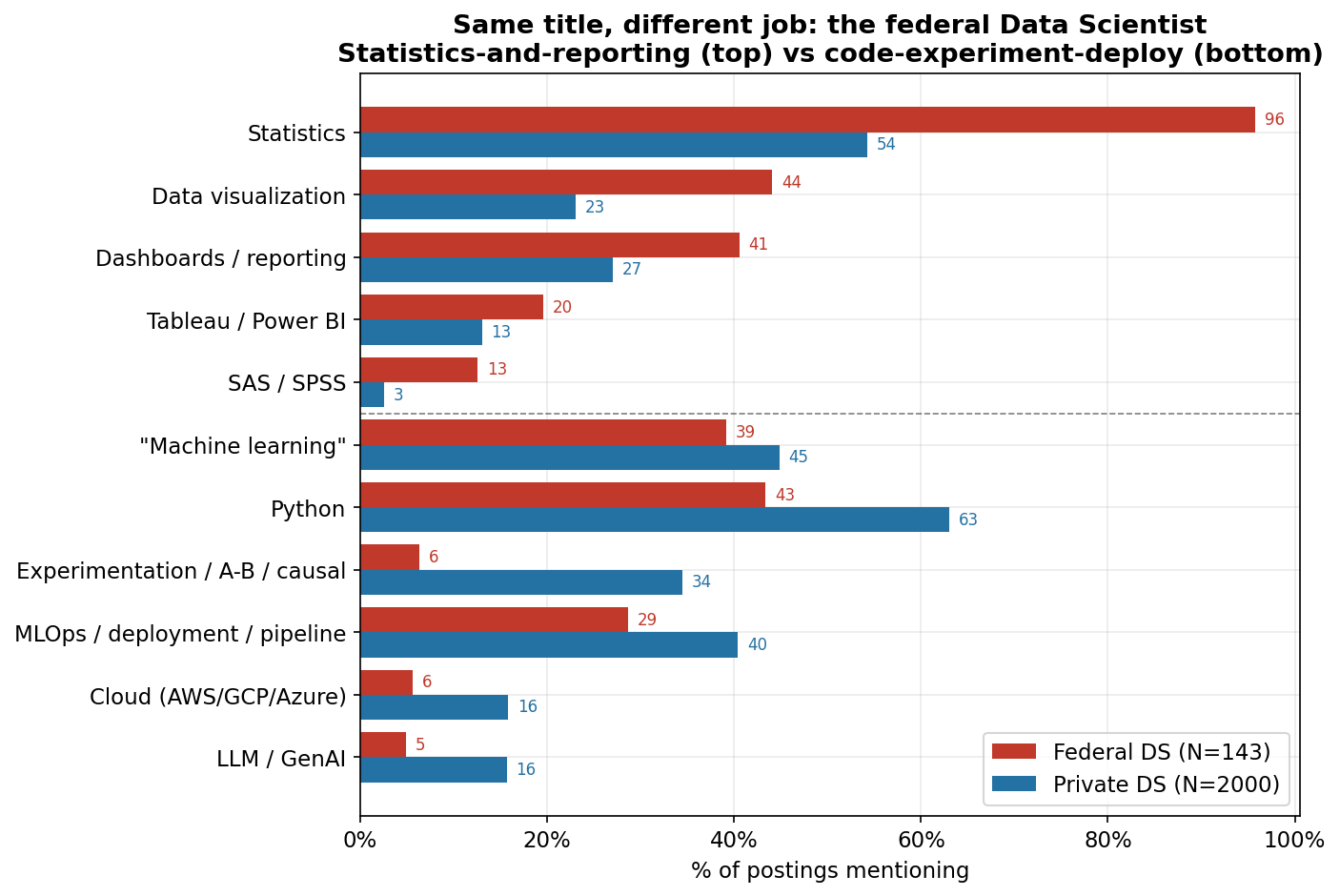
The split is clean. Federal Data Scientist postings over-index on statistics-and-reporting — statistics (96% vs 54%), data visualization (44% vs 23%), dashboards (41% vs 27%), SAS/SPSS (13% vs 3%). Private postings over-index on code-experiment-deploy — Python (63% vs 43%), experimentation / A-B / causal inference (34% vs 6%), MLOps / deployment (40% vs 29%), cloud (16% vs 6%), LLM/GenAI (16% vs 5%).
The tell is the middle: both sectors say "machine learning" at nearly the same rate (~40%). Federal data scientists name ML as often as anyone — they just lack the hands-on toolchain to operationalize it. It stays a concept, not a deployed system. Even federal "Data Scientist (AI)" roles turn out to be about AI standards and evaluation policy, not building models — verbatim: "promotes the adoption of standards, guides, best practices, and policy for measuring and evaluating AI technology."
A federal Data Scientist and a private Data Scientist share a title and a vocabulary, but not a job: one describes machine learning, the other ships it.
The pattern repeats: Software and Security
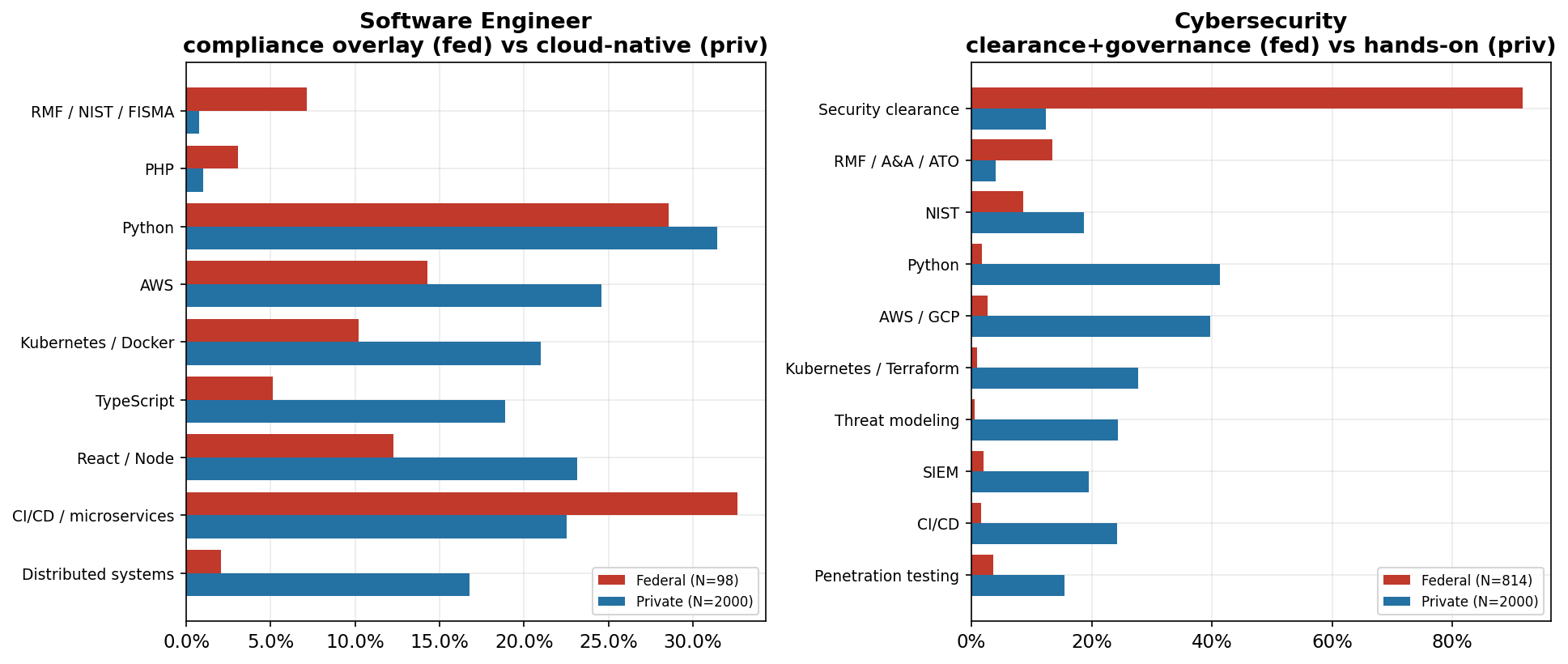
Software Engineer (federal N=98) — the milder split. Federal software engineers use Python about as often as private ones (29% vs 31%), but they're markedly less cloud-native (AWS 13% vs 24%, Kubernetes/Docker 10% vs 21%, TypeScript 5% vs 19%) and carry a compliance overlay private software lacks (RMF/NIST/FISMA 7% vs 1%). Federal software modernizes defensively more than architecturally.
Cybersecurity (federal N=814) — the sharpest divergence in the data. Federal security is clearance-and-governance: security clearance in 92% of postings, RMF 11%. But the hands-on toolset is nearly absent — Python 2% vs 41%, threat modeling 0% vs 24%, Kubernetes/Terraform 1% vs 28%, SIEM 2% vs 20%. A private "Security Engineer" is a cloud DevSecOps builder; a federal "Cybersecurity Specialist" is a cleared compliance professional.
Why matched titles cover so little: the composition inverts
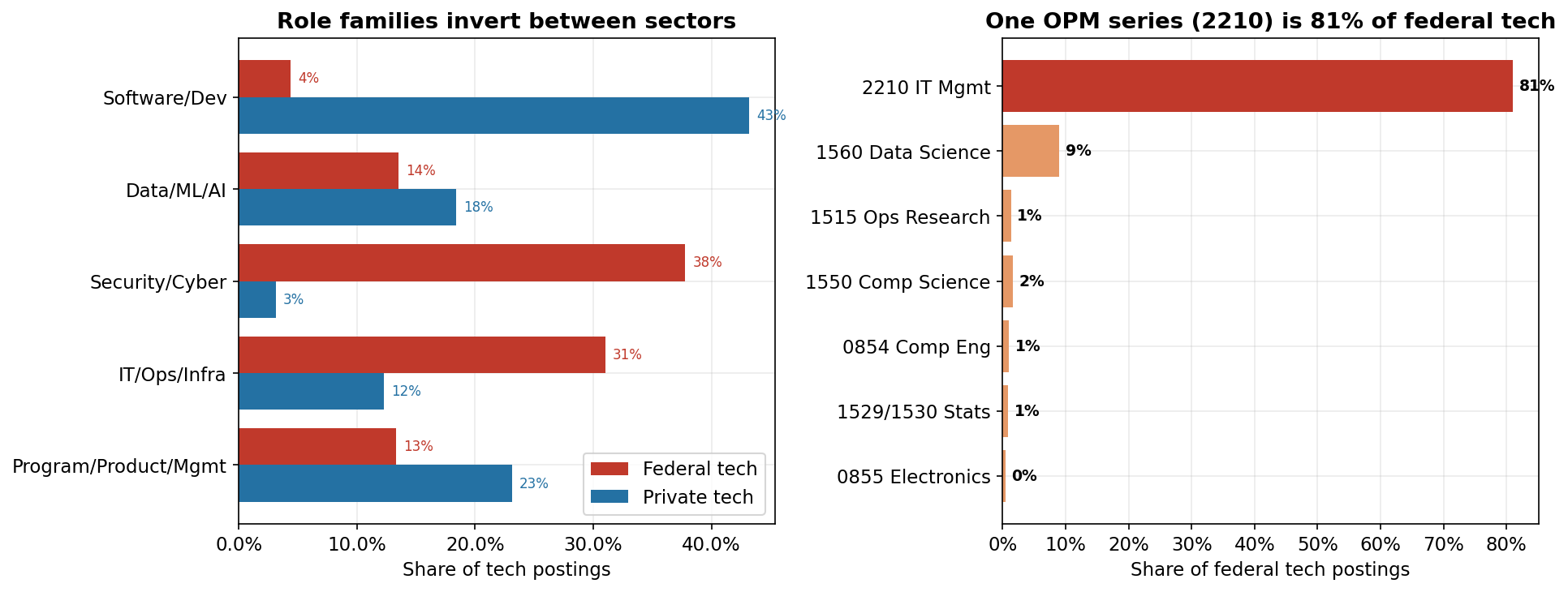
Collapse both sides into role families and the shares invert:
| Role family | Federal tech | Private tech |
|---|---|---|
| Software/Dev (hands-on) | 4.4% | 43.2% |
| Data/ML/AI | 13.5% | 18.4% |
| Security/Cyber | 37.8% | 3.1% |
| IT/Ops/Infra | 31.0% | 12.3% |
| Program/Product/Mgmt | 13.3% | 23.1% |
Hands-on software development is ~10× rarer in federal tech; security is ~12× more common. And one occupational series — 2210 (IT Management) — is 81% of federal tech postings (Data Science, series 1560, is ~9%). The hands-on-keyboard coders most able to arbitrage a pay gap by moving are exactly the population federal tech barely employs. Low mobility isn't only a handcuff on the people who are there — it's partly a question of who's there to begin with.
Two more walls: clearance and the closed remote door
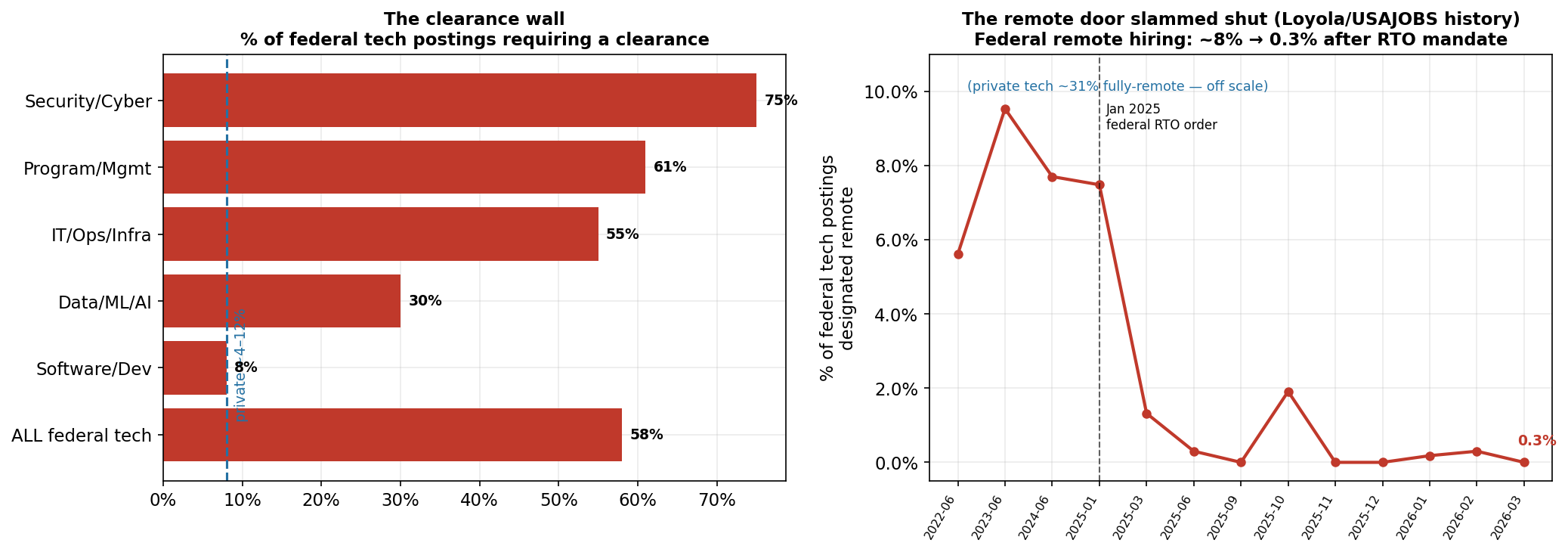
Clearance. 58% of federal tech postings require a real security clearance (Secret / Top Secret / SCI) — 75% in security roles — versus low single digits private. A private engineer without one can't take most federal tech jobs regardless of skill.
Remote — the door just slammed shut. (This one panel uses the longer Loyola/USAJOBS history, since our own index doesn't reach before 2026.) USAJOBS carries an official "Remote job" designation (work-from-anywhere). Federal tech remote hiring held at ~6–10% from 2022 through January 2025 — then collapsed to ~0.3%, dropping precisely in Q1–Q2 2025: 7.5% in January → 1.3% in March → ~0% after. That's the federal return-to-office order (January 2025). Private tech still designates ~31% of postings fully-remote. The field is demonstrably real, not a scraping glitch: it read a healthy 6–10% for three years, then collapsed exactly when policy changed.
What it means
If you're a federal tech worker thinking of leaving: the pension is the handcuff you can feel; the skills gap is the one you can't. Operations Research, statistics-and-reporting data science, clearance-gated compliance security — the private market runs on Python, cloud, experimentation, and DevSecOps. The move is a retraining project, not just a resignation, which is why so few make it, vested or not.
If you're a private engineer eyeing government: several roles you'd recognize barely exist as federal jobs, and most that do want a clearance you can't get on your own.
For the government: the pipeline problem is deeper than pay. Even a fully-funded, competitively-paid hiring push would be hiring into role categories — analyst data science, compliance security — that don't match where technical talent is trained. Closing the pay gap wouldn't make a modern ML-engineering workforce appear. The job architecture has to change first.
Federal and private postings from the Skillenai job index (2026), both under the same relevance filter; the remote-work time series uses the open loyoladatamining/usajobs USAJOBS corpus (2022–2026), which reaches further back than our index. Skill measurement is raw-text phrase matching applied identically to both sides. Full methodology and code.