
Do Product Managers Out-Earn Engineers? Not Level-for-Level
Get an email when we publish a new post. No account needed, unsubscribe anytime.
The headline, once you compare like-for-like
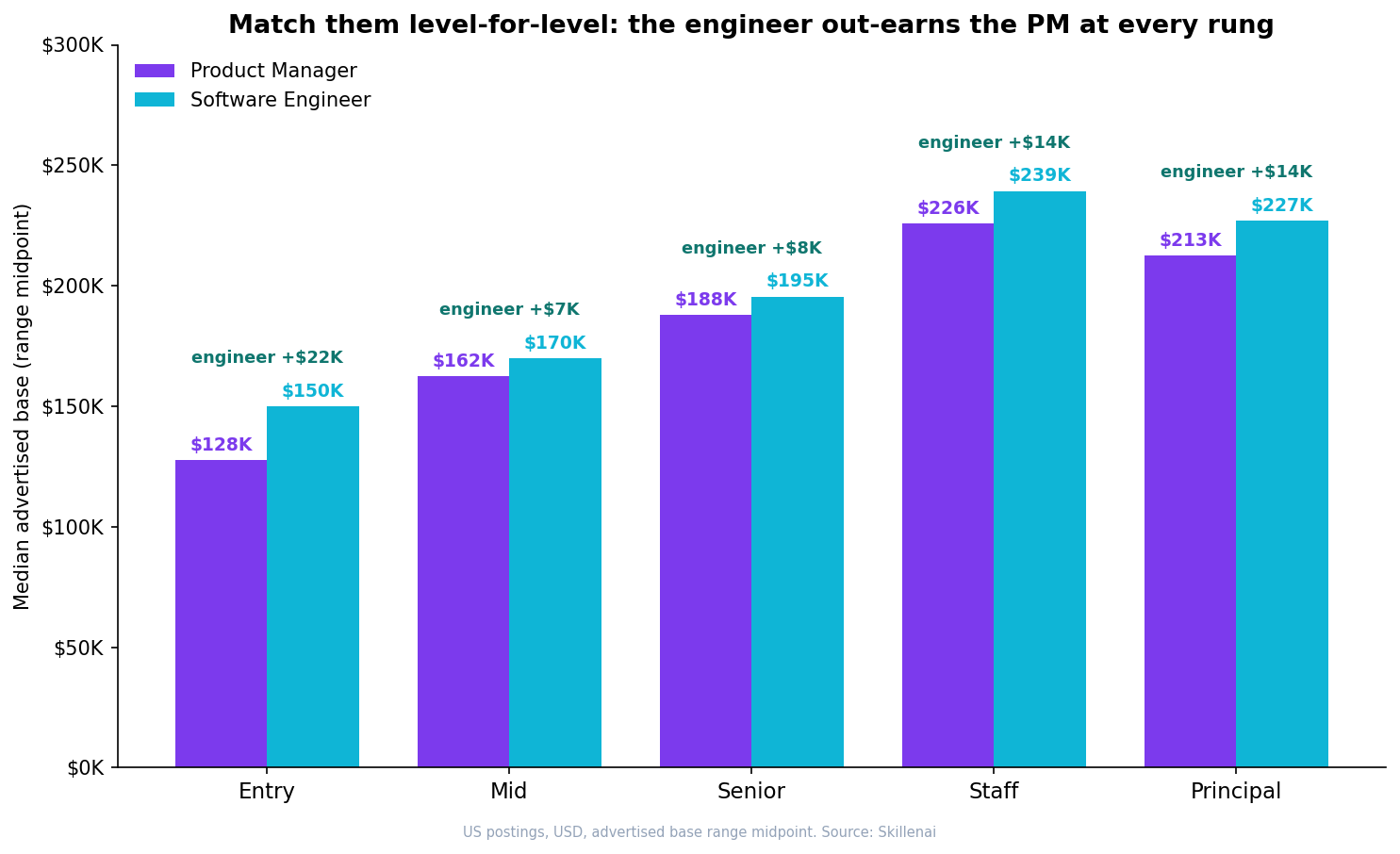
Match a product manager and a software engineer rung-for-rung, and the engineer wins at every level of the ladder — entry to principal. The pooled "PMs earn more" story is an artifact of who sits in each bucket, not what each role pays.
| Comparison (US, USD, base-range midpoint) | Product Manager | Software Engineer |
|---|---|---|
| Pooled median | $189K | $191K |
| Entry | $128K | $150K |
| Mid | $162K | $170K |
| Senior | $188K | $195K |
| Staff | $226K | $239K |
| Principal | $213K | $227K |
The "PM" label bundles in management
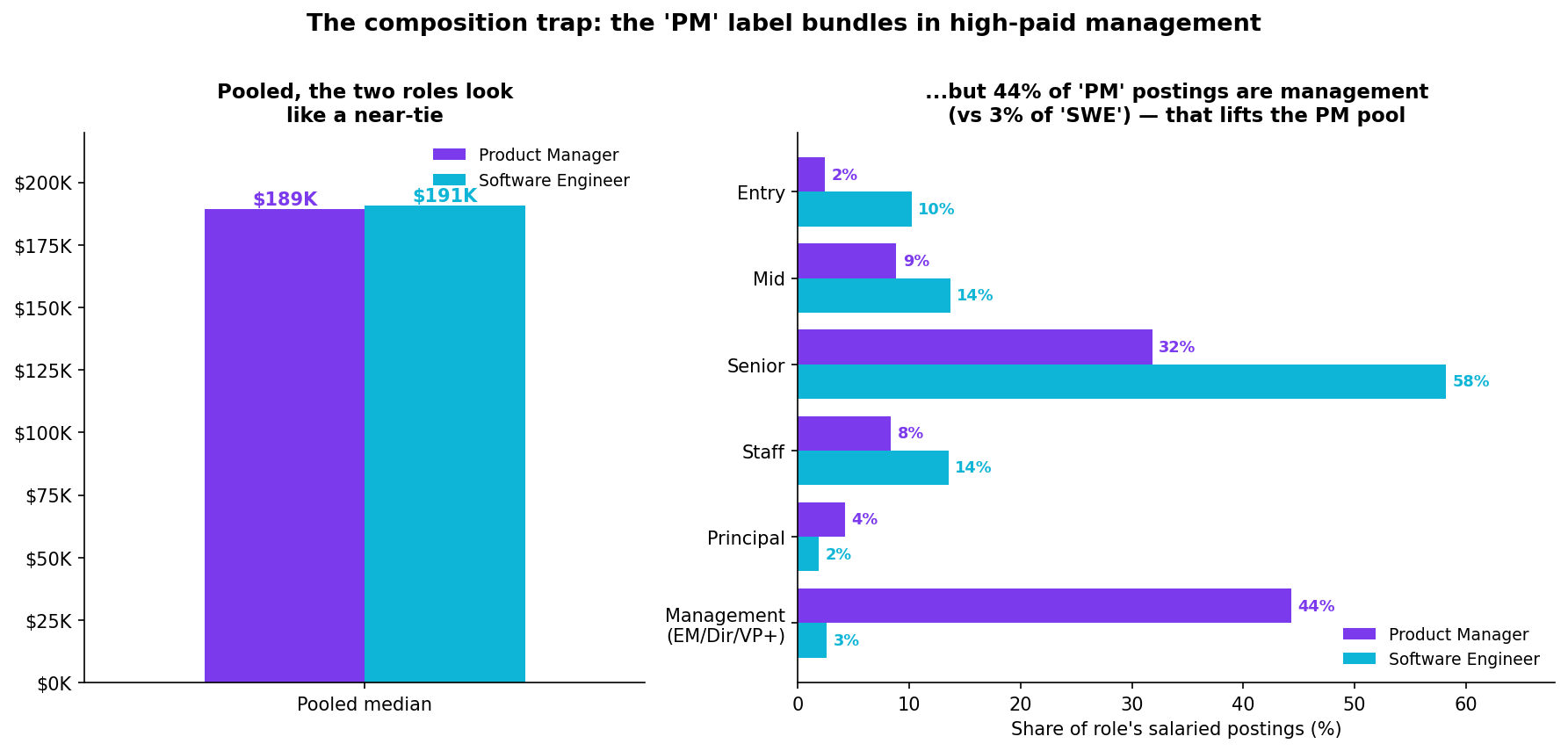
Pooled, the two labels tie (~$189K PM vs ~$191K SWE) — and that tie is misleading, because they describe populations at very different points on the ladder:
| Seniority | Share of PM postings | Share of SWE postings |
|---|---|---|
| Entry | 2% | 10% |
| Mid | 9% | 14% |
| Senior | 32% | 58% |
| Staff | 8% | 14% |
| Principal | 4% | 2% |
| Management (EM / Director / VP+) | 44% | 3% |
Almost half of everything labelled "Product Manager" is actually a management job — and management pays a premium. "Software Engineer," by contrast, is 96% individual contributors. Pool each role across its own seniority mix and the PM median gets lifted by its heavy management tail. The "tie" is a composition effect, not a like-for-like fact.
Fix it by comparing the same rung to the same rung, and the engineer leads at entry (+$22K), mid (+$8K), senior (+$8K), staff (+$14K), and principal (+$14K). Modest, but perfectly consistent. At the senior level — our largest cell — the $8,750 gap clears a Mann-Whitney test at p ≈ 1.7 × 10⁻⁶, with a bootstrapped 95% confidence interval of [+$5.3K, +$14K], entirely above zero.
The "generalist" role is paid as an engineer
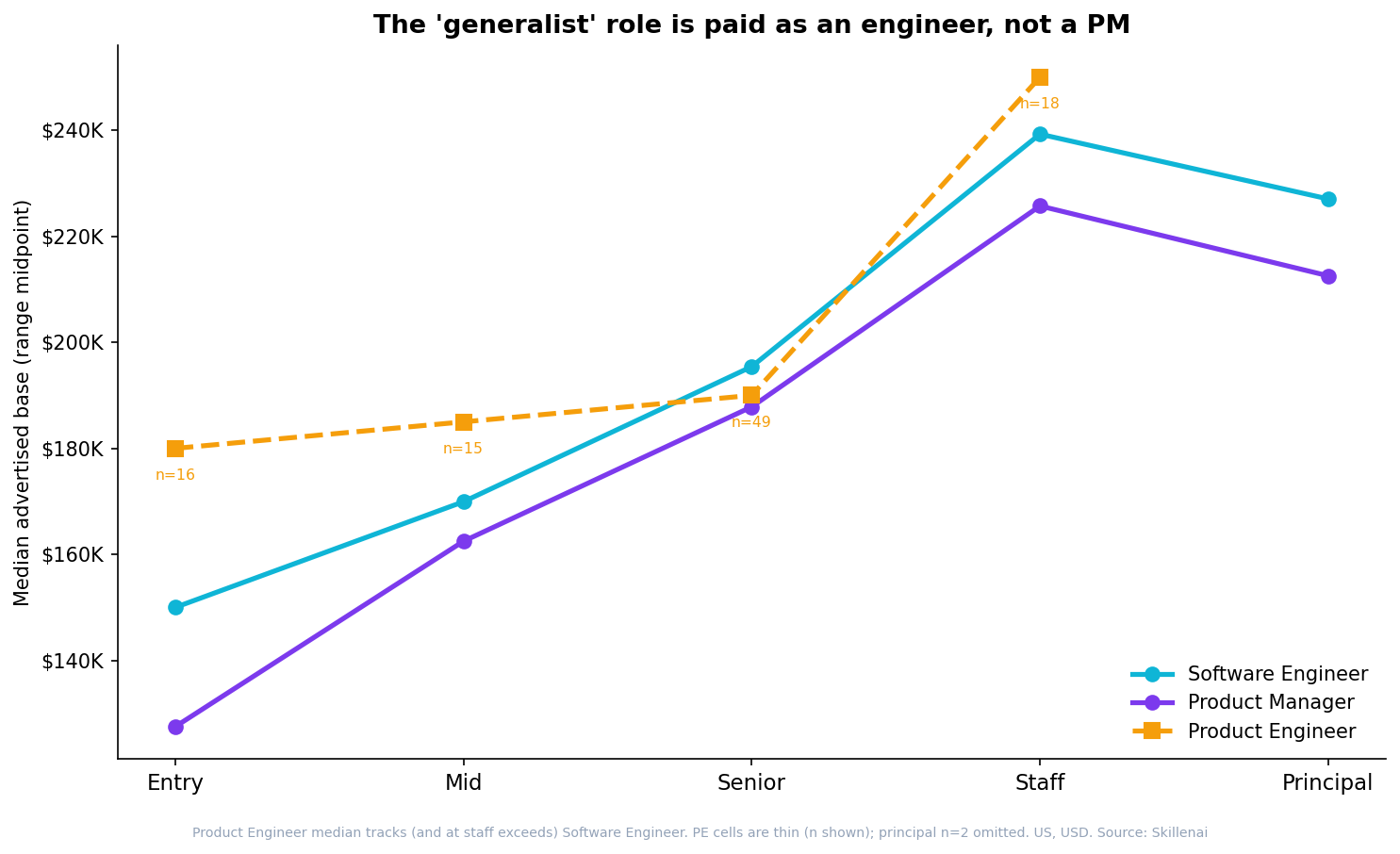
The Levels.fyi piece also argues roles are generalizing — "product engineer, design engineer… people who can wear more than one hat are becoming more valuable." If that hybrid were genuinely half-product, its pay should sit between PM and engineer. It doesn't. Product Engineer tracks the engineering ladder at every level we can measure, and at staff it exceeds it ($250K vs $239K).
That echoes an earlier Skillenai analysis of the skills side of the same claim: Product Manager and Software Engineer share only two skills in their top-50 (a Jaccard of 0.04), so there's no meaningful "PM ∩ SWE" region for a hybrid to occupy. Product Engineer's distinctive skills turn out to be modern web and AI tooling — Next.js, LLMs, FastAPI — not borrowed PM responsibilities. Two independent angles, one conclusion: the market's "generalist" is an engineer, and it pays like one.
What this means for your career
- Choosing tracks for money alone? At the same level, engineering pays a small, consistent premium over product management in advertised base. The "PMs earn more" belief comes from comparing a management-heavy PM pool against an IC-heavy engineer pool.
- Already a PM? The real pay ceiling runs through management — nearly half of PM demand is for people-managers, and that's where the premium concentrates.
- Eyeing "product engineer" as a softer, generalist path? It isn't. It's a senior-leaning software role that pays like — or above — a straight engineer.
Methodology
US postings only, USD, with a structured salary range; salary is the range midpoint. Roles are exact-matched on entity-resolved titles. Seniority uses the index's inferred level field (~76% coverage). Significance via Mann-Whitney U; confidence interval via a 2,000-draw bootstrap.
Two caveats matter. First, this is advertised base pay, not total compensation. Levels.fyi reports self-reported total comp including equity and bonus; we see only the advertised base range. Since equity is a larger share of engineer comp at senior levels, a total-comp view would likely widen the per-level engineer advantage, not close it. Second, Big Tech is largely absent from open job boards — Meta, Google, Apple, Nvidia, and Netflix post through proprietary systems we don't crawl — so we can't reproduce the per-company table and make no claim about any specific company. This is a read on the broad open market, offered as a complement to the company-level numbers. Notably, the Levels.fyi author's own aside — that "PMs tend to be slightly more senior" — is exactly the effect that, measured here, fully accounts for the pooled gap.