
Loop Engineering: We Caught a New AI Buzzword Three Days After Birth
Get an email when we publish a new post. No account needed, unsubscribe anytime.
What loop engineering actually is
The people writing about it agree on the definition. One explainer put it simply: loop engineering means you stop being the person who types every prompt to a coding agent — and start designing a small system that discovers work, delegates it, checks it, remembers progress, and repeats. You write the definition of "done" once; the loop runs until the work passes.
And its proponents are explicit that this is a succession, not a sibling:
Loop engineering is replacing prompt engineering. Prompt engineering was about writing better instructions. Loop engineering is about designing the system that generates better instructions at the right time.
Several pieces tie it directly to Claude Fable 5, Anthropic's frontier model built for long-horizon agentic autonomy — the capability that makes a hands-off loop worth building.
The birth: 7 articles in 3 days
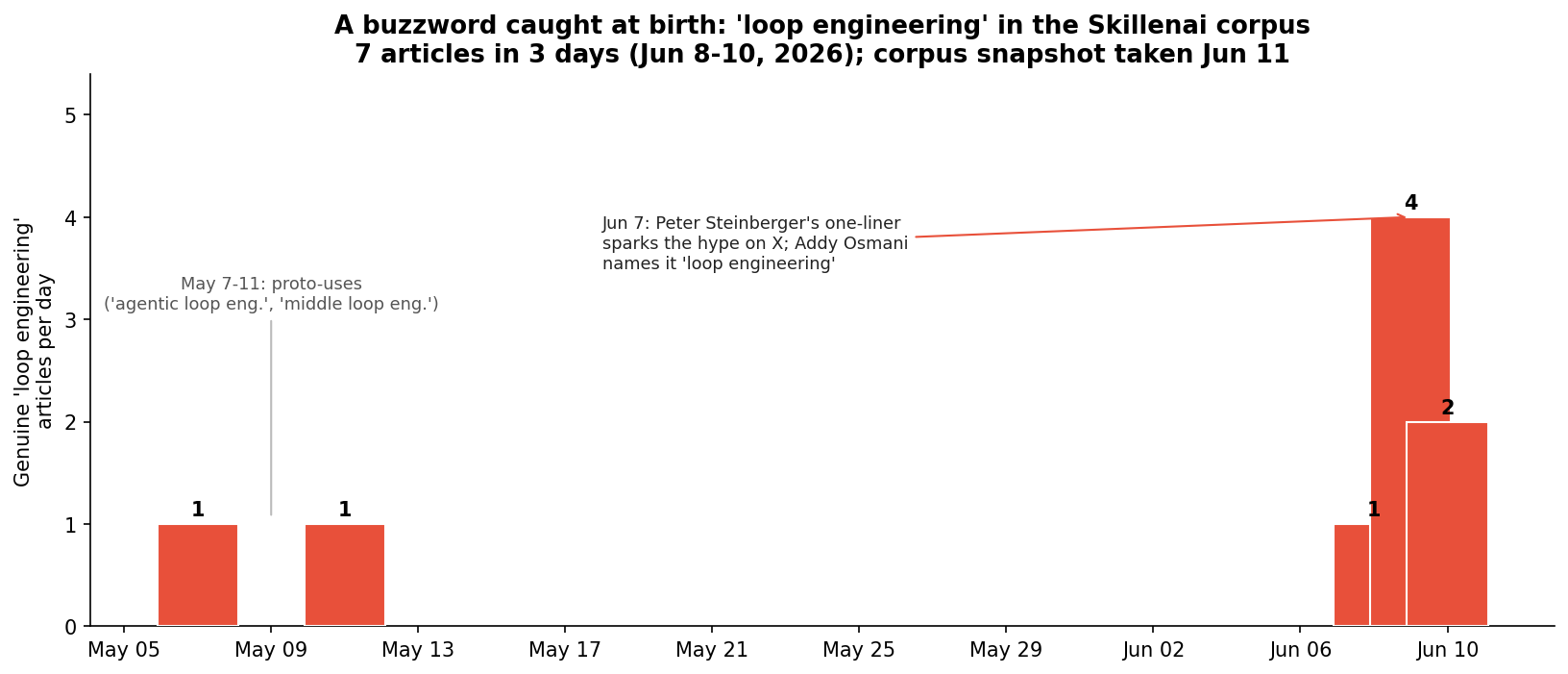
In our entire corpus, the genuine agentic sense of "loop engineering" shows up in just 9 documents. Two are May proto-uses ("agentic loop engineering," "middle loop engineering") where the idea existed but the name hadn't set. The other seven all landed in a 72-hour window, June 8–10: an explainer-and-digest cascade, with the newsletters crediting the coinage to Addy Osmani by name.
There is no trend line to fit. The term simply did not exist in measurable form until this week. The honest chart is a flat zero with a cliff at the right edge.
Why you can't just count it
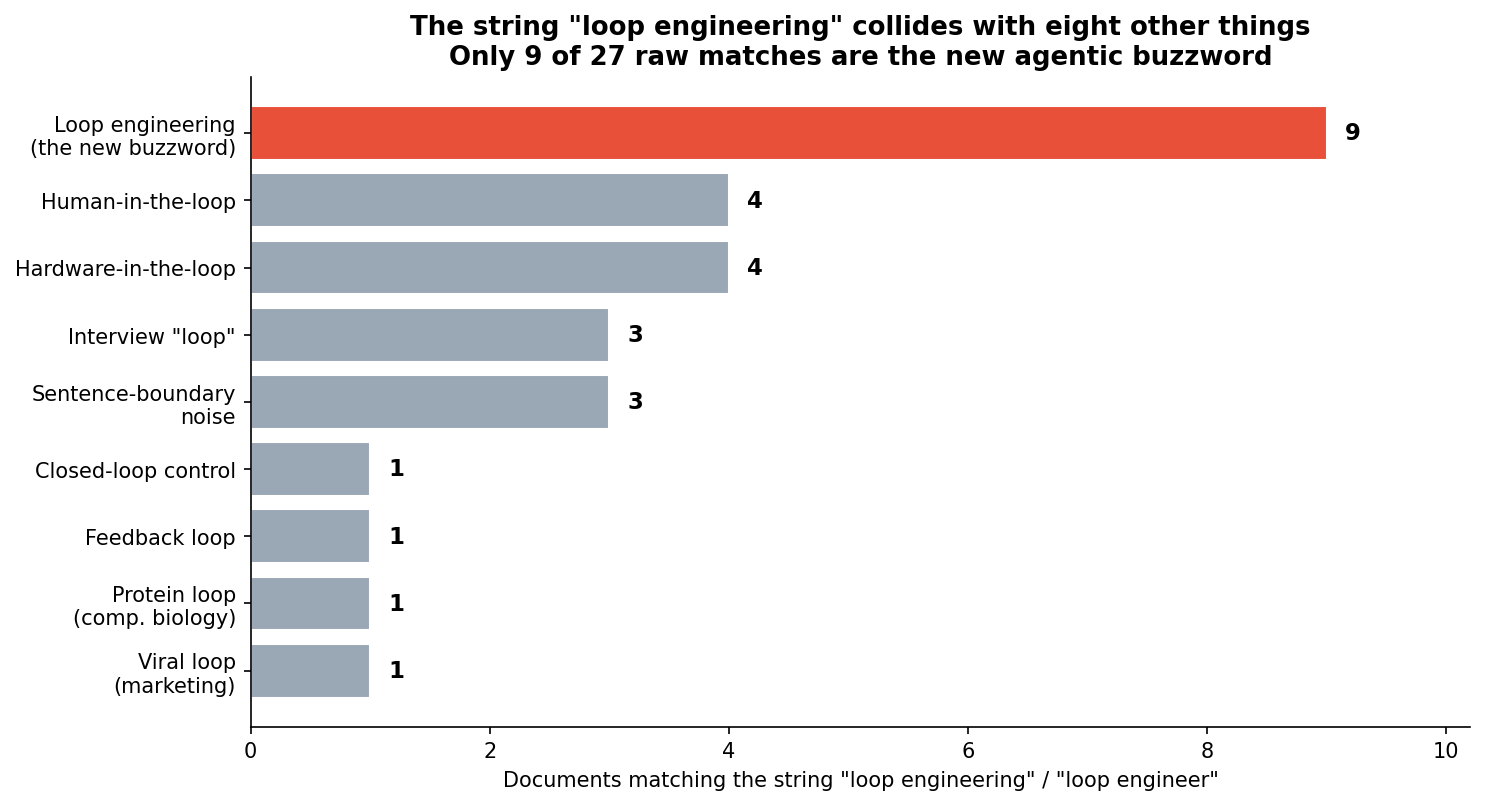
Search the string "loop engineering" and you get 27 documents — which would tempt you to write "27 mentions and climbing." But read the sentence around each one and only 9 are the new buzzword. The phrase collides with eight unrelated meanings:
| What the string matched | Docs | What it really is |
|---|---|---|
| Loop engineering (the buzzword) | 9 | Designing an agent's autonomous loop |
| Human-in-the-loop | 4 | ML supervision |
| Hardware-in-the-loop | 4 | Embedded/robotics test roles |
| Interview "loop" | 3 | Recruiter boilerplate ("Loop: Engineering Leadership Interview") |
| Sentence-boundary noise | 3 | Punctuation the search engine drops |
| Closed-loop control | 1 | Industrial systems |
| Feedback loop | 1 | Generic dev term |
| Protein loop | 1 | A computational-biology job posting |
| Viral loop | 1 | Growth marketing |
Two-thirds of the raw count is hardware testing, ML supervision, recruiter templates, protein folding, and marketing funnels. Text search strips punctuation and case, so loop. Engineering, Loop: Engineering, and in-the-Loop Engineer all collapse into the same thing. The newborn buzzword is a thin sliver riding on top of five older meanings — and that ambiguity is part of why it spreads so fast. It sounds familiar before anyone's told you what it means.
The lineage: prompt to context to loop
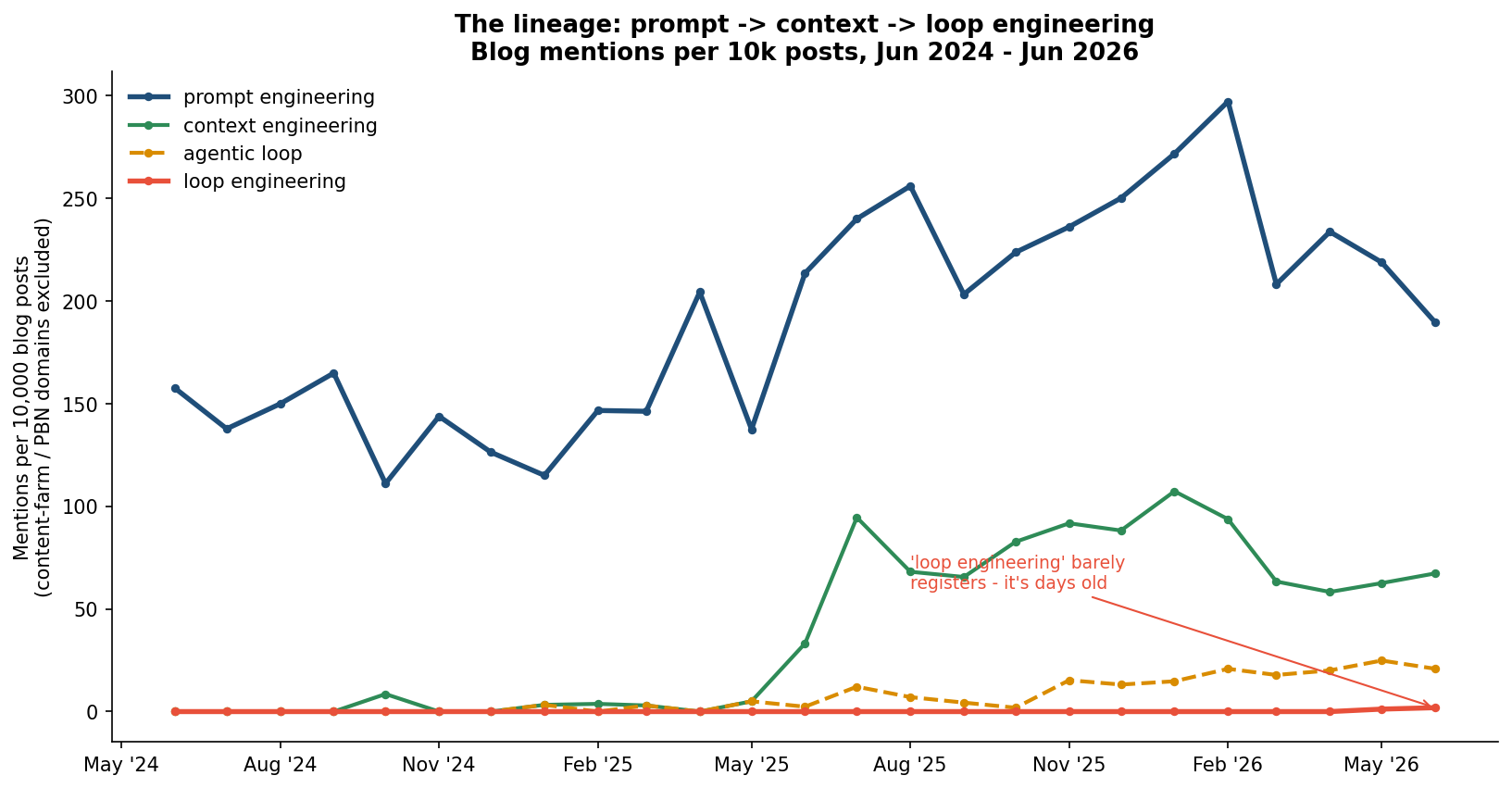
Loop engineering didn't appear from nowhere. Its own advocates place it third in a chain — and we can chart the first two, because they have history. Here are mentions per 10,000 blog posts (with AI content-farm domains stripped out of the denominator):
- Prompt engineering — the mature incumbent, holding ~190–300 per 10k for two years. Still the most-discussed AI skill by a wide margin.
- Context engineering — the 2025 successor. Near-zero until a sharp take-off in May–July 2025 to ~90 per 10k, where it's held. This is what a buzzword looks like after it crosses into the durable record.
- Loop engineering — flat on zero until May 2026, nudging under 2 per 10k in June. Quantitatively invisible — precisely because we're seeing it on day three.
Each term is about an order of magnitude smaller than its predecessor at any given moment, because we keep catching them earlier. Context engineering is roughly where prompt engineering was a year ago. Loop engineering is roughly where context engineering was a year before that.
Update, two weeks later: it diffused
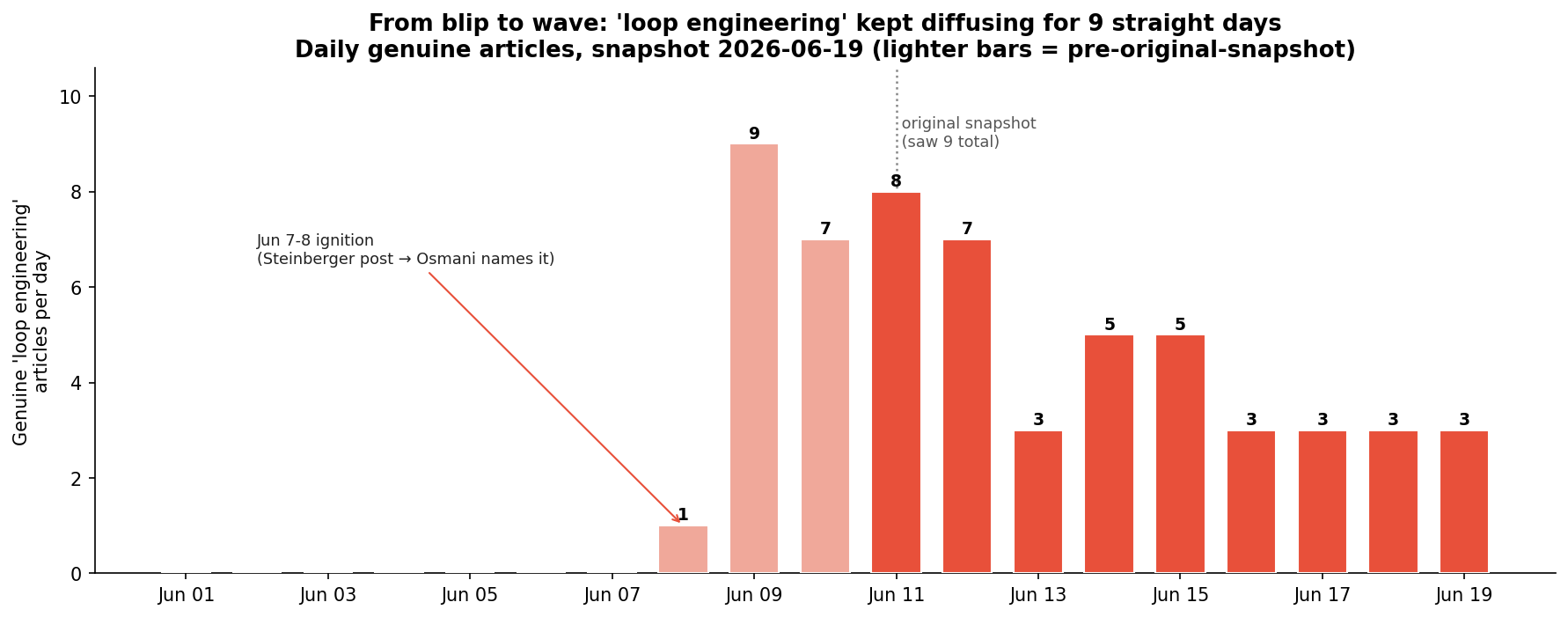
Added June 19, 2026. We re-ran the exact same query eight days after first publishing this. The buzzword didn't fizzle — it spread, and fast.
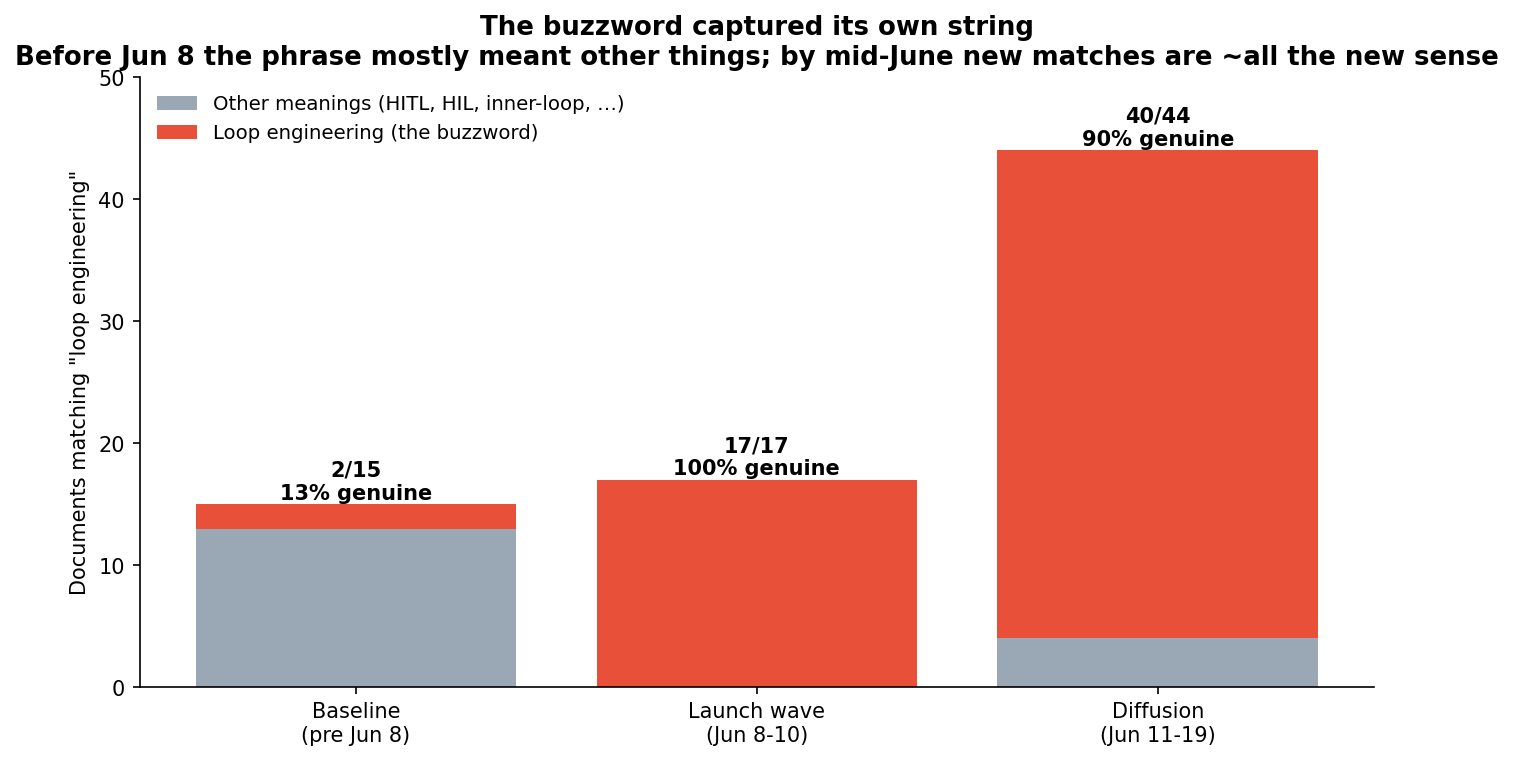
Genuine mentions went from 9 to 59. Part of that is honest mechanics: our crawler hadn't finished ingesting the launch wave when we first looked, so "7 articles, June 8–10" was a real-time undercount — that same window now holds 17. But the bigger story is the 40 new genuine articles dated June 11–19, roughly four to five every day for nine straight days across 32 different domains. A one-day dunk decays the next morning; this didn't.
It also captured its own string. The original report's loudest caveat was that two-thirds of "loop engineering" matches meant something else. Look only at articles published since June 11 and that flips: 90% are the new sense. A two-week-old coinage annexed an ambiguous English phrase.
And it went mainstream and global: The New Stack ("the best piece I've read on this shift"), a skeptical The Register ("a week or two ago it was harness engineering; now it's loop engineering"), HackerNoon, plus Chinese (Pandaily) and Thai (techsauce) explainers — and Addy Osmani's own follow-up.
The most telling sign a buzzword has grown up is when the critics arrive — and they all land on one point: a loop is only as good as the spec that verifies it. "Loop engineering without verification is just automation," as one widely-shared piece put it. The team at BrainGrid framed this precisely: loop engineering doesn't eliminate the work, it relocates it to writing the specifications that verify what the loop produces. Our diffusion data is the longitudinal evidence for exactly that take — the whole field converged on the verification burden inside a single week.
What this means for your career
- If you build with AI agents: the skill being renamed is real even if the name is three days old. The leverage is moving from what you type to the system that decides what gets typed — scheduling, verification, memory, when to stop, when to ask a human. Worth learning regardless of whether "loop engineering" is the label that sticks.
- If you hire or write job descriptions: don't keyword-match this one yet. Today, a posting that mentions "loop engineering" is four times more likely to want a hardware-in-the-loop test engineer or an ML-supervision specialist than an agent-loop designer.
- If you track trends: treat any single-week buzzword spike as a hypothesis, not a finding. The testable prediction: if loop engineering follows context engineering's curve, it should cross ~30–90 per 10k on blogs by late 2026. We'll know by then whether this was a movement or a moment.
Methodology
Mentions were detected with phrase search on post text and titles across the Skillenai enriched blog, news, jobs, scholarly, and social indices, then every match was read and hand-classified by the meaning of its surrounding sentence. The lineage series is a monthly histogram of blog publication dates, normalized to mentions per 10,000 posts, with a 333-domain AI content-farm denylist removed from the denominator so the shares reflect human-authored writing. One important limitation: X/Twitter is not in our corpus — our "social" coverage is the open Fediverse (Bluesky, Mastodon), which had zero mentions of any of these terms. The claim that loop engineering went viral on X is sourced to the newsletter digests that cite it, not measured directly. The original snapshot rested on nine genuine documents (a forensic count, not a statistical trend); a two-week update extends it to a 59-article diffusion curve. We measure how fast the term spreads — not whether teams using loops ship more, which stays an open question.