
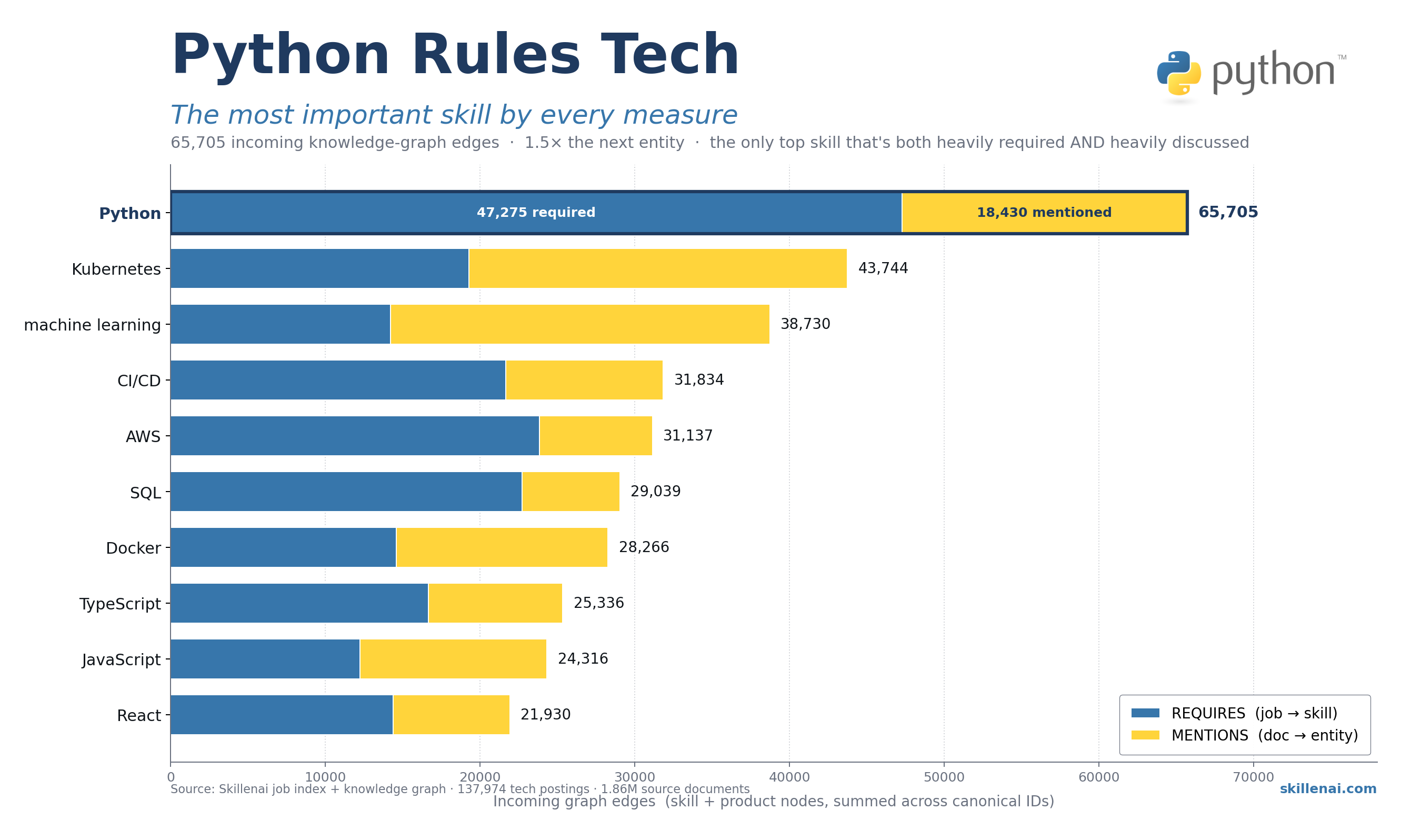
Python Rules Tech: The Most Important Skill by Every Measure
Get an email when we publish a new post. No account needed, unsubscribe anytime.
The leaderboard isn't close
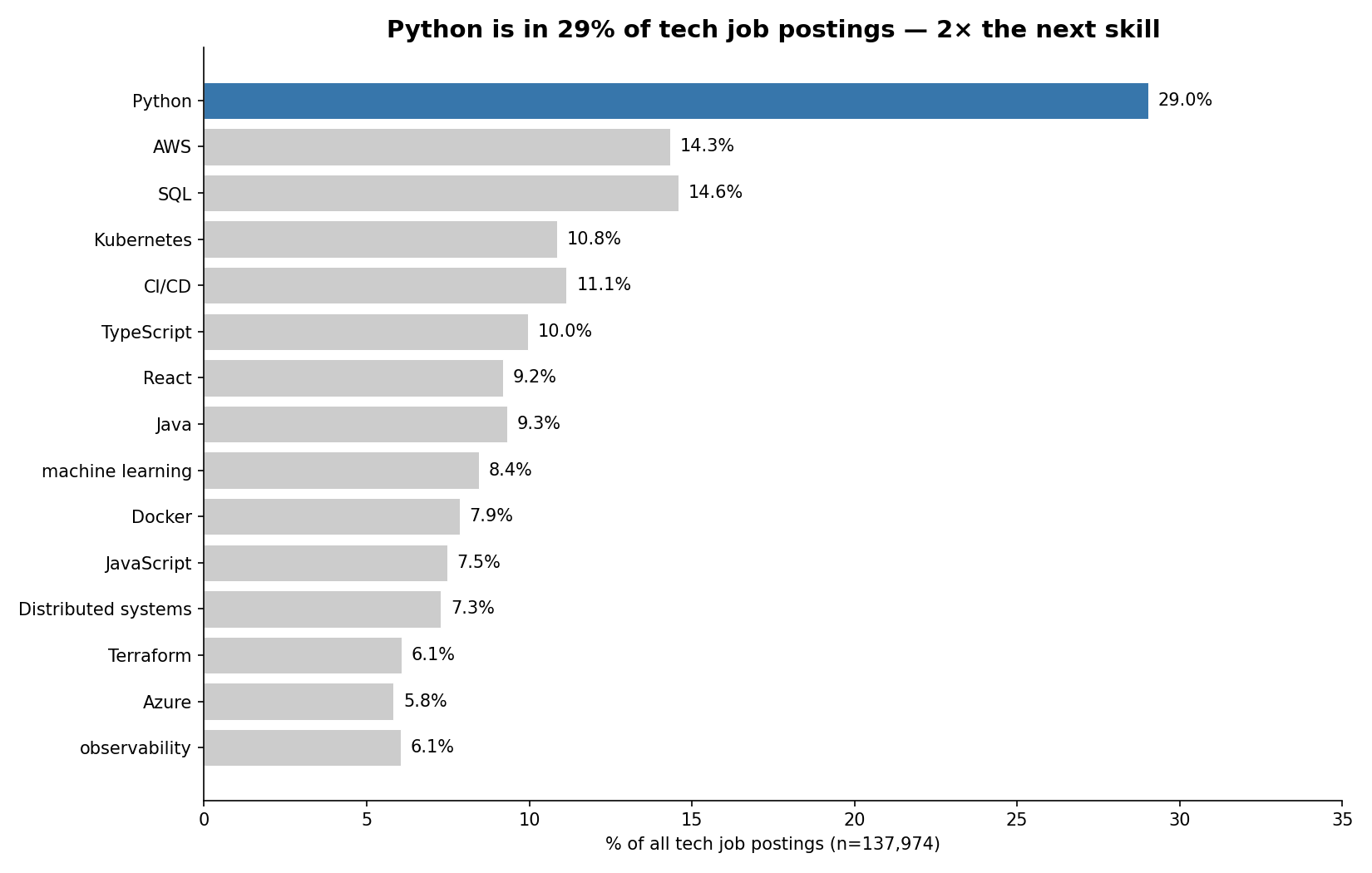
Across 137,974 tech postings in our index (Speechify excluded as a known carpet-bomber), Python appears in 29.0% of all postings — roughly twice the next-most-prevalent skill.
| Rank | Skill | % of postings | n |
|---|---|---|---|
| 1 | Python | 29.0% | 40,055 |
| 2 | SQL | 14.6% | 20,123 |
| 3 | AWS | 14.3% | 19,777 |
| 4 | CI/CD | 11.1% | 15,383 |
| 5 | Kubernetes | 10.8% | 14,961 |
| 6 | TypeScript | 10.0% | 13,753 |
| 7 | Java | 9.3% | 12,858 |
| 8 | React | 9.2% | 12,682 |
Python is the only skill that's everywhere
Prevalence alone doesn't capture importance. A skill could be in 30% of postings because half of one big role demands it. We tested all 18 of the most common tech roles separately and counted how many of them require each skill at a meaningful rate.
| Skill | Roles requiring it ≥30% of the time | Mean per-role prevalence |
|---|---|---|
| Python | 14 of 18 | 36.3% |
| AWS | 5 of 18 | 20.4% |
| Kubernetes | 4 of 18 | 17.2% |
| Machine learning | 4 of 18 | 14.4% |
| SQL | 3 of 18 | 15.1% |
| Terraform | 3 of 18 | 11.4% |
Python clears that bar 14 times. Nothing else clears it more than 5. Python is universal across the technical IC track in a way that no other skill is.
The role pattern is bimodal
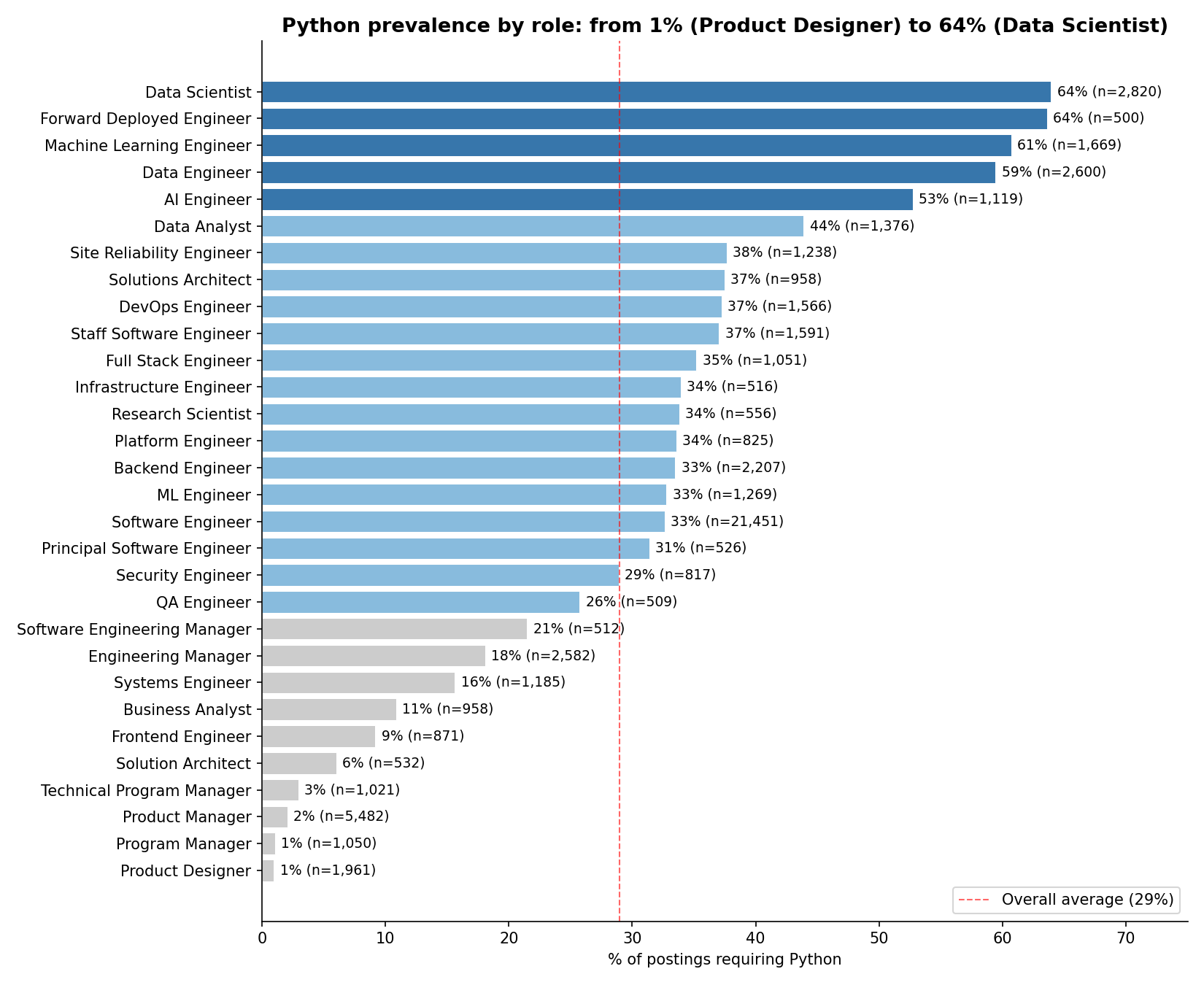
The roles where Python is most heavily required:
- Data Scientist: 64% of postings
- Forward Deployed Engineer: 64%
- ML Engineer: 61%
- Data Engineer: 59%
- AI Engineer: 53%
And the roles where Python is essentially absent:
- Product Designer: 1%
- Program Manager: 1%
- Product Manager: 2%
- Technical Program Manager: 3%
- Frontend Engineer: 9%
This is the cleanest pattern in our data: if your role touches code or data, you need Python; if it doesn't, you don't. The story isn't "everyone needs Python" — it's "Python is the price of admission to the technical IC track."
Python is the closest thing tech has to a global standard
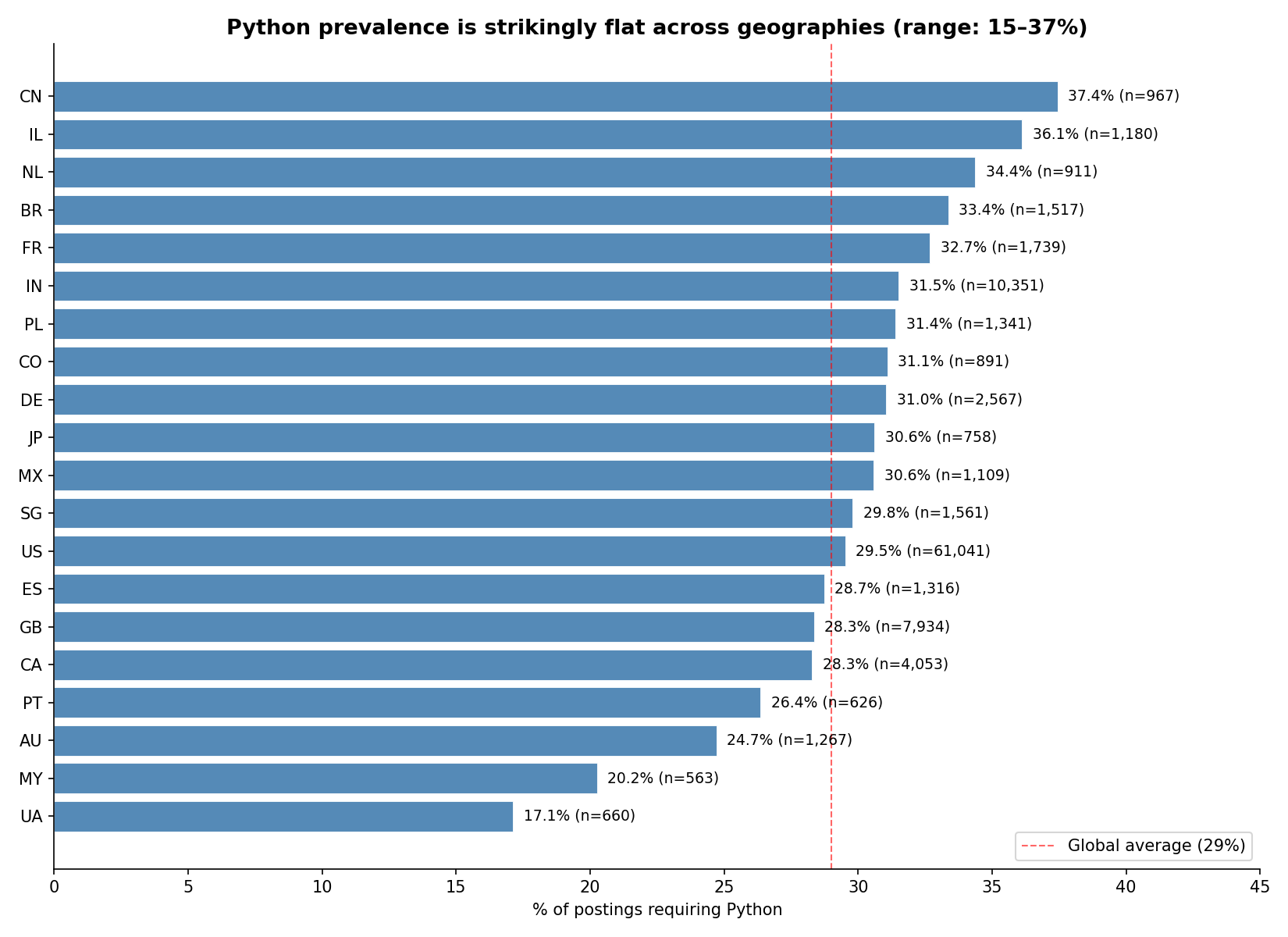
This is where Python's lead becomes uniquely impressive. Across the top 25 countries by job count, Python's prevalence sits in a tight band of roughly 25–37%. The standard deviation is about 5 percentage points.
| Country | n postings | Python % |
|---|---|---|
| China | 967 | 37.4% |
| Israel | 1,180 | 36.1% |
| Netherlands | 911 | 34.4% |
| Brazil | 1,517 | 33.4% |
| France | 1,739 | 32.7% |
| India | 10,351 | 31.5% |
| Germany | 2,567 | 31.0% |
| US | 61,041 | 29.5% |
| UK | 7,934 | 28.3% |
| Canada | 4,053 | 28.3% |
| Australia | 1,267 | 24.7% |
Compare this to other top skills. React skews toward frontend-heavy markets. AWS skews toward US tech. Java skews toward India enterprise. Python is the rare skill that's just the same percentage everywhere — and it's actually higher in China, Israel, and Brazil than in the US.
Python is also flat across seniority levels
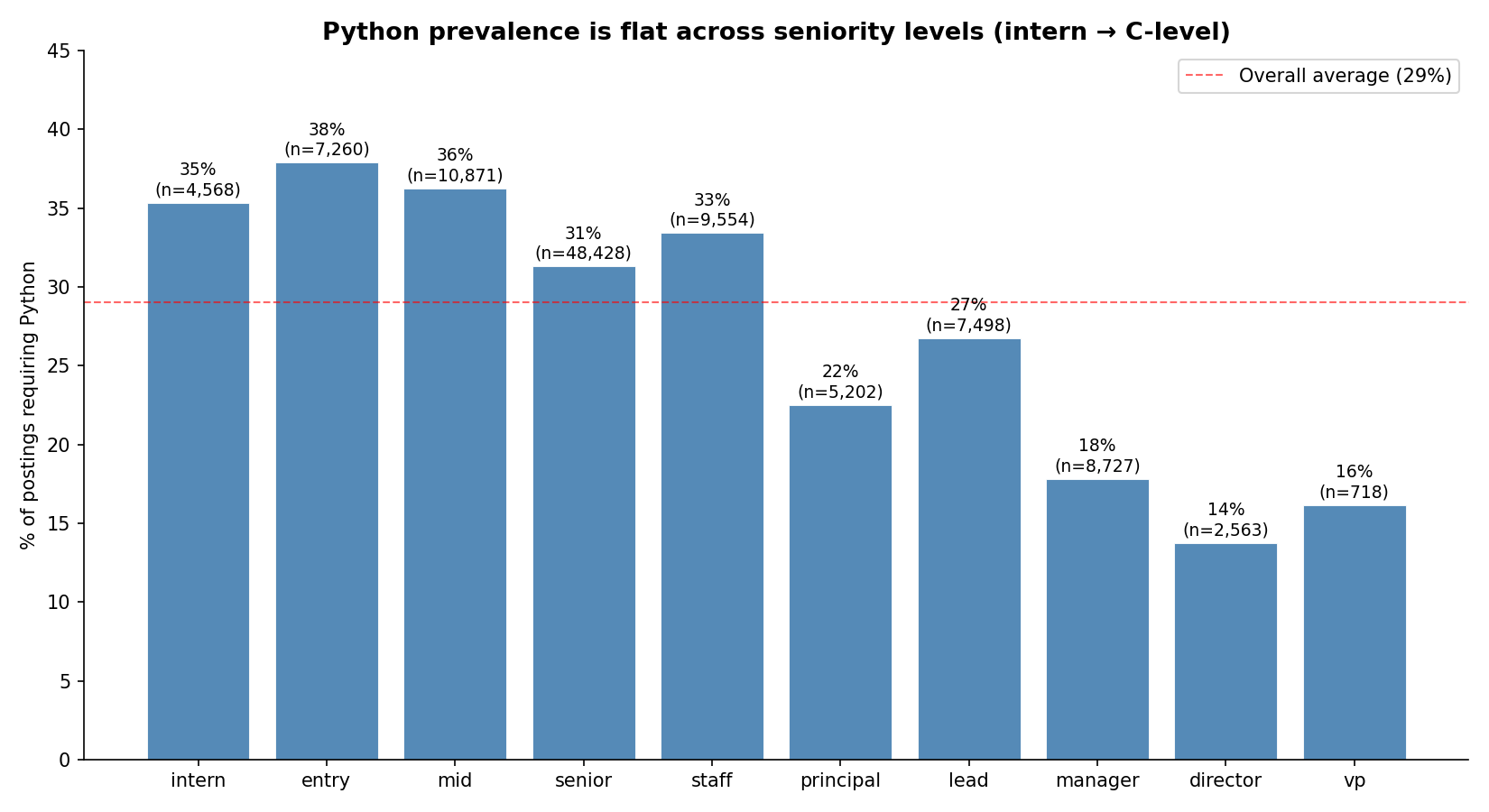
The other dimension where most skills fan out is seniority. Skills typically curve up (more senior → more likely to be required) or curve down (more senior → less likely, because seniors lead teams instead of writing code).
| Seniority | n | Python % |
|---|---|---|
| Entry | 7,260 | 37.9% |
| Mid | 10,871 | 36.2% |
| Intern | 4,568 | 35.3% |
| Staff | 9,554 | 33.4% |
| Senior | 48,428 | 31.3% |
| Lead | 7,498 | 26.7% |
| Principal | 5,202 | 22.5% |
| Manager | 8,727 | 17.8% |
| Director | 2,563 | 13.7% |
Across every IC level from intern to staff, Python sits in a 32–38% band. It's not a beginner skill that you outgrow. It's not an expert skill you have to build toward. It's the persistent floor of technical IC work.
The drop in management roles isn't because Python becomes less relevant — it's because manager job descriptions describe what the team needs to do, not what the manager personally codes.
Python is a floor, not a salary premium
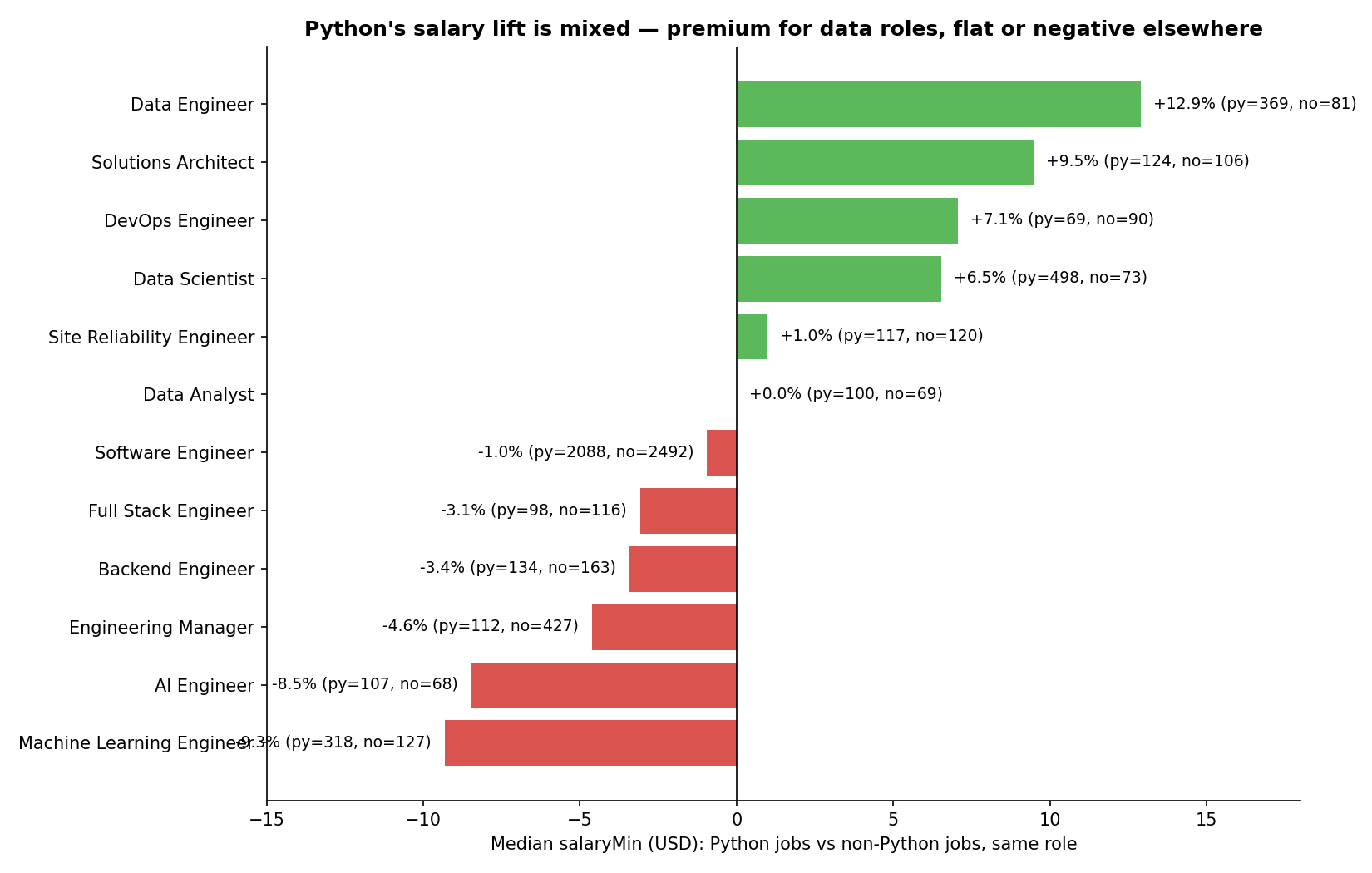
Here's where the narrative gets nuanced. We compared median salaryMin (USD only) for Python jobs vs non-Python jobs in the same role. The pattern is mixed, and that mix tells you something:
| Role | Python median | Non-Python median | Lift |
|---|---|---|---|
| Data Engineer | $149,152 | $132,100 | +12.9% |
| Solutions Architect | $180,656 | $165,000 | +9.5% |
| Data Scientist | $149,468 | $140,300 | +6.5% |
| DevOps Engineer | $129,000 | $120,500 | +7.1% |
| Software Engineer | $157,412 | $158,955 | -1.0% |
| Backend Engineer | $156,151 | $161,727 | -3.4% |
| AI Engineer | $137,250 | $150,000 | -8.5% |
| ML Engineer | $176,800 | $181,500 | -2.6% |
| Machine Learning Engineer | $171,273 | $188,907 | -9.3% |
For data roles, Python jobs pay 6–13% more — Python is genuinely value-additive. For ML and AI roles, Python jobs pay less. That feels paradoxical until you realize what it means: in those roles, Python is assumed, and the salary premium goes to the layer above — CUDA, C++, Triton, custom infrastructure, distributed systems specialization.
The takeaway: Python doesn't earn you a raise. Knowing what to stack on top of it does.
What pairs with Python: SQL, AWS, Kubernetes
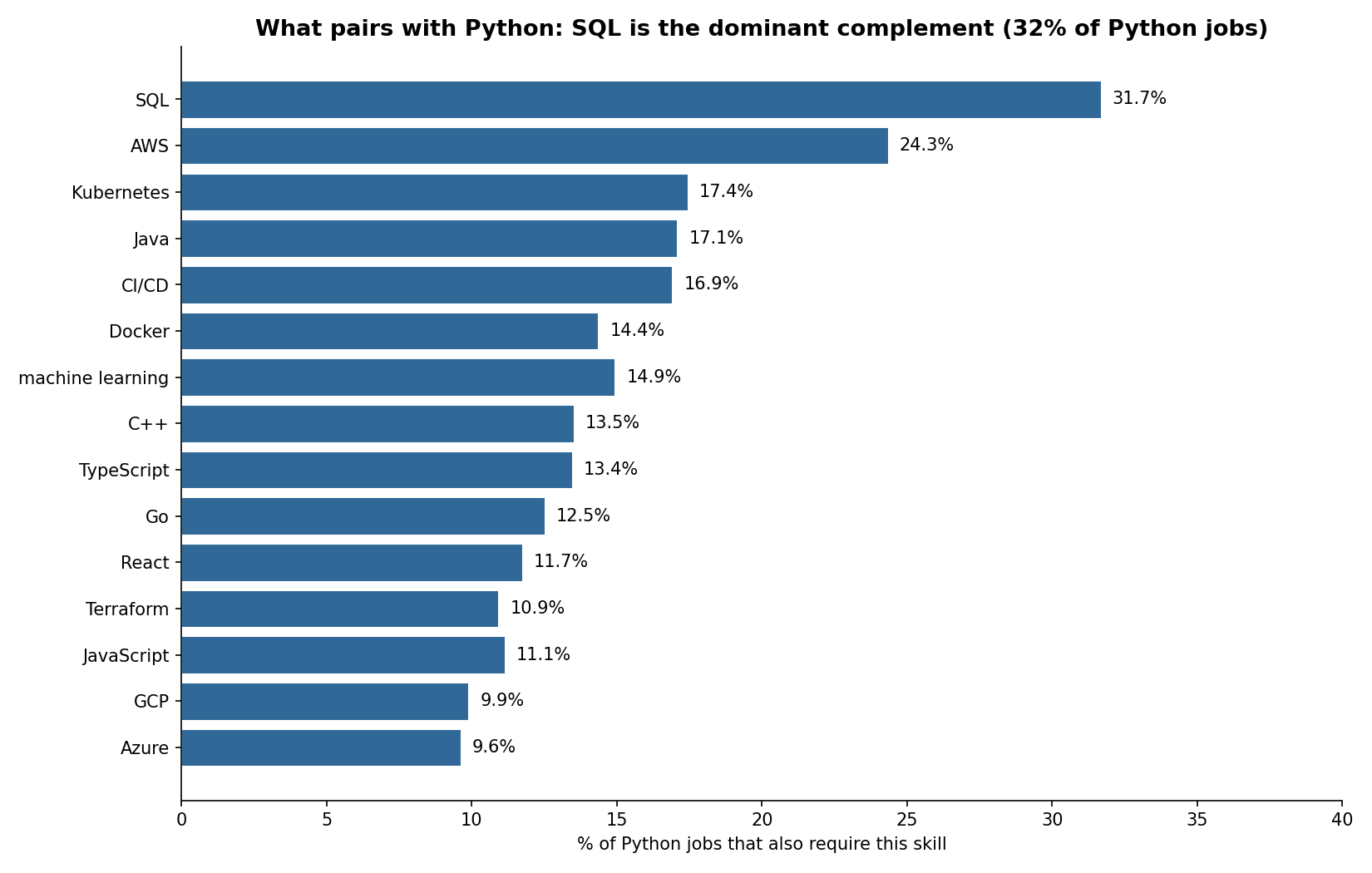
Of the 40,055 jobs that require Python, here's what they also require:
| Co-occurring skill | % of Python jobs |
|---|---|
| SQL | 31.7% |
| AWS | 24.3% |
| Kubernetes | 17.4% |
| Java | 17.1% |
| CI/CD | 16.9% |
| Machine learning | 14.9% |
| Docker | 14.4% |
Python + SQL is the dominant tech-skill pair in our index — 12,688 postings, more than any other two-skill combination. Add a cloud platform (AWS, GCP, or Azure) and you have the modal "ready for a tech IC role" stack.
What this means for your career
- If you're in a technical IC role: Python is the floor. The career-relevant question is no longer "should I learn Python?" — it's "what stacks on top of my Python?"
- If you're early-career: Python's prevalence is highest at the entry level (38%). It's the most universal first investment you can make.
- If you're aiming for ML/AI specialist roles: Python is assumed. The pay differential goes to people who can do the things Python alone can't — CUDA, distributed systems, custom infra.
- If you're in product, design, or program management: The universal-Python narrative does not apply to you. Less than 3% of those postings ask for Python. Your career invests in different skills.
- If you're hiring: Python is no longer a differentiator. It's table stakes. What separates candidates is what they pair it with.
Methodology
Skillenai job index, prod-enriched-jobs, snapshot 2026-05-03. n = 137,974 postings after excluding Speechify (carpet-bomb employer). Skill mentions extracted via NER; counts at the posting level (one mention per posting). Salary medians use salaryMin for salaryCurrency = USD only. Graph centrality uses Apache AGE on Postgres, summing incoming MENTIONS and REQUIRES edges across all canonical entity IDs. Big Tech (Google, Apple, Microsoft, Netflix, NVIDIA) is largely missing because they use proprietary ATS we don't scrape. Full methodology, charts, and JSON artifacts.