
Product Engineer Is Not the Intersection of PM and Software Engineer
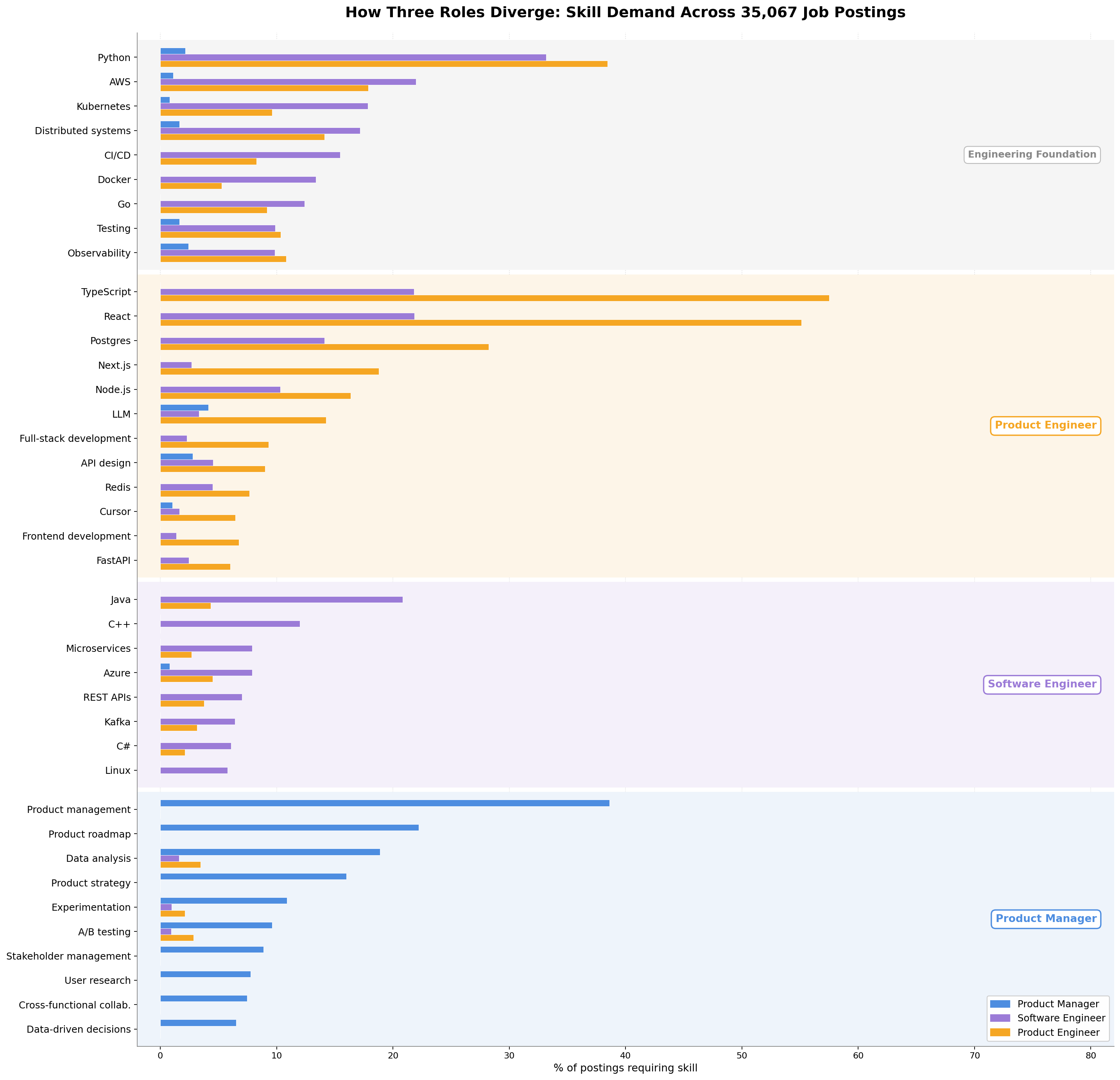
A popular framing — most recently from the Levels.fyi founder — says Product Engineer sits at the intersection of Product Manager and Software Engineer. Think like a PM, ship code like an engineer. The Venn diagram has three circles, and Product Engineer lives in the middle.
We measured that overlap empirically. The Venn diagram is geometrically wrong.
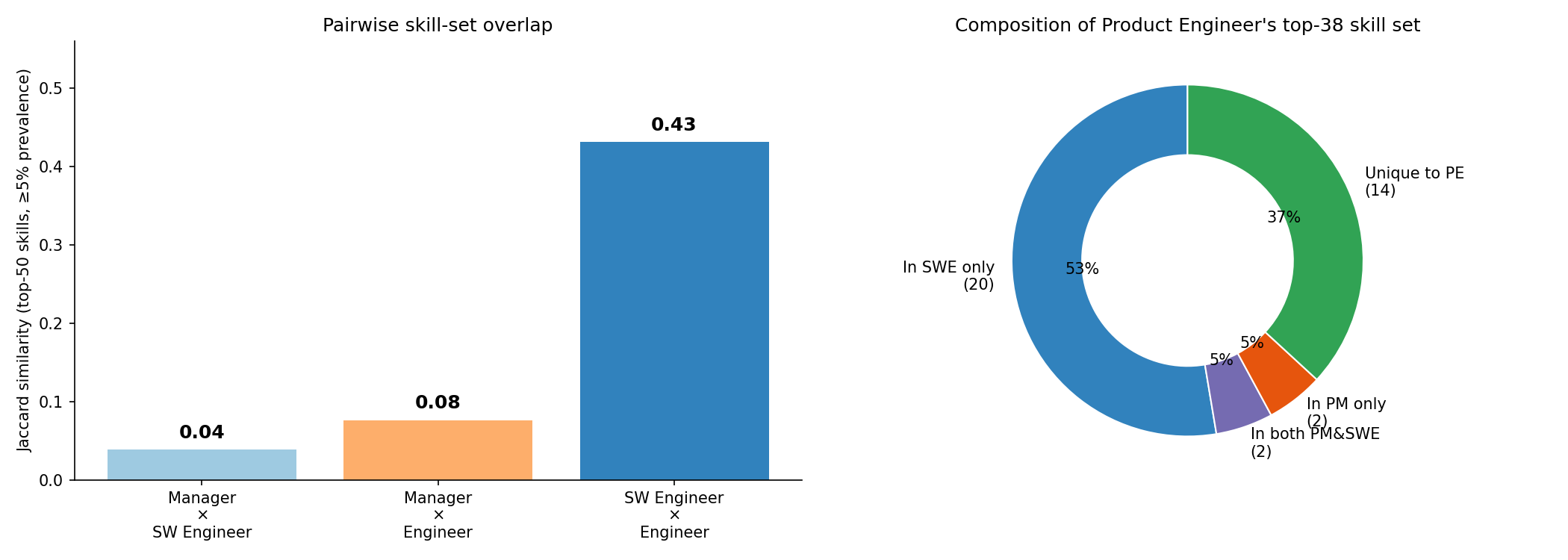
Across 35,067 job postings in the Skillenai labor-market index — 7,411 Product Manager, 26,990 Software Engineer, and 666 Product Engineer postings — we computed the actual skill-set overlap between the three roles.
TL;DR — three numbers
| Comparison | Jaccard similarity (top-50 skills, ≥5% prevalence) | Skills shared |
|---|---|---|
| Product Manager ↔ Software Engineer | 0.04 | 2 of 51 |
| Product Manager ↔ Product Engineer | 0.08 | 4 of 52 |
| Software Engineer ↔ Product Engineer | 0.43 | 22 of 51 |
Product Manager and Software Engineer share 2 skills in their respective top-50 lists: Agile and Data analysis. That's it. The two circles in the Venn diagram are nearly disjoint vocabularies.
If Product Engineer were the intersection of PM and SWE, mathematically it would be ≈ ∅. It's not — Product Engineer is a real, populated role. It just isn't the intersection.
What Product Engineer actually is
Of the 38 high-prevalence skills (≥5% of postings) in Product Engineer:
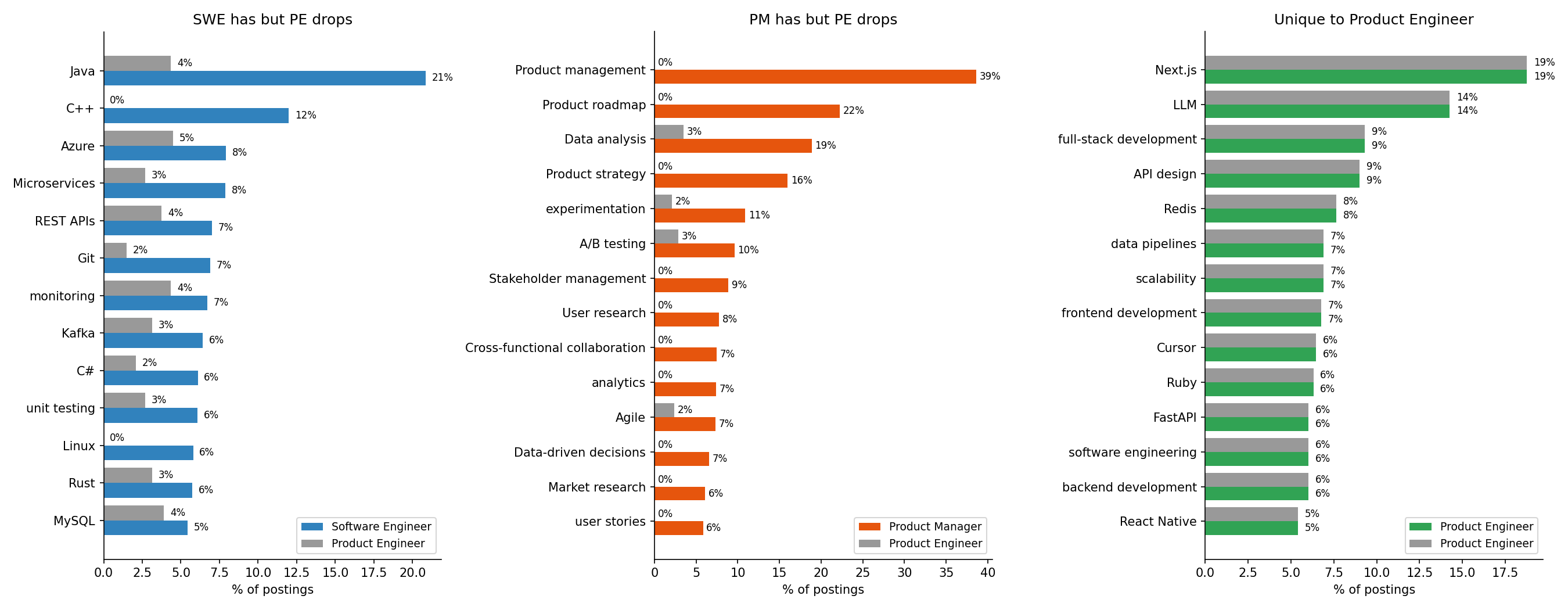
- 20 (53%) are SWE-only skills — present in Software Engineer's top-50 but not in PM's
- 2 (5%) are PM-only skills — and they are prototyping and SaaS, both engineering-adjacent
- 2 (5%) appear in both PM and SWE — Agile and Data analysis
- 14 (37%) are unique to Product Engineer — and they are not borrowed PM responsibilities. They are modern web and AI tooling.
The 14 PE-distinctive skills, ranked by prevalence: Next.js, LLM, full-stack development, API design, Redis, data pipelines, scalability, frontend development, Cursor, Ruby, software engineering, backend development, FastAPI, React Native.
The pattern is not "engineer who does PM work." The pattern is "full-stack SWE on a Next.js + TypeScript + LLM stack who uses Cursor."
The Product Engineer vs Software Engineer delta is a stack tilt
Going from Software Engineer to Product Engineer means dropping enterprise stack vocabulary and picking up modern web + AI tooling.
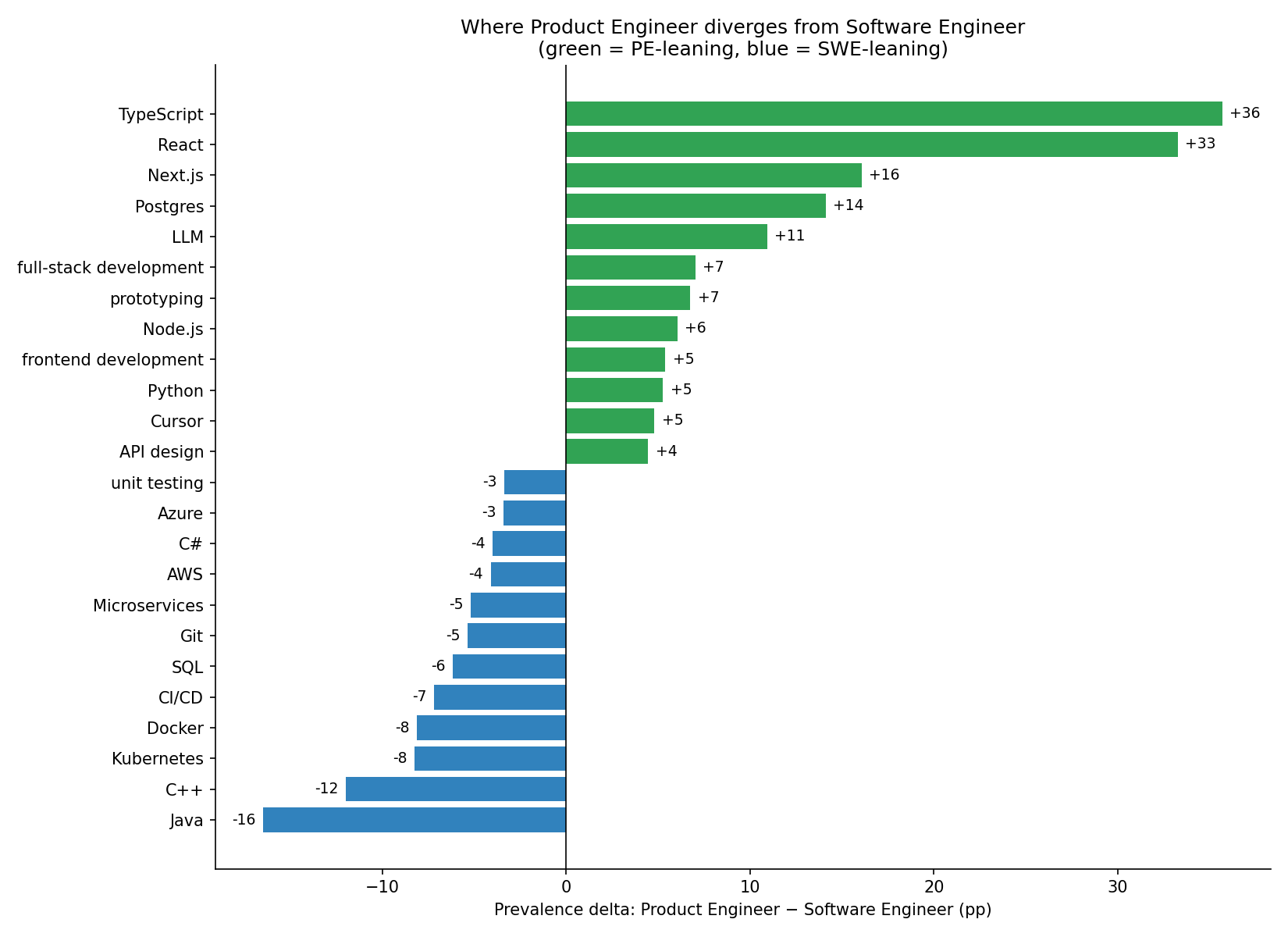
PE picks up vs SWE:
| Skill | Product Engineer | Software Engineer | Δ |
|---|---|---|---|
| TypeScript | 58% | 22% | +36 pp |
| React | 55% | 22% | +33 pp |
| Next.js | 19% | 3% | +16 pp |
| Postgres | 28% | 14% | +14 pp |
| LLM | 14% | 3% | +11 pp |
| full-stack development | 9% | 2% | +7 pp |
| Node.js | 16% | 10% | +6 pp |
| frontend development | 7% | 1% | +5 pp |
| Cursor | 6.5% | 1.7% | +5 pp |
| FastAPI | 6% | 2% | +4 pp |
PE drops vs SWE:
| Skill | Product Engineer | Software Engineer | Δ |
|---|---|---|---|
| Java | 4% | 21% | −17 pp |
| C++ | 0% | 12% | −12 pp |
| Linux | 0% | 6% | −6 pp |
| Microservices | 3% | 8% | −5 pp |
| C# | 2% | 6% | −4 pp |
| Kafka | 3% | 6% | −3 pp |
| Azure | 5% | 8% | −3 pp |
| Distributed systems | 14% | 17% | −3 pp |
This is a stack switch within engineering. The "Product" prefix is a stack signal, not a hybrid signal. It says "we work in startup-SaaS-shaped, web-and-AI-flavored code" — not "we expect you to do product management."
What about "think like a PM"?
If Product Engineer postings expected candidates to think like PMs, we would expect at least partial inheritance of PM's signature skill vocabulary. They don't get any of it.
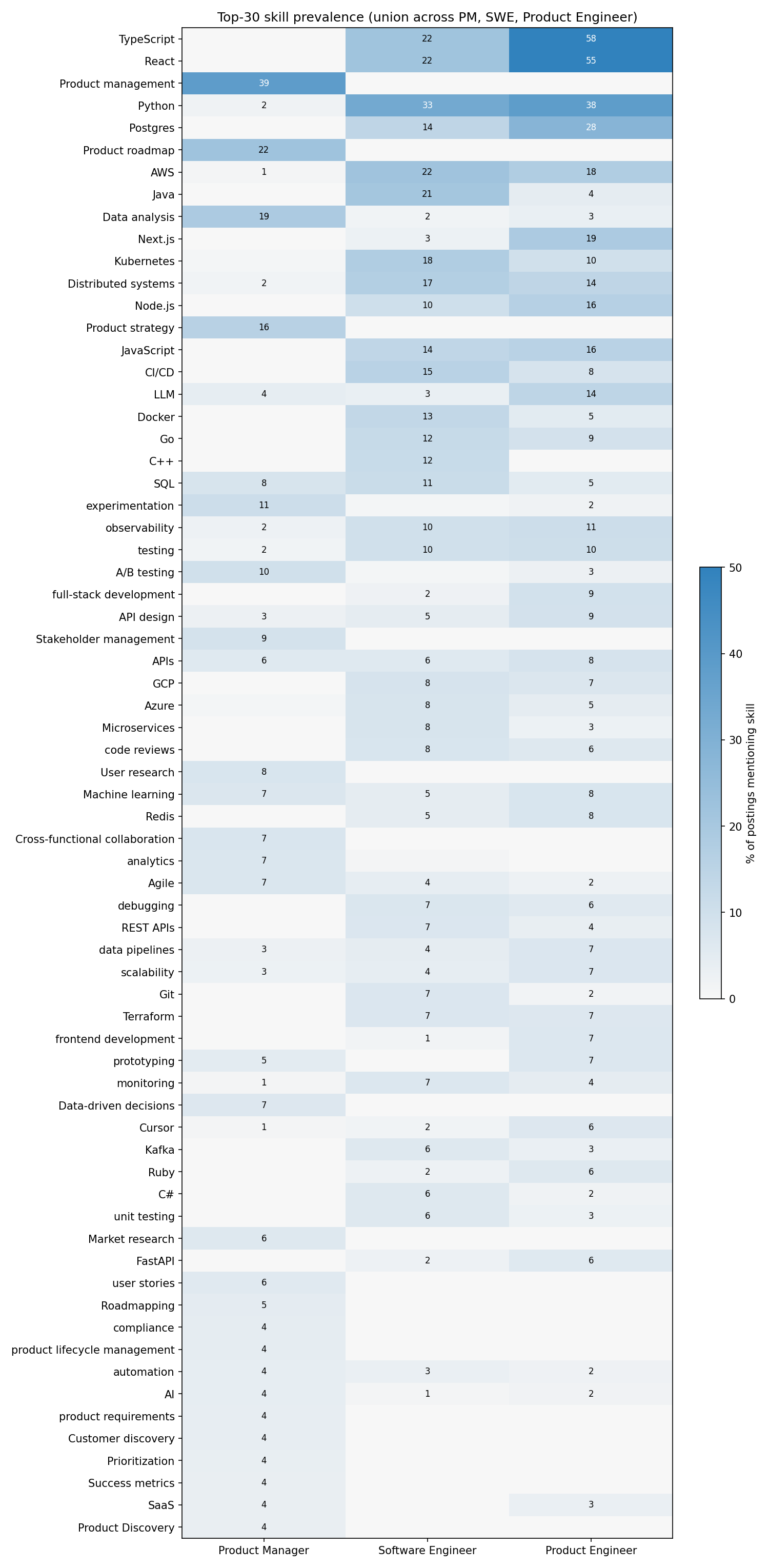
Look at what PM postings ask for and what fraction of Product Engineer postings list the same skill:
| PM skill | PM prevalence | PE prevalence | Inherited by PE? |
|---|---|---|---|
| Product management | 38.6% | 0.0% | No |
| Product roadmap | 22.2% | 0.0% | No |
| Data analysis | 18.9% | 3.4% | Trace |
| Product strategy | 16.0% | 0.0% | No |
| Experimentation | 10.9% | 2.1% | Trace |
| A/B testing | 9.6% | 2.9% | Trace |
| Stakeholder management | 8.9% | 0.0% | No |
| User research | 7.8% | 0.0% | No |
| Cross-functional collaboration | 7.5% | 0.0% | No |
| Data-driven decisions | 6.5% | 0.0% | No |
| Market research | 6.1% | 0.0% | No |
| User stories | 5.8% | 0.0% | No |
| KPIs / OKRs | 4–5% | 0.0% | No |
The PM skill vocabulary does not transfer to Product Engineer postings. Even softened — even allowing for the possibility that the same concept gets phrased differently — there is no signal that hiring managers expect Product Engineer candidates to do named product work.
So what is a Product Engineer?
Empirically, in software, today (Q2 2026):
A Product Engineer is a Software Engineer working on a modern web/AI startup stack — heavy TypeScript + React + Next.js, Node.js or FastAPI on Postgres, building LLM-powered product features with Cursor as their daily tool — who carries an explicit "full-stack / ship features end-to-end" mandate. The "Product" prefix signals stack and product-building style, not hybrid PM/SWE responsibilities.
This matches the demand side too. Top employers in our Product Engineer bucket are Intercom, Dropbox, Attio, Linear, Replit, Hightouch, Speakeasy, Bounce, Kota, Sequence, OpenAI — modern SaaS and AI startups, not enterprises with deep product-organization charts.
Career implication
- Software Engineer → Product Engineer: this is a stack and tooling switch. You learn Next.js, lean on TypeScript, get fluent with LLM APIs, adopt Cursor as your editor, drop your Java and C++ vocabulary from the resume. You do not need to learn product management.
- Product Manager → Product Engineer: this is a near-total reskilling. PM's named skill vocabulary — roadmap, strategy, A/B testing, stakeholder management, user research — does not transfer. You'd be starting from the engineering side from scratch.
- Engineer who also does product work is real. It's just not what "Product Engineer" empirically maps to in 2026 hiring. That archetype is closer to what "Founding Engineer" or "Forward Deployed Engineer" describes.
What we are not claiming
- Product Engineers don't do product work. They probably do. But job postings list named, hard skills, and the PM skill vocabulary doesn't appear — even softened. If hiring managers expected PE candidates to think like PMs, they don't write that they expect it using the language they describe PM hires with.
- The PE bucket is small (n=666). It's 38× smaller than SWE. We used chi-square with Bonferroni correction (α = 0.05/68 ≈ 0.000735) for significance — every top-20 deviation reported here is significant at that threshold.
- Some of the Java/C++ drop is startup-vs-enterprise mix. PE skews early-stage SaaS; SWE includes huge enterprises. But the +16 pp Next.js, +11 pp LLM, +5 pp Cursor deltas are PE-distinctive even among engineering roles.
- Hardware Product Engineer is a different animal. The semiconductor industry has a long-standing Product Engineer career ladder (characterization, qualification, failure analysis). This analysis is software-only by construction: 0 of the top 50 employers in our PE bucket are semiconductor companies, and 2 of 666 postings mention any hardware skill (Verilog/SystemVerilog).
Methodology
- Source: Skillenai labor-market index,
prod-enriched-jobs - Role buckets (entity-resolved exact
role.keywordmatch): - PM: 9 IC variants (Product Manager, Senior/Staff/Principal/Lead/Group/Associate, Technical, AI)
- SWE: 12 IC variants (Software Engineer, Senior/Staff/Principal/Lead, Backend/Frontend/Full Stack/Fullstack/Full-Stack, SDE, AI)
- PE: 14 IC variants (Product Engineer + AI/Staff/Lead/Principal/Full Stack/Frontend/Backend/Fullstack variants and Product Software Engineer)
- Specialized variants excluded from all buckets (Embedded, Robotics, Flight, SDET, Test, Security, Intern, Manager).
- Filters: Speechify excluded (carpet-bombs the PE bucket with ~120 duplicates). Top-employer dominance check passes for all three buckets (top employer < 5% of postings).
- Skill measurement: top-200 skills per role via nested aggregation on
entities[].resolved.canonicalNamefiltered toentityType = "skill". Light alias canonicalization (TypeScript / typescript, Postgres / PostgreSQL, LLM / large language models, etc.) to address known canonical-name duplicates in the entity-resolution layer. - Statistical tests: per-skill 2×2 chi-square (Yates corrected) of PE vs PM+SWE; Bonferroni-corrected α across the 68-skill union.
Full methodology, raw data, and the per-skill chi-square table are in the Skillenai Notebooks repo.