
Remote Work, Seniority, and the Junior-Hiring Cliff: 50,757 Tech Postings
A new Federal Reserve Bank of New York study made the rounds this week with a striking claim: remote work, not AI, is driving roughly two-thirds of the post-pandemic rise in unemployment among recent college graduates. Among young workers in remote-able occupations, the unemployment rate climbed about one percentage point from 2017–2019 to 2022–2024. For older workers, it fell. AI exposure was tested directly — the authors say it had little effect.
That study is a demand-side finding. It measures who can't get hired. We wondered whether the labor supply — the postings themselves — shows the same fingerprint.
It does. And it's stark.
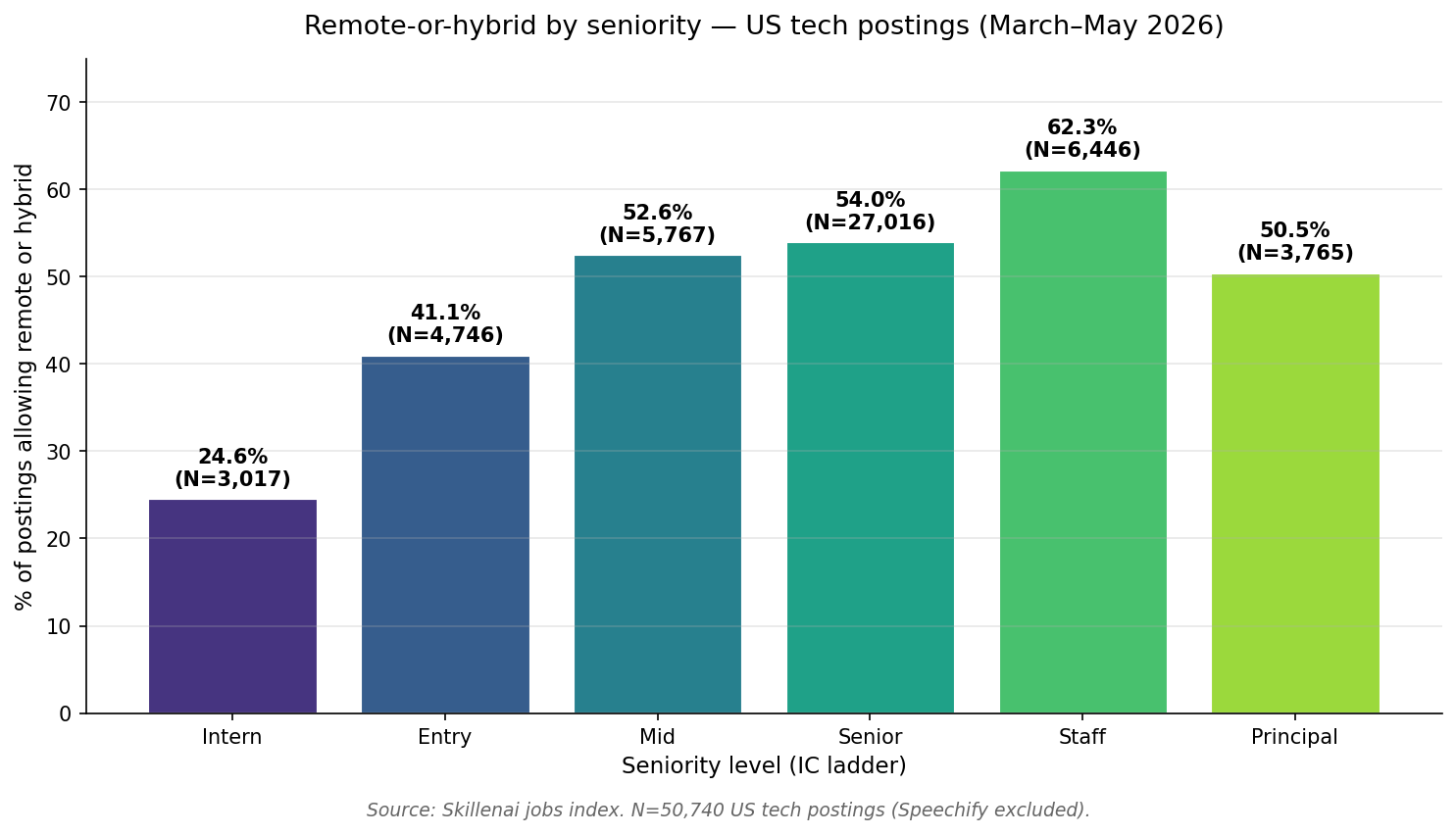
A staff engineer is 2.5x more likely to be offered remote than an intern
We took 50,757 US tech postings ingested between March and May 2026, kept the ones where we know both work mode and seniority level, excluded one notorious carpet-bomber from the data, and asked one question: what share of postings at each seniority level allow remote or hybrid work?
The answer is a near-perfect staircase, climbing in lockstep with the IC ladder.
| Seniority | Postings | % onsite | % hybrid | % remote | % remote or hybrid |
|---|---|---|---|---|---|
| Intern | 3,017 | 75.4% | 8.8% | 15.9% | 24.6% |
| Entry | 4,746 | 58.9% | 10.6% | 30.5% | 41.1% |
| Mid | 5,767 | 47.4% | 13.5% | 39.1% | 52.6% |
| Senior | 27,016 | 46.0% | 13.7% | 40.3% | 54.0% |
| Staff | 6,446 | 37.7% | 14.9% | 47.3% | 62.3% |
| Principal | 3,765 | 49.5% | 11.1% | 39.3% | 50.5% |
Three out of every four tech intern postings are onsite-only. Three out of every five staff engineer postings allow remote or hybrid. Between those two endpoints, every step up the ladder bumps the remote share — and the jump from entry to mid alone is more than 11 points.
The composition shift is almost entirely onsite vs remote
The middle "hybrid" lane is small and stable across seniority — only 9% to 15% at every level. The real movement is between fully onsite and fully remote.
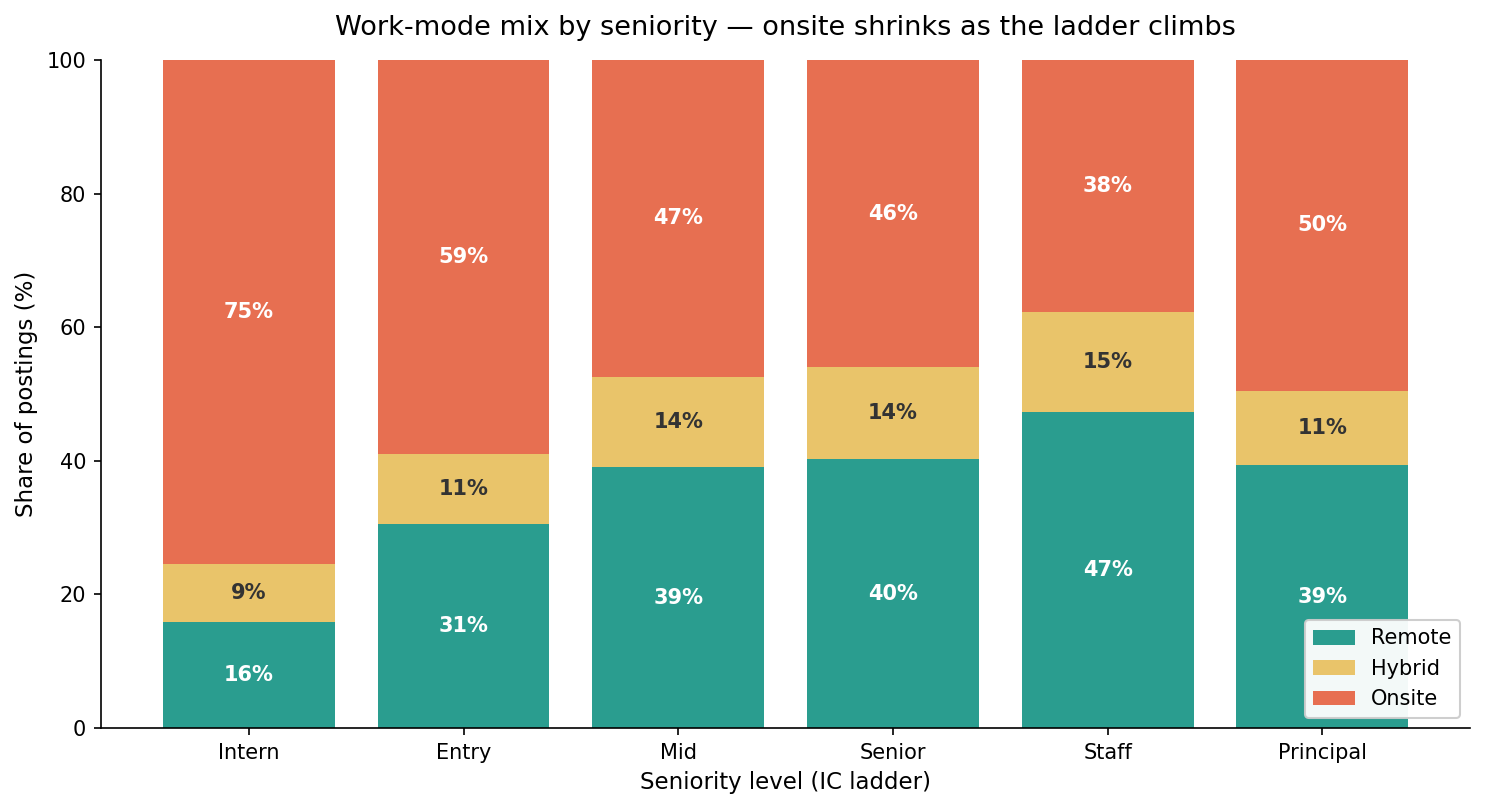
An intern faces a 75% / 16% onsite-to-remote split. A staff engineer faces a 38% / 47% split. The labor market hasn't built a graduated remote on-ramp — it has built two doors, and the one labelled "remote" largely opens for people who have already done the job.
It isn't a role-mix artifact
The obvious counter is that senior workers might just cluster in remote-friendly roles. We tested it. The gradient holds inside every individual tech role we have enough data for.
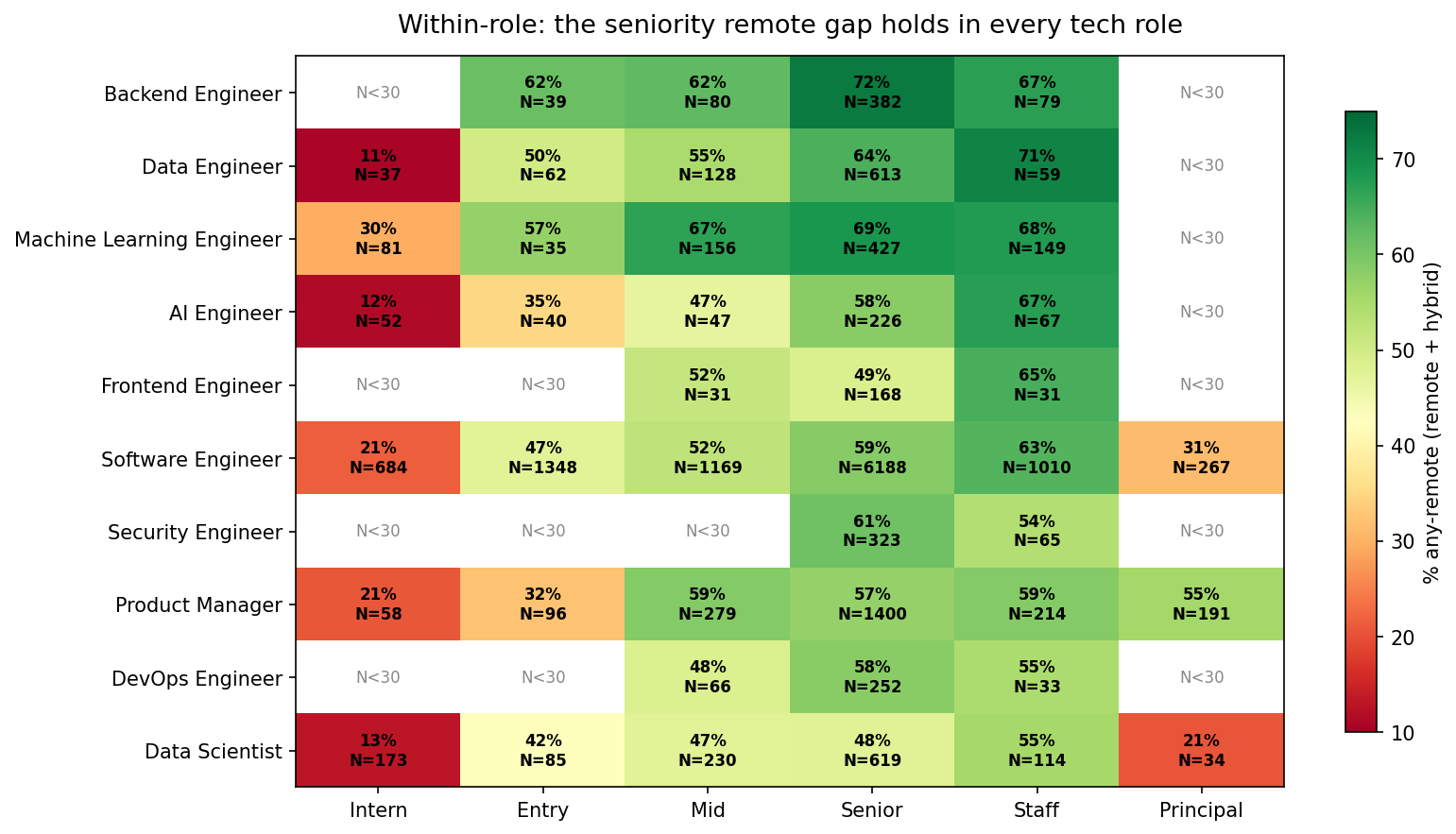
Within a single role title:
| Role | Intern | Entry | Mid | Senior | Staff |
|---|---|---|---|---|---|
| Software Engineer | 21% | 47% | 52% | 59% | 63% |
| Data Engineer | 11% | 50% | 55% | 64% | 71% |
| Machine Learning Engineer | 30% | 57% | 67% | 69% | 68% |
| AI Engineer | 12% | 35% | 47% | 58% | 67% |
| Data Scientist | 13% | 42% | 47% | 48% | 55% |
| Product Manager | 21% | 32% | 59% | 57% | 59% |
A Software Engineer intern faces a 21% remote rate. A Software Engineer at staff level faces 63%. That's a 42 percentage point gap inside one role title.
The statistics are not subtle
A chi-square test of homogeneity on the 6x3 contingency table returns χ² = 1,486 on 10 degrees of freedom, with p effectively zero. Cramér's V is 0.12 — formally a "small" effect, but with N = 50,757 the per-cell signal is overwhelming. Standardized residuals show intern and staff as near-perfect mirror images: intern is +21σ onsite-heavy and −20σ remote-heavy; staff is the inverse.
Every adjacent-seniority comparison is significant under a Bonferroni-corrected threshold, except mid versus senior — those collapse into a single tier for this question.
What this corroborates
The NY Fed study argued that remote work has changed the hiring decision for junior workers — that firms are less willing to bring in early-career employees when the mentorship and learning that historically happened in person now doesn't happen at all. That argument lives on the demand side: it's a statement about what employers are willing to do.
Our data shows the matching supply-side fingerprint. Firms aren't just hiring fewer juniors into remote-able occupations — when they do post junior roles in tech, those roles overwhelmingly require coming in. The market has split into a two-tier remote economy: senior tech workers got the remote benefits; juniors got the bill.
The "remote-friendly" tech employer brand that defined 2021 is, for the early-career rung of the ladder, mostly back to a co-located workplace.
What this doesn't show
We see postings, not outcomes — so we can't say whether juniors apply for remote roles and lose, or never see them in the first place. We don't have a pre-pandemic comparison; our index starts well after 2020, so we can confirm the present cross-section but not the trend through time. And we look only at tech, where the Fed contrast against in-person occupations (nursing, in-person services) isn't reproducible. The "principal dip" — principal postings are slightly less remote than staff — is most plausibly about stakeholder time and not a structural exception.
What this means for your career
If you're a new graduate targeting tech. Filter your search by which companies are actually hiring junior workers onsite in cities you can live in. Roughly three-quarters of intern postings and 59% of entry-level postings are onsite-only in our data. A relocation budget may matter more than a list of "remote-first" companies. The remote-first employer brand was built on senior postings.
If you're a mid-career engineer. You sit at the inflection. Mid-level postings allow remote or hybrid at 52.6% — nearly the same as senior at 54.0%, and a full 11 points above entry. The remote-economy benefit kicks in at mid, not senior.
If you're a staff or principal engineer. You have the most remote-friendly rung on the ladder. Staff peaks at 62.3% remote-or-hybrid.
If you hire entry-level tech talent. The market is already pricing in a re-onshoring of junior hiring. If you can offer remote intern or entry-level seats and a credible mentorship plan, you are doing something almost no one else in this dataset is doing — which is either a strategic advantage or a tell that you haven't thought about the mentorship problem yet.
Methodology
Index: Skillenai's prod-enriched-jobs. Filtered to locationCountry = "US", with known workModel ∈ {onsite, hybrid, remote} and known seniorityLevel ∈ {intern, entry, mid, senior, staff, principal}. Excluded one persistent carpet-bomber from the postings to avoid inflating a single employer's signal. Counts use companyCanonicalName to deduplicate ATS slug case variants.
Statistical tests: chi-square test of homogeneity (omnibus on the full 6×3 table, plus pairwise 2×2 on adjacent seniority levels for onsite vs any-remote), Cramér's V for effect size, standardized residuals for cell-level signal, Bonferroni correction for the pairwise comparisons.
Robustness: the gradient holds (intern 24.9% → staff 63.4%) when we additionally exclude defense and hardware-heavy employers (SpaceX, Anduril, Raytheon, Lockheed, Northrop, Boeing) and known junk employer strings. The gradient is also present in every month of the data window.
Full methodology, data, and reproducible analysis script.
Source for the Fed study coverage: Fortune, NPR, Boston Globe.